Suriname: Military Tightens Its Grip – National Intelligence Daily – 9 December 1982
CIA-RDP84T00301R000600010143-3
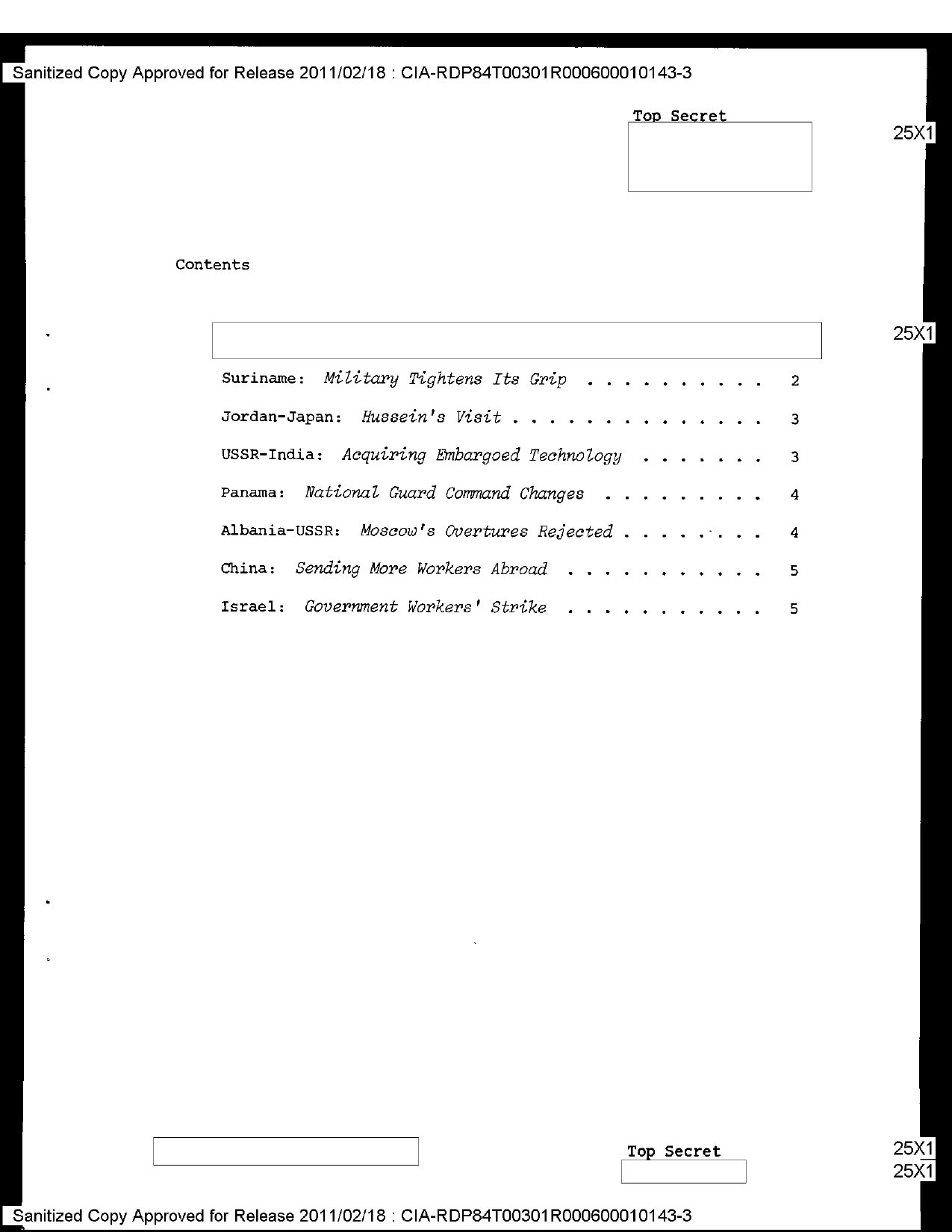
| Country / Topic | Page |
|---|---|
| Suriname: Military Tightens Its Grip | 2 |
| Jordan-Japan: Hussein’s Visit | 3 |
| USSR-India: Acquiring Embargoed Technology | 3 |
| Panama: National Guard Command Changes | 4 |
| Albania-USSR: Moscow’s Overtures Rejected | 4 |
| China: Sending More Workers Abroad | 5 |
| Israel: Government Workers’ Strike | 5 |
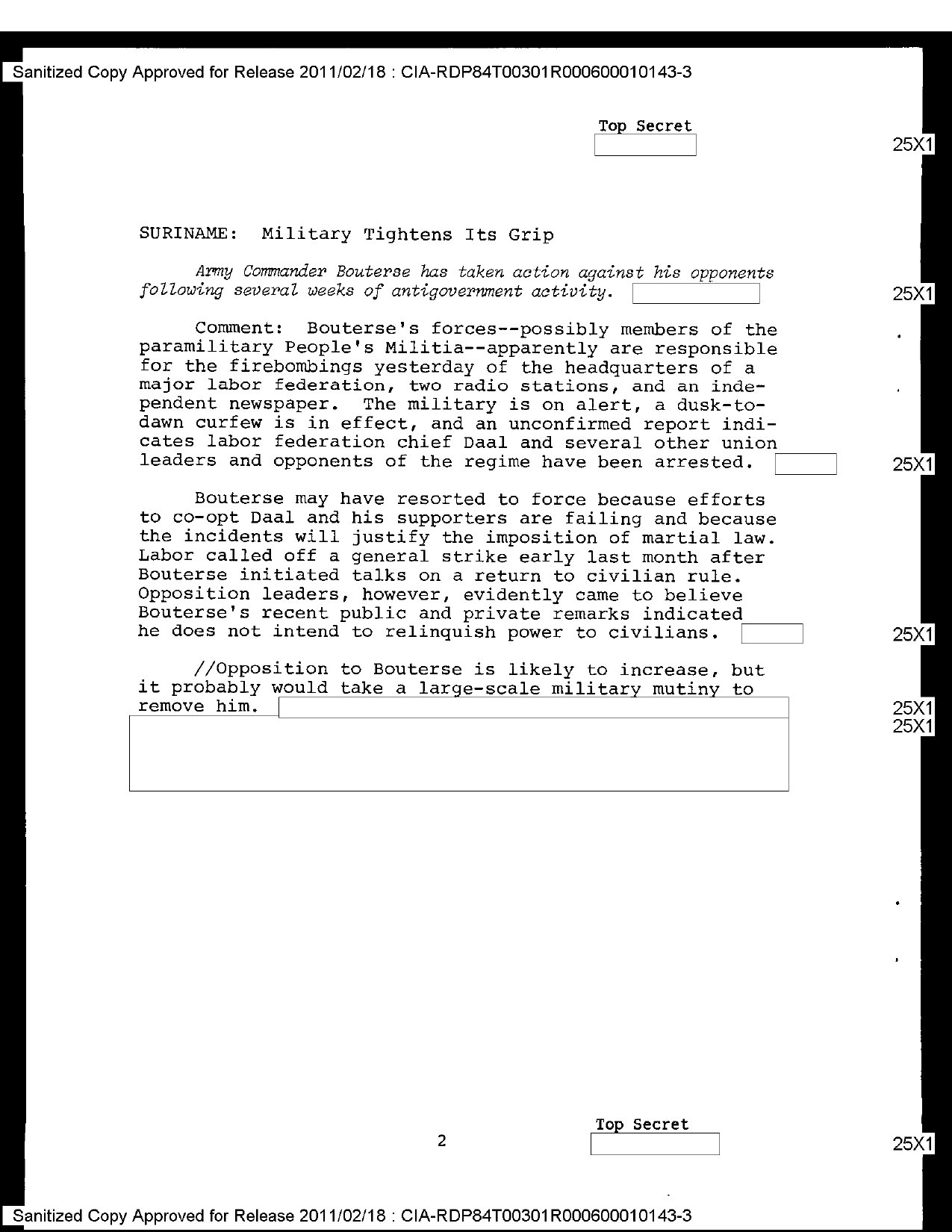
SURINAME: Military Tightens Its Grip
Army Commander Bouterse has taken action against his opponents following several weeks of antigovernment activity.
Comment: Bouterse’s forces—possibly members of the paramilitary People’s Militia—apparently are responsible for the firebombings yesterday of the headquarters of a major labor federation, two radio stations, and an independent newspaper. The military is on alert, a dusk-to-dawn curfew is in effect, and an unconfirmed report indicates labor federation chief Daal and several other union leaders and opponents of the regime have been arrested.
Bouterse may have resorted to force because efforts to co-opt Daal and his supporters are failing and because the incidents will justify the imposition of martial law. Labor called off a general strike early last month after Bouterse initiated talks on a return to civilian rule. Opposition leaders, however, evidently came to believe Bouterse’s recent public and private remarks indicated he does not intend to relinquish power to civilians.
//Opposition to Bouterse is likely to increase, but it probably would take a large-scale military mutiny to remove him.
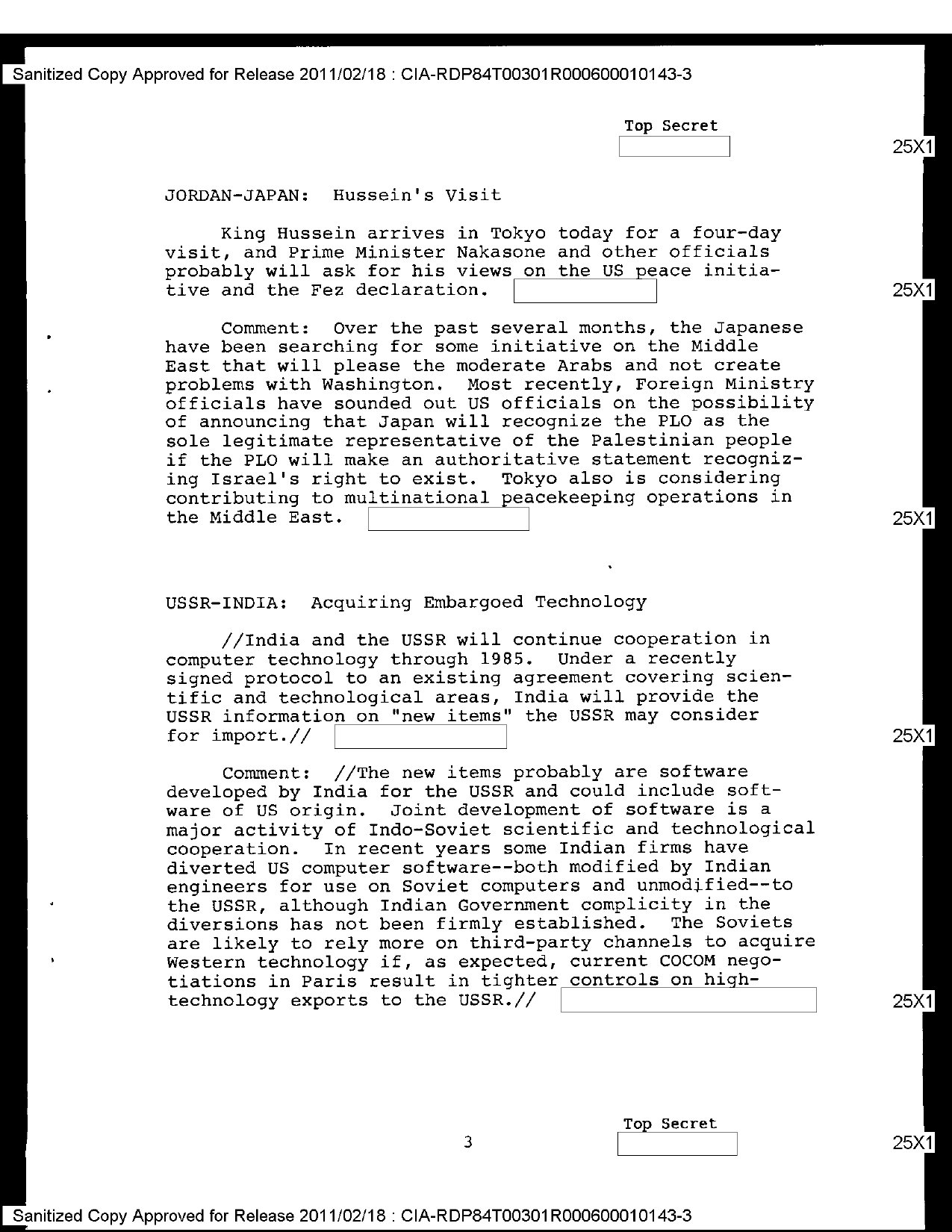
JORDAN-JAPAN: Hussein’s Visit
King Hussein arrives in Tokyo today for a four-day visit, and Prime Minister Nakasone and other officials probably will ask for his views on the US peace initiative and the Fez declaration.
Comment: Over the past several months, the Japanese have been searching for some initiative on the Middle East that will please the moderate Arabs and not create problems with Washington. Most recently, Foreign Ministry officials have sounded out US officials on the possibility of announcing that Japan will recognize the PLO as the sole legitimate representative of the Palestinian people if the PLO will make an authoritative statement recognizing Israel’s right to exist. Tokyo also is considering contributing to multinational peacekeeping operations in the Middle East.
USSR-INDIA: Acquiring Embargoed Technology
//India and the USSR will continue cooperation in computer technology through 1985. Under a recently signed protocol to an existing agreement covering scientific and technological areas, India will provide the USSR information on “new items” the USSR may consider for import.//
Comment: //The new items probably are software developed by India for the USSR and could include software of US origin. Joint development of software is a major activity of Indo-Soviet scientific and technological cooperation. In recent years some Indian firms have diverted US computer software—both modified by Indian engineers for use on Soviet computers and unmodified—to the USSR, although Indian Government complicity in the diversions has not been firmly established. The Soviets are likely to rely more on third-party channels to acquire Western technology if, as expected, current COCOM negotiations in Paris result in tighter controls on high-technology exports to the USSR.//
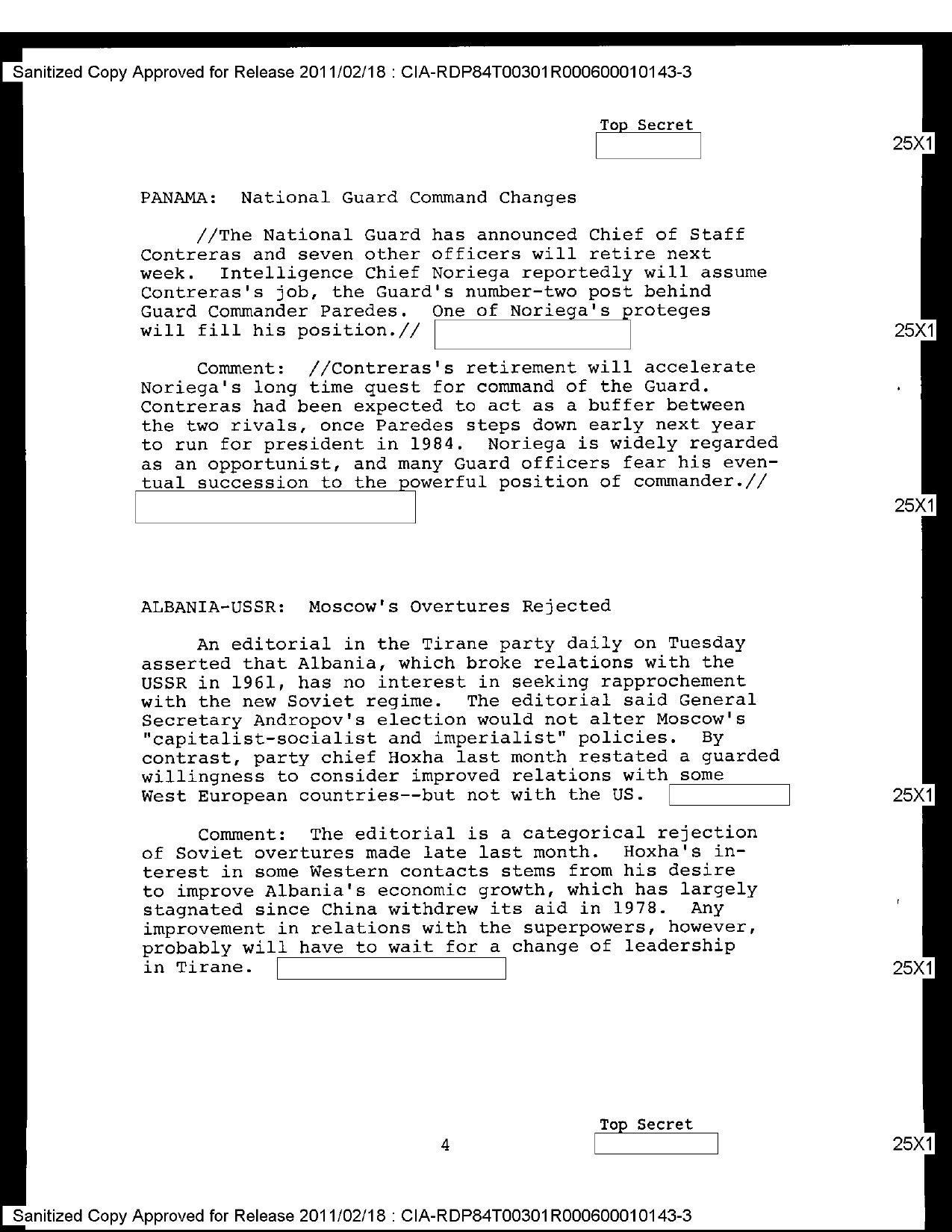
PANAMA: National Guard Command Changes
//The National Guard has announced Chief of Staff Contreras and seven other officers will retire next week. Intelligence Chief Noriega reportedly will assume Contreras’s job, the Guard’s number-two post behind Guard Commander Paredes. One of Noriega’s proteges will fill his position.//
Comment: //Contreras’s retirement will accelerate Noriega’s long time quest for command of the Guard. Contreras had been expected to act as a buffer between the two rivals, once Paredes steps down early next year to run for president in 1984. Noriega is widely regarded as an opportunist, and many Guard officers fear his eventual succession to the powerful position of commander.//
[CENSORED] ALBANIA-USSR: Moscow’s Overtures Rejected
An editorial in the Tirane party daily on Tuesday asserted that Albania, which broke relations with the USSR in 1961, has no interest in seeking rapprochement with the new Soviet regime. The editorial said General Secretary Andropov’s election would not alter Moscow’s “capitalist-socialist and imperialist” policies. By contrast, party chief Hoxha last month restated a guarded willingness to consider improved relations with some West European countries—but not with the US.
Comment: The editorial is a categorical rejection of Soviet overtures made late last month. Hoxha’s interest in some Western contacts stems from his desire to improve Albania’s economic growth, which has largely stagnated since China withdrew its aid in 1978. Any improvement in relations with the superpowers, however, probably will have to wait for a change of leadership in Tirane.
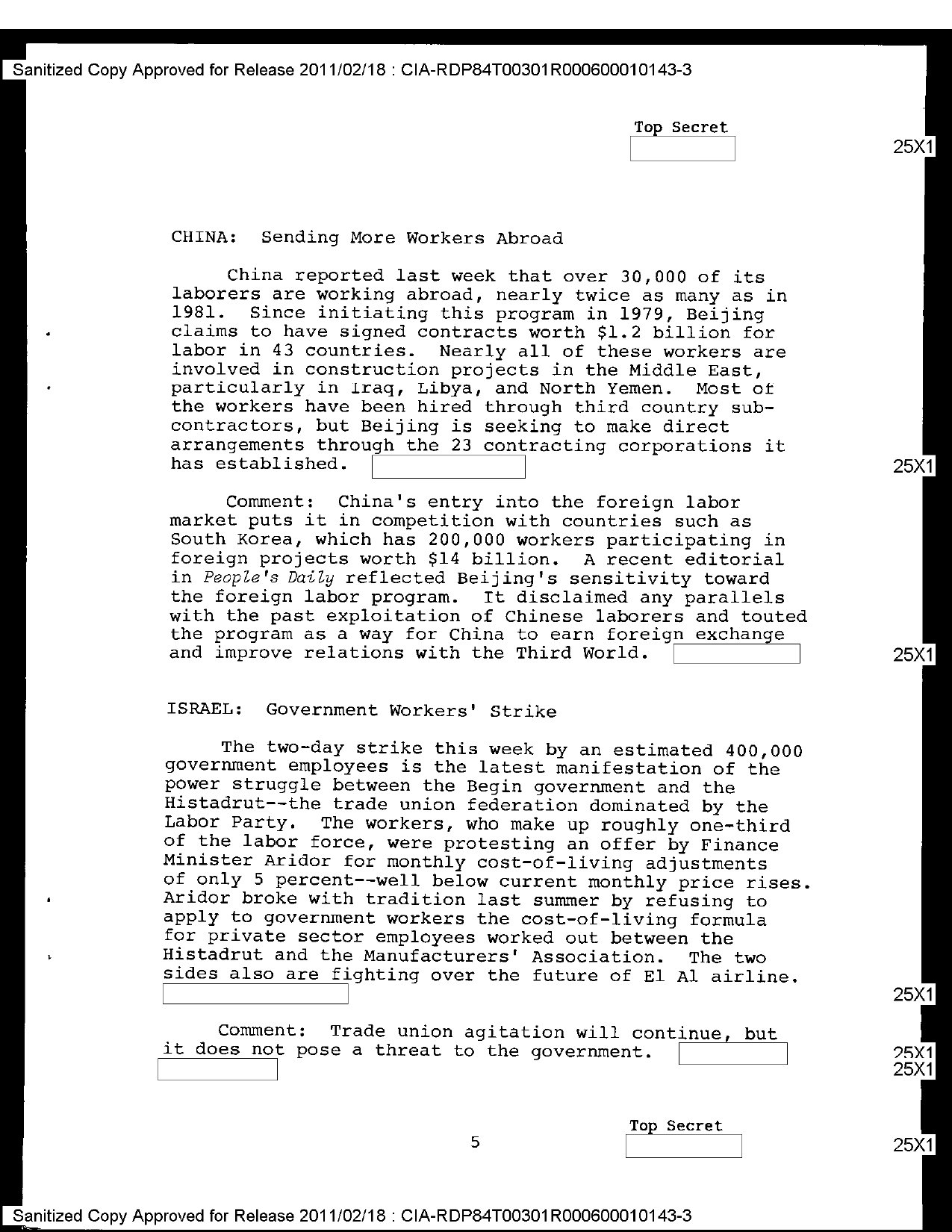
CHINA: Sending More Workers Abroad
China reported last week that over 30,000 of its laborers are working abroad, nearly twice as many as in 1981. Since initiating this program in 1979, Beijing claims to have signed contracts worth $1.2 billion for labor in 43 countries. Nearly all of these workers are involved in construction projects in the Middle East, particularly in Iraq, Libya, and North Yemen. Most of the workers have been hired through third-country subcontractors, but Beijing is seeking to make direct arrangements through the 23 contracting corporations it has established.
Comment: China’s entry into the foreign labor market puts it in competition with countries such as South Korea, which has 200,000 workers participating in foreign projects worth $14 billion. A recent editorial in People’s Daily reflected Beijing’s sensitivity toward the foreign labor program. It disclaimed any parallels with the past exploitation of Chinese laborers and touted the program as a way for China to earn foreign exchange and improve relations with the Third World.
ISRAEL: Government Workers’ Strike
The two-day strike this week by an estimated 400,000 government employees is the latest manifestation of the power struggle between the Begin government and the Histadrut—the trade union federation dominated by the Labor Party. The workers, who make up roughly one-third of the labor force, were protesting an offer by Finance Minister Aridor for monthly cost-of-living adjustments of only 5 percent—well below current monthly price rises.
Aridor broke with tradition last summer by refusing to apply to government workers the cost-of-living formula for private sector employees worked out between the Histadrut and the Manufacturers’ Association. The two sides also are fighting over the future of El Al airline.
Comment: Trade union agitation will continue, but it does not pose a threat to the government.
Source:
Link:
Internal Link:
Date:
December 9, 1982