Suriname Political Currents and United States Aluminum Interests 1971
CIA-RDP85T00875R002000110020-2
CENTRAL INTELLIGENCE AGENCY
OFFICE OF NATIONAL ESTIMATES
4 June 1971
MEMORANDUM
SUBJECT: Surinam: Political Currents and United States Aluminum Interests
NOTE:
In November 1970, we examined the racial tensions and problems arising from political and economic developments in the Caribbean basin. In this paper, we take a closer look at Surinam—a small, nearby mainland country which to date has been a calm, capitalistic oasis despite potential difficulties.
The memorandum assesses the prospects over the next year or two for the large U.S. investment in Surinamese bauxite, alumina, and aluminum production. Special attention is given to the impact on Surinam of the imminent nationalization of bauxite investments in Guyana, latent racial frictions, and the pressures on Surinam’s leaders to provide more benefits to the populace.
(This memorandum was prepared by the Office of National Estimates and coordinated within the Central Intelligence Agency.)
1. Background
Surinam is tucked away on the northeast shoulder of South America. Its 400,000 people are isolated from the Latin countries of the continent by geography, race, language, and cultural traditions. The country is one of three internally autonomous members of the Kingdom of the Netherlands.
Long association with the Dutch has given Surinam a tradition of public order and slow but systematic development. Its major domestic problems arise from tensions in its multiracial society and a recent slowdown in economic growth.
Racial frictions stem from rivalry between the two main groups—the Creoles (blacks and mixed blacks) and the East Indians. Up to now, the two communities have lived together with only minor disturbances, partly due to enlightened political leadership and partly because East Indians have been largely rural while blacks concentrated in the city.
Tensions, however, are increasing as East Indians move into urban areas—clearly the most ominous national problem.
Population Composition (1964 Census):
- Creoles: 39%
- East Indians: 38%
- Indonesians: 17%
- Chinese: 2%
- Europeans: 2%
- Amerindians: 1%
- Unknown: 1%
Among these are 27,000 “Bush Negroes” and 4,000 Amerindians living in tribal societies in the interior.
2. The Bauxite-Aluminum Industry
Surinam is one of the few underdeveloped nations with a fully integrated bauxite–alumina–aluminum industry. It ranks second only to Jamaica in the Caribbean as a producer and exporter and possesses considerable unexploited reserves.
Constructed largely during the 1960s, the industry accounts for about 30% of GDP. In 1969, bauxite, alumina, and aluminum made up roughly 90% of exports.
U.S. interest in Surinam is centered almost entirely on bauxite. U.S. producers worry that other Caribbean bauxite nations may follow Guyana’s lead in nationalizing foreign operations.
About 80% of total U.S. bauxite consumption in 1969 was imported—almost all from the Caribbean. Approximately 23% of that came from Surinam.
Private U.S. investment totals about $200 million (book value), mainly through the Surinam Aluminum Company (SURALCO), a subsidiary of ALCOA. SURALCO has built refining, smelting, and hydroelectric facilities. Other U.S. firms have signed exploration agreements which could raise total U.S. investment above $300 million.
3. Political and Economic Climate
The pending nationalization of bauxite in Guyana has not persuaded Surinam’s Minister-President Jules Sedney to follow suit. Sedney, an economist, believes economic progress depends heavily on foreign capital.
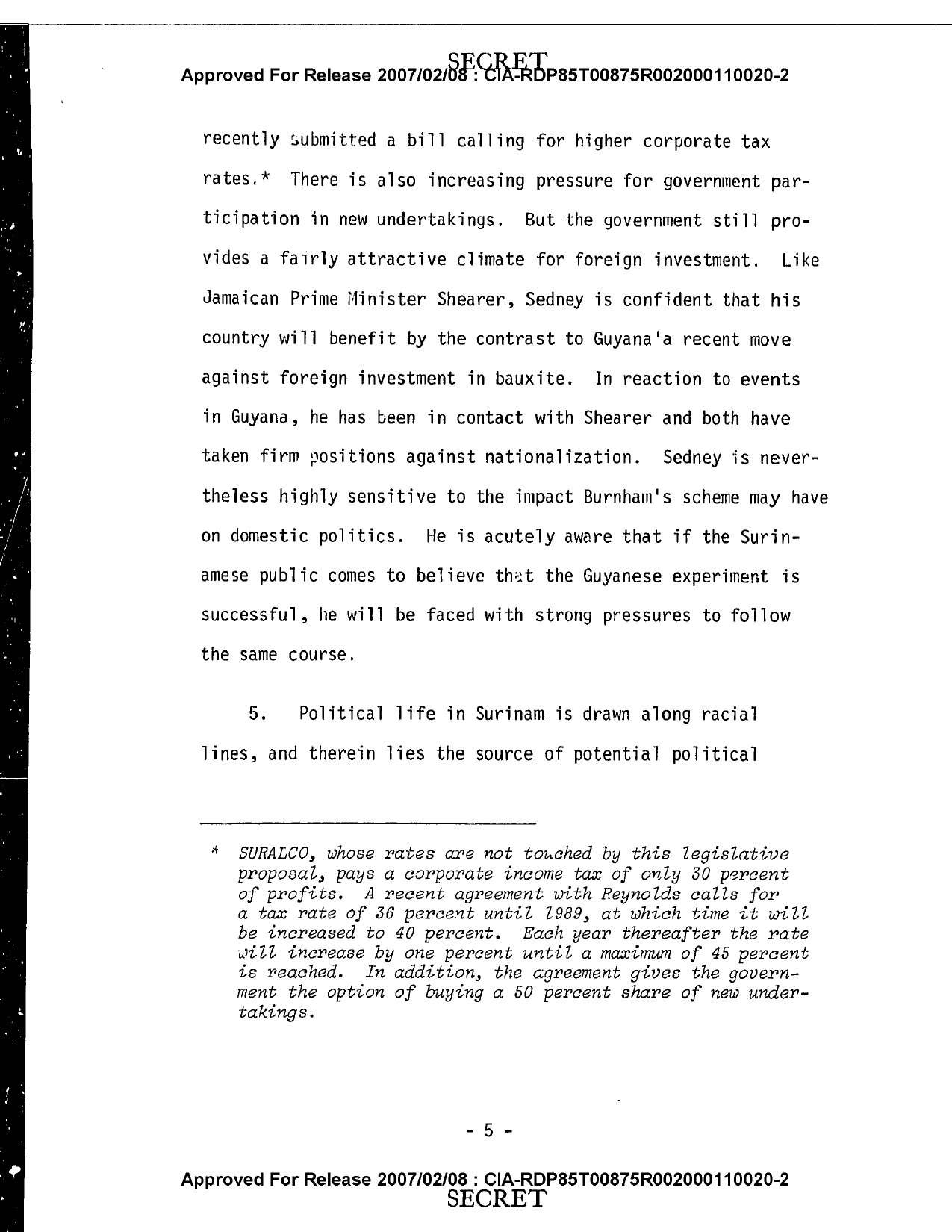
He has, however, proposed higher corporate taxes and increased government participation in new ventures. Even so, the climate remains favorable for investment. Sedney and Jamaican Prime Minister Shearer share firm opposition to nationalization, believing their nations will benefit from contrast with Guyana’s policies.
Still, if Guyana’s experiment appears successful, Sedney may face growing domestic pressure to adopt similar measures.
4. Political Structure and Stability
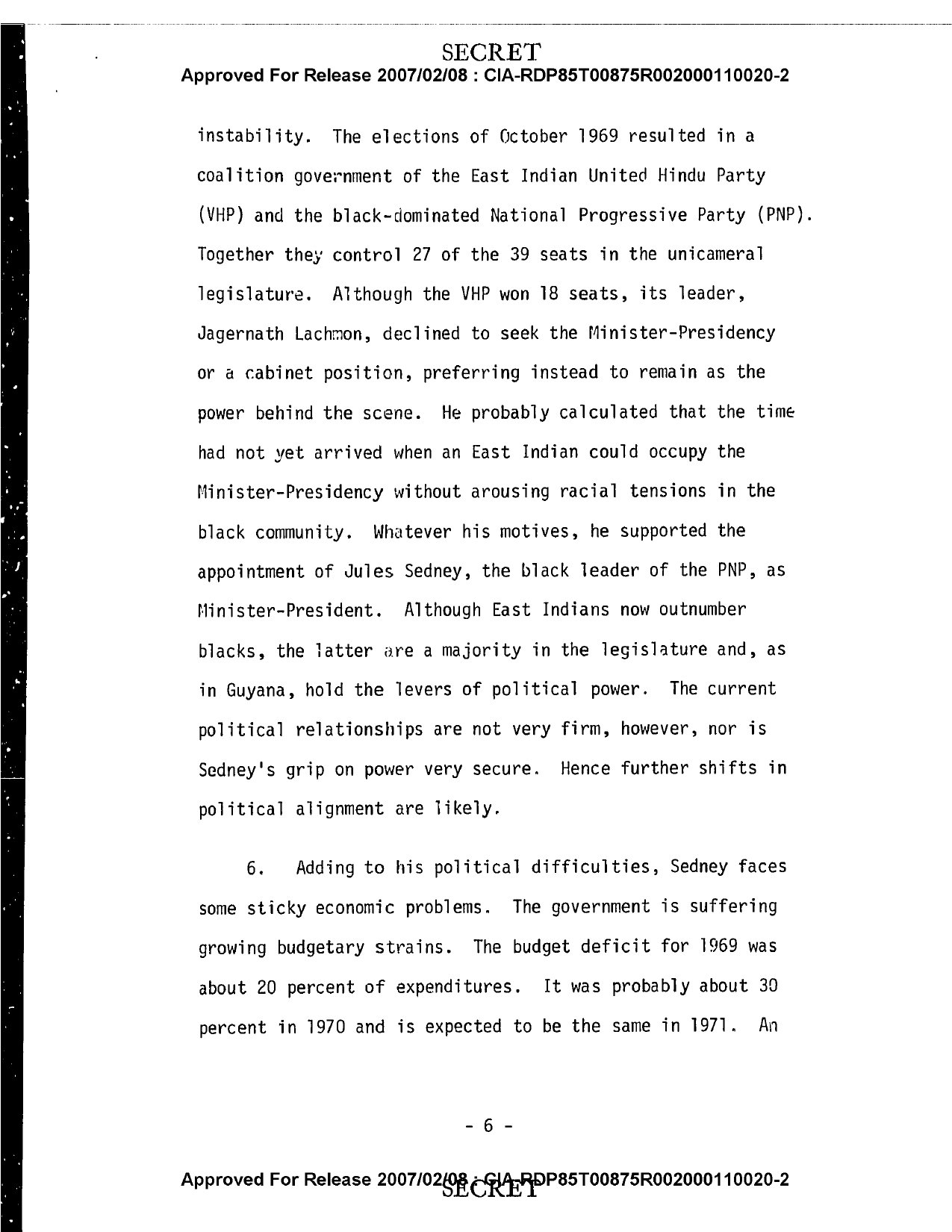
Politics in Surinam follow racial lines. The October 1969 elections produced a coalition of the East Indian United Hindu Party (VHP) and the black-dominated National Progressive Party (PNP), together controlling 27 of 39 legislative seats.
VHP leader Jagernath Lachmon declined the top post, backing Sedney, the black PNP leader, as Minister-President—recognizing that an East Indian leader might still provoke racial tensions.
Although East Indians now outnumber blacks, the latter still dominate the legislature and hold key levers of power. Sedney’s grip, however, is tenuous, and future political shifts are likely.
5. Economic Strains
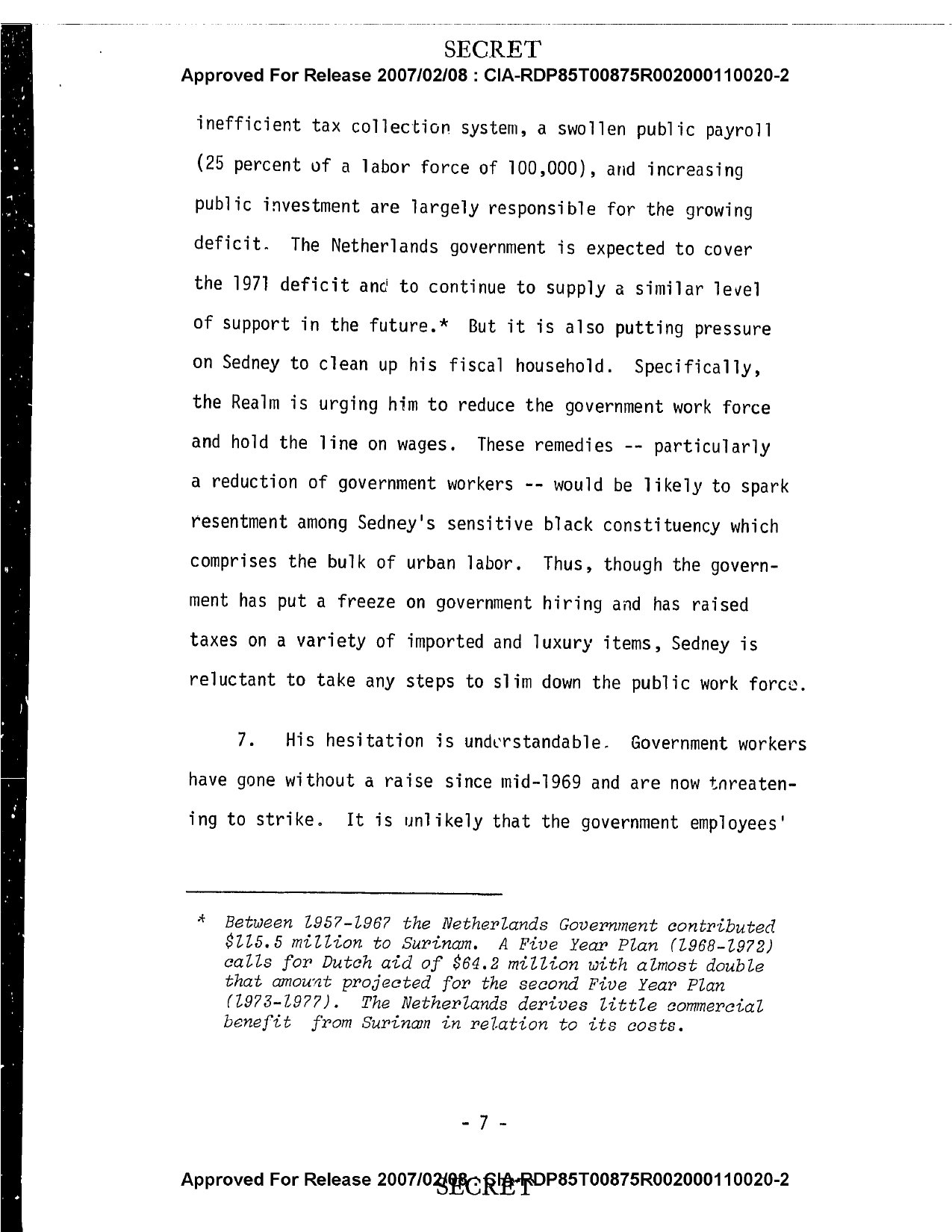
Government finances are under strain. The budget deficit, about 20% of expenditures in 1969, likely rose to 30% by 1970–71. Inefficient tax collection, a swollen public payroll (25% of the labor force), and public investment are key causes.
The Netherlands covers much of the deficit and exerts pressure for fiscal reform—particularly reducing the government workforce and restraining wages. But such cuts risk alienating Sedney’s largely black urban base.
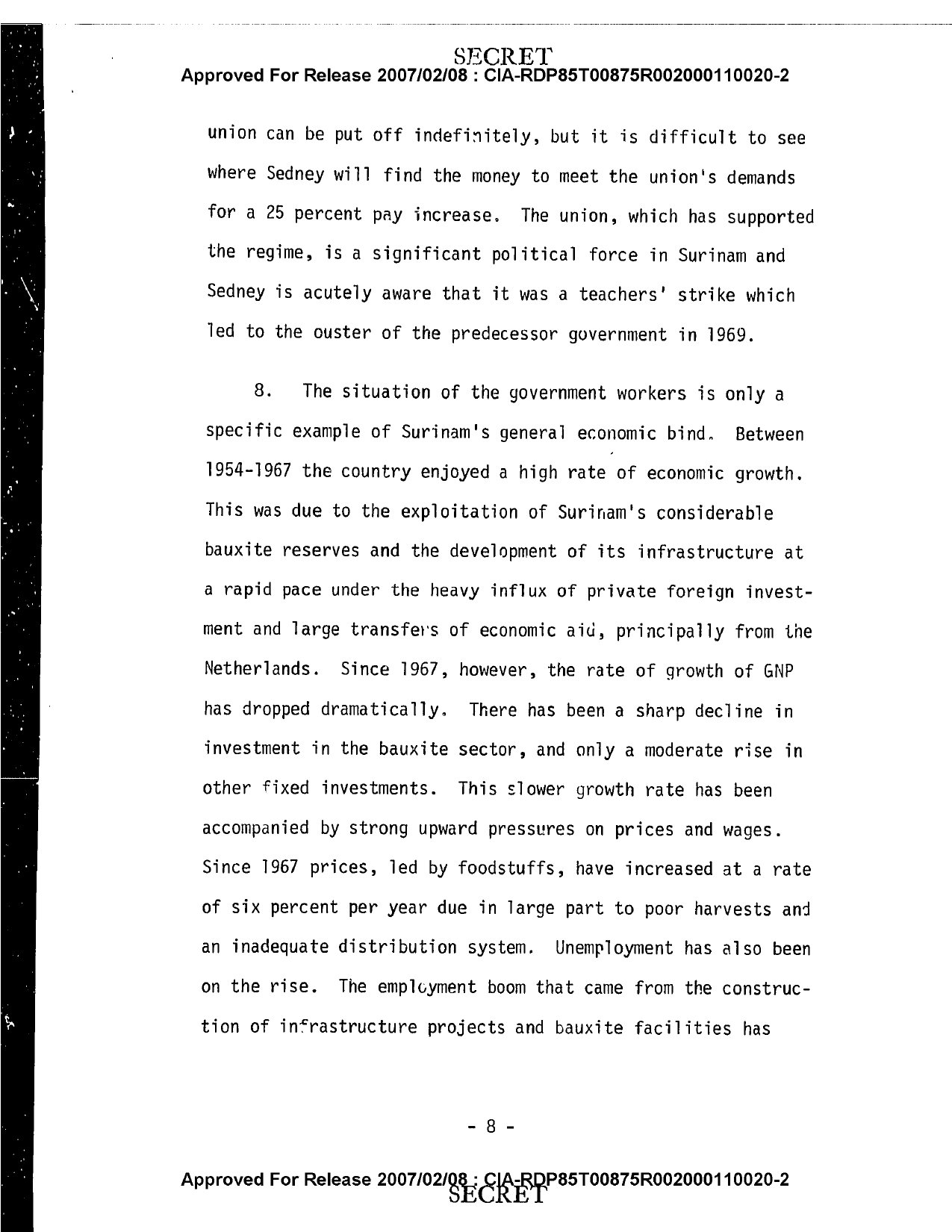
Government workers, without raises since mid-1969, are threatening to strike for a 25% pay hike. A strike could destabilize the coalition, recalling how a teachers’ strike toppled the previous government in 1969.
6. Broader Economic Picture
Surinam’s growth rate was high between 1954–1967, driven by bauxite and Dutch aid. Since 1967, growth has slowed sharply, inflation has risen (about 6% annually), and unemployment now stands near 20%.
Job creation from earlier construction booms has tapered off, and the public sector cannot absorb more workers.
7. Political Opposition and Labor
Opposition to Sedney comes mainly from the National Party of Surinam, the Nationalistic Republic Party, and Black Power elements. These groups exert influence within trade unions and may merge to challenge the ruling coalition in the 1973 elections.
There is no organized Communist presence. Labor leader Edward Bruma, head of the Nationalistic Republic Party, admires Guyana’s Cheddi Jagan but has little support.
8. Independence Question
Independence is viewed as inevitable but not urgent. The Netherlands has agreed in principle to grant it within 5–7 years. The Sedney government and most citizens favor a gradual transition to ensure economic stability and defense readiness.
Only a small group of militant blacks demands immediate separation.
9. Outlook
Unresolved economic and racial issues will continue to dominate. New investments will not bring quick relief, and political tensions will persist. However, violence is likely to remain limited and directed at domestic grievances rather than foreign business.
U.S. investments should remain relatively safe; anti-American sentiment is minimal, and U.S. firms have a good reputation.
Security is adequate:
- 800-man police force, backed by
- 1,000 Dutch troops in-country, and
- additional Dutch forces stationed in Curacao.
However, security could weaken as the Dutch military presence is phased out and replaced by a new Surinamese army.
10. Conclusion
Between now and independence, nationalization of foreign assets is unlikely. The leadership will continue to seek foreign capital under increasingly stringent—but still attractive—terms.
While domestic pressures may push for higher taxes and participation rights, these reflect fiscal needs rather than nationalist ideology.
Surinam’s investment environment will probably remain favorable by regional standards, especially in contrast to the growing nationalism elsewhere in Latin America.
SECRET
Approved For Release 2007/02/08: CIA-RDP85T00875R002000110020-2
Source:
Link:
Internal Link:
Date:
June 4, 1971