Latin America Review – Suriname: Prospects for Democratization – 22 November 1985
CIA-RDP87T00289R000200940001-4
Overview
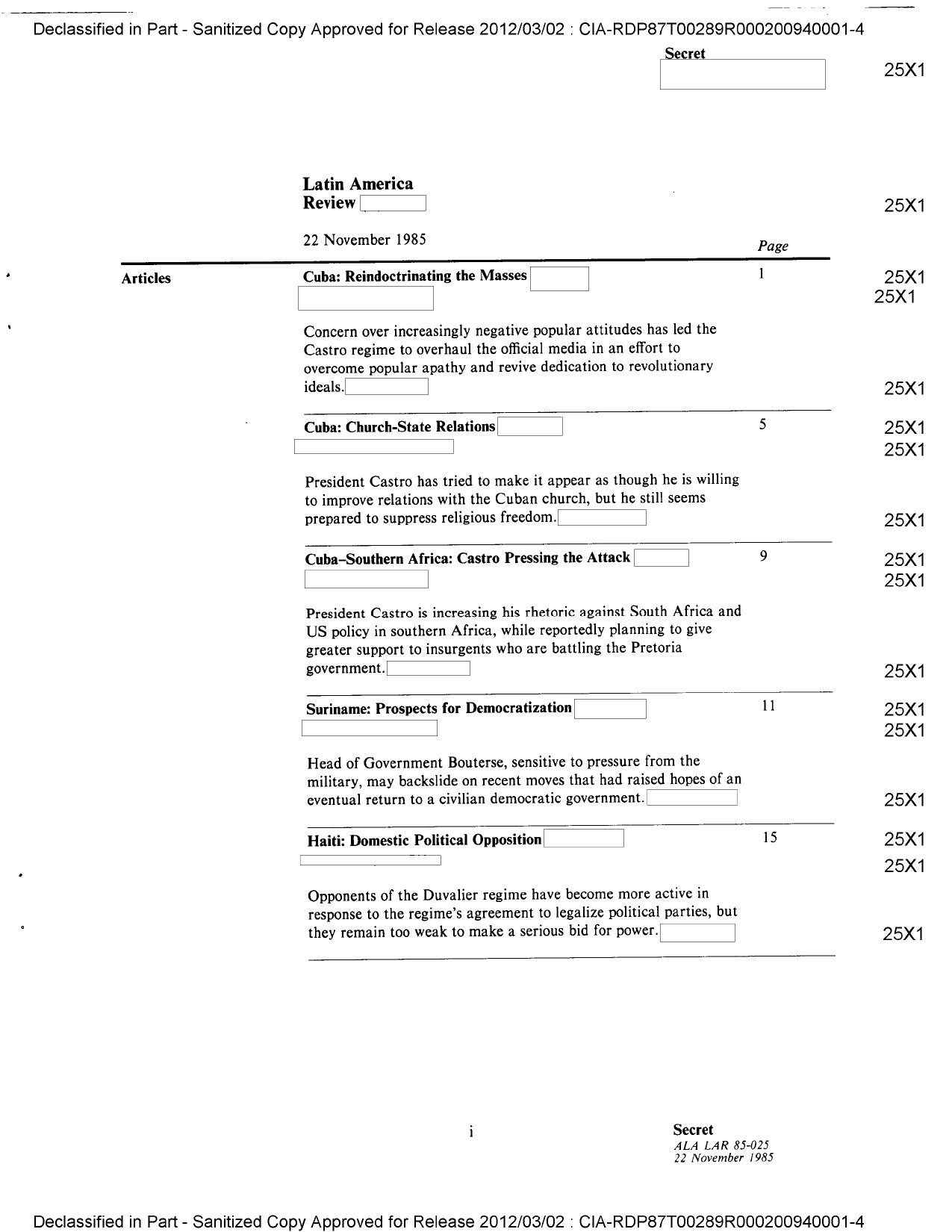
| Subject | Page |
|---|---|
| Cuba: Reindoctrinating the Masses Concern over increasingly negative popular attitudes has led the Castro regime to overhaul the official media in an effort to overcome popular apathy and revive dedication to revolutionary ideals. |
1 |
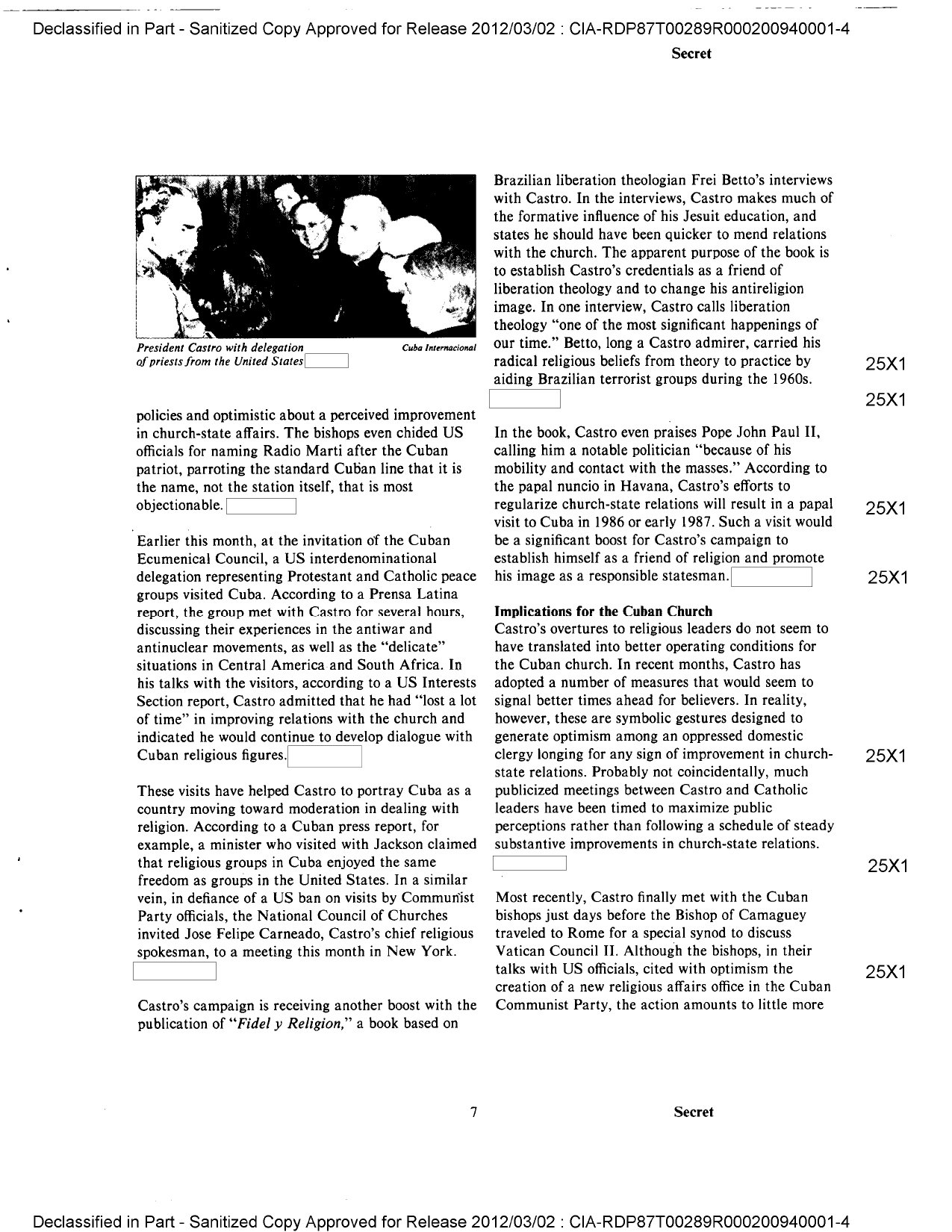
| Cuba: Church-State Relations President Castro has tried to make it appear as though he is willing to improve relations with the Cuban church, but he still seems prepared to suppress religious freedom. |
5 |
| Cuba-Southern Africa: Castro Pressing the Attack President Castro is increasing his rhetoric against South Africa and US policy in southern Africa, while reportedly planning to give greater support to insurgents who are battling the Pretoria government. |
9 |
| Suriname: Prospects for Democratization Head of Government Bouterse, sensitive to pressure from the military, may backslide on recent moves that had raised hopes of an eventual return to a civilian democratic government. |
11 |
| Haiti: Domestic Political Opposition Opponents of the Duvalier regime have become more active in response to the regime’s agreement to legalize political parties, but they remain too weak to make a serious bid for power. |
15 |
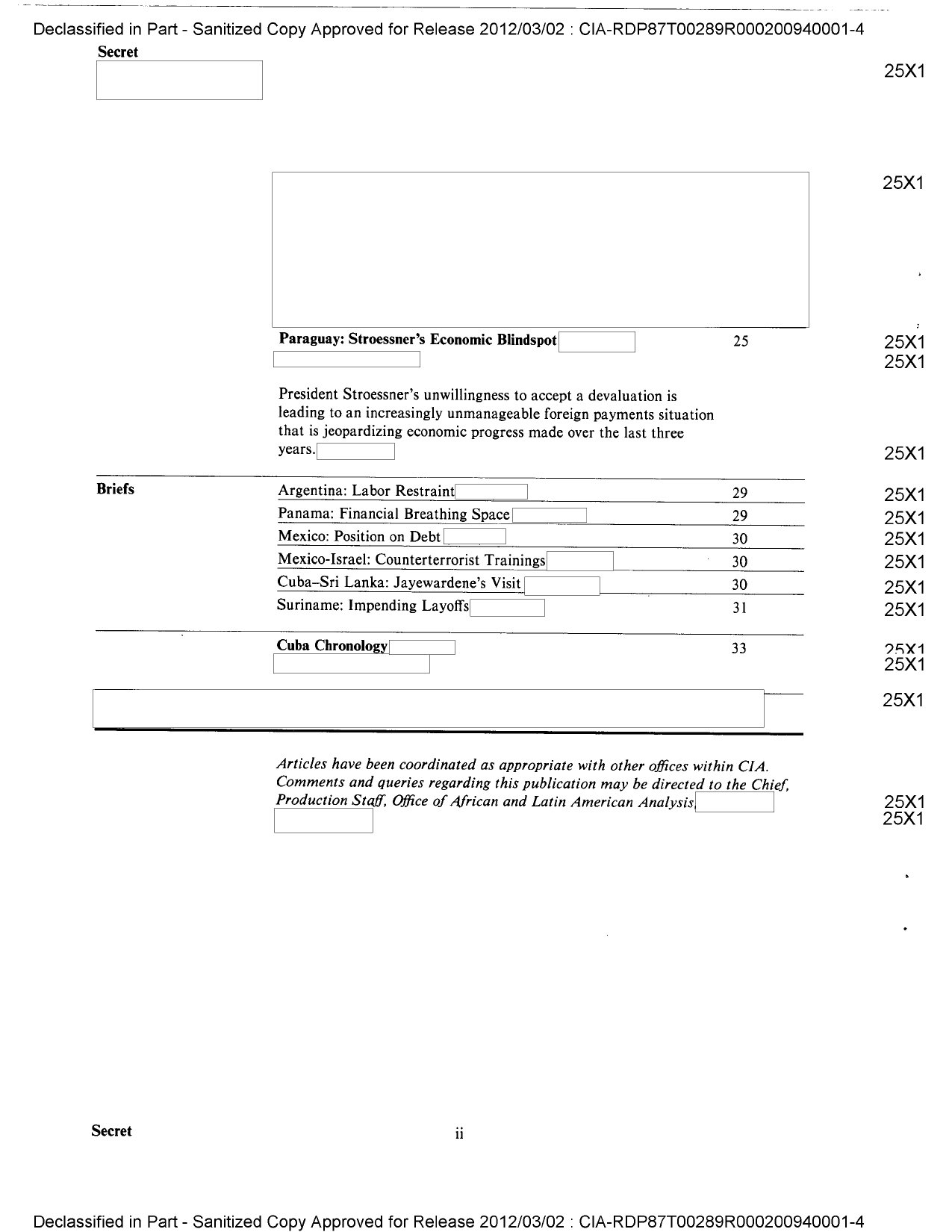
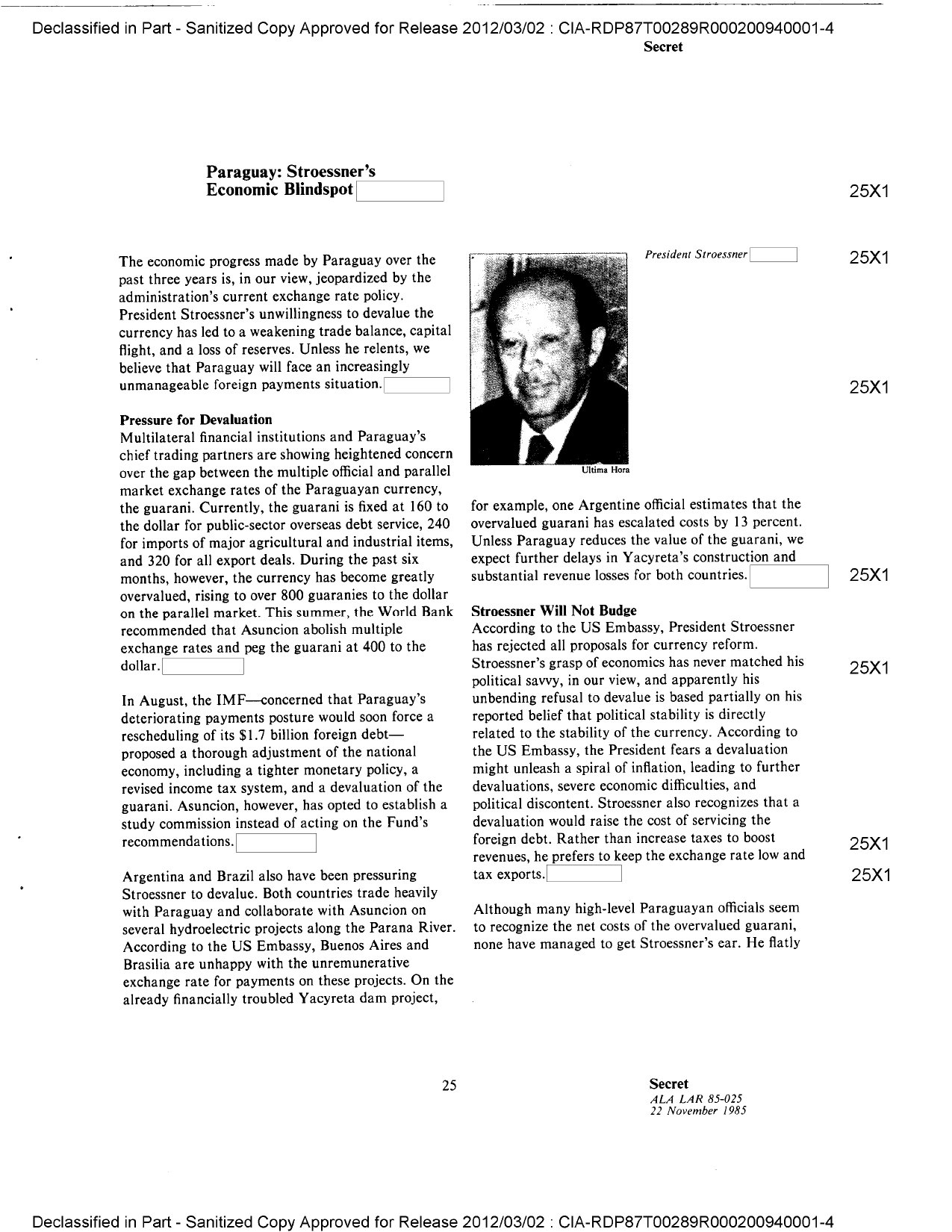
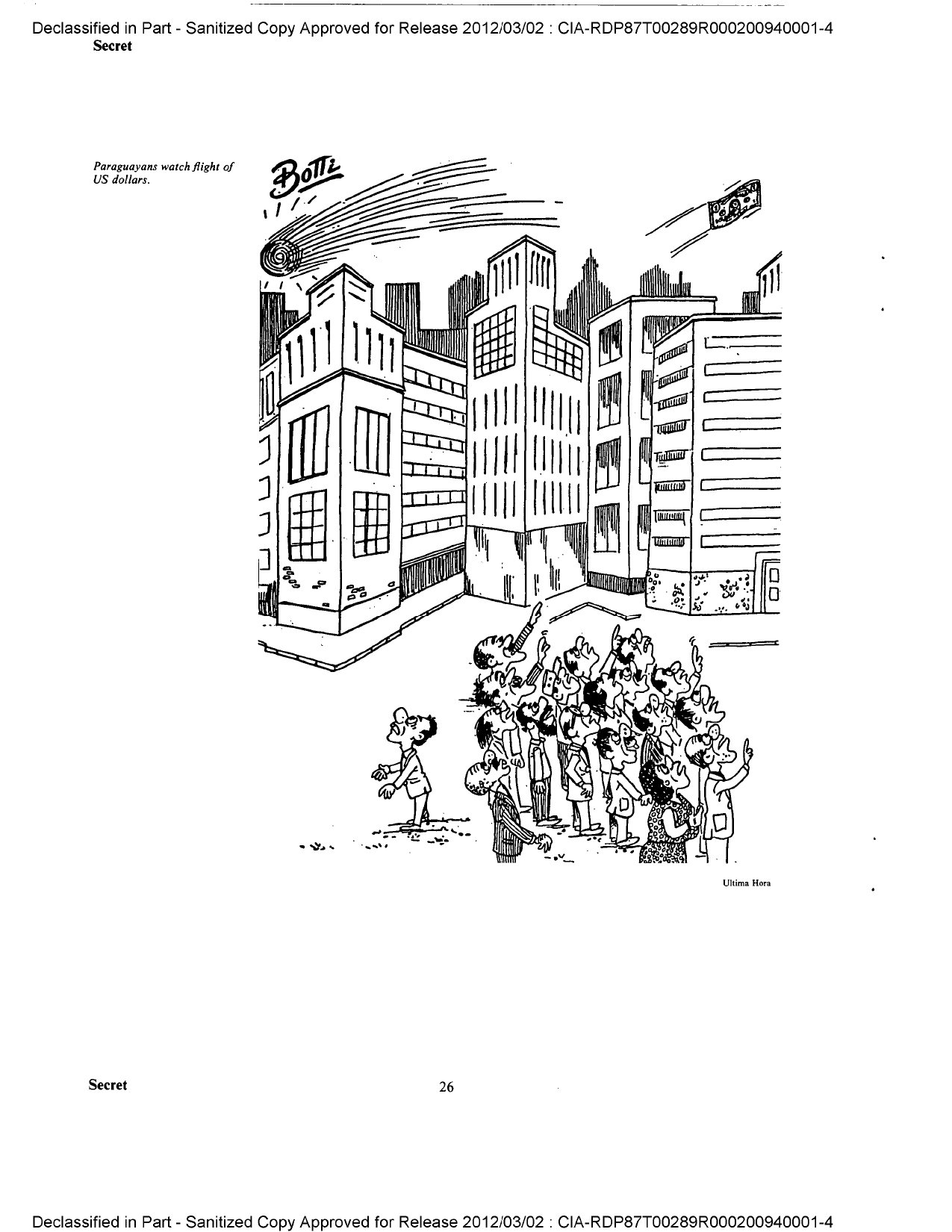
| Paraguay: Stroessner’s Economic Blindspot President Stroessner’s unwillingness to accept a devaluation is leading to an increasingly unmanageable foreign payments situation that is jeopardizing economic progress made over the last three years. |
25 |
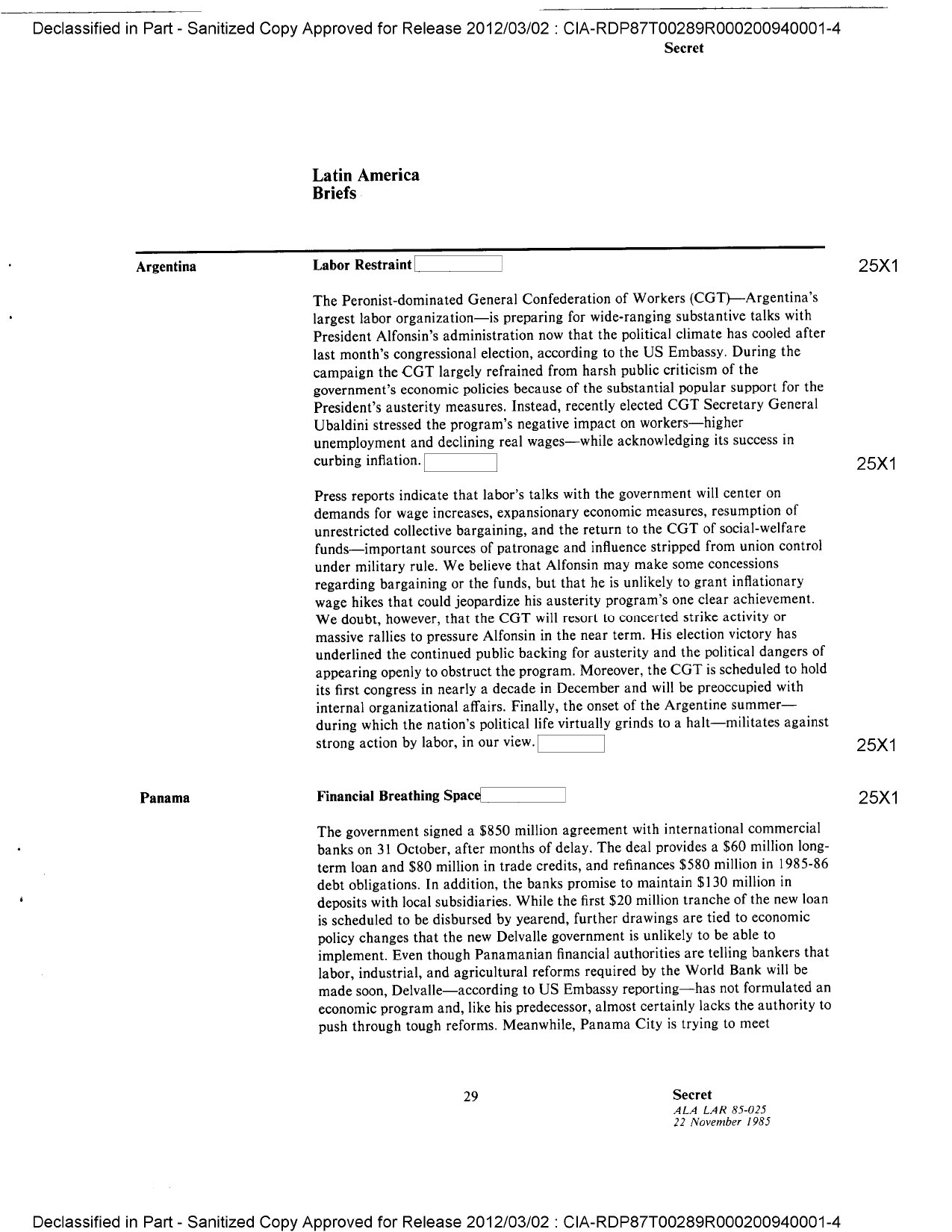
| Argentina: Labor Restraint | 29 |
| Panama: Financial Breathing Space | 29 |
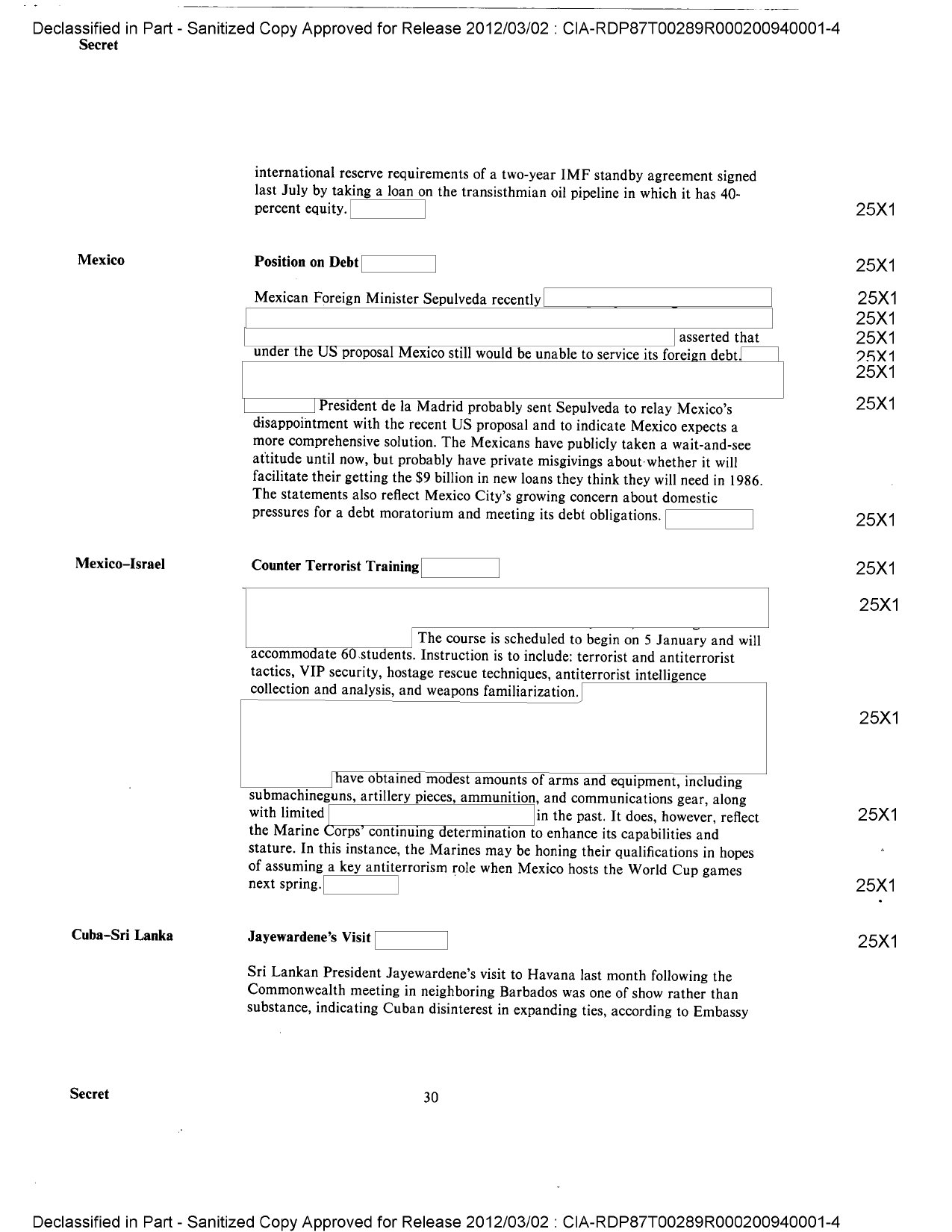
| Mexico: Position on Debt | 30 |
| Mexico-Israel: Counterterrorist Trainings | 30 |
| Cuba-Sri Lanka: Jayewardene’s Visit | 30 |
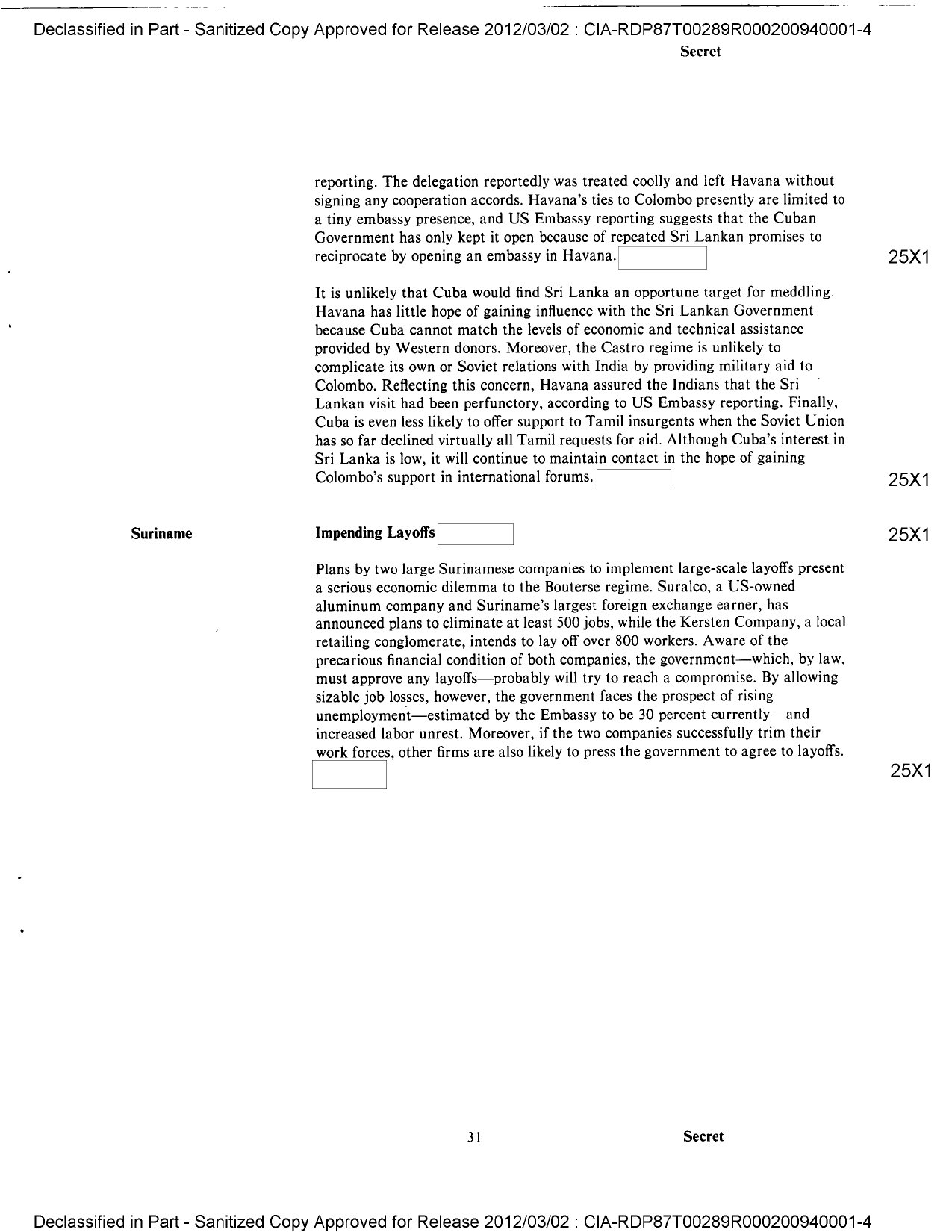
| Suriname: Impending Layoffs | 31 |
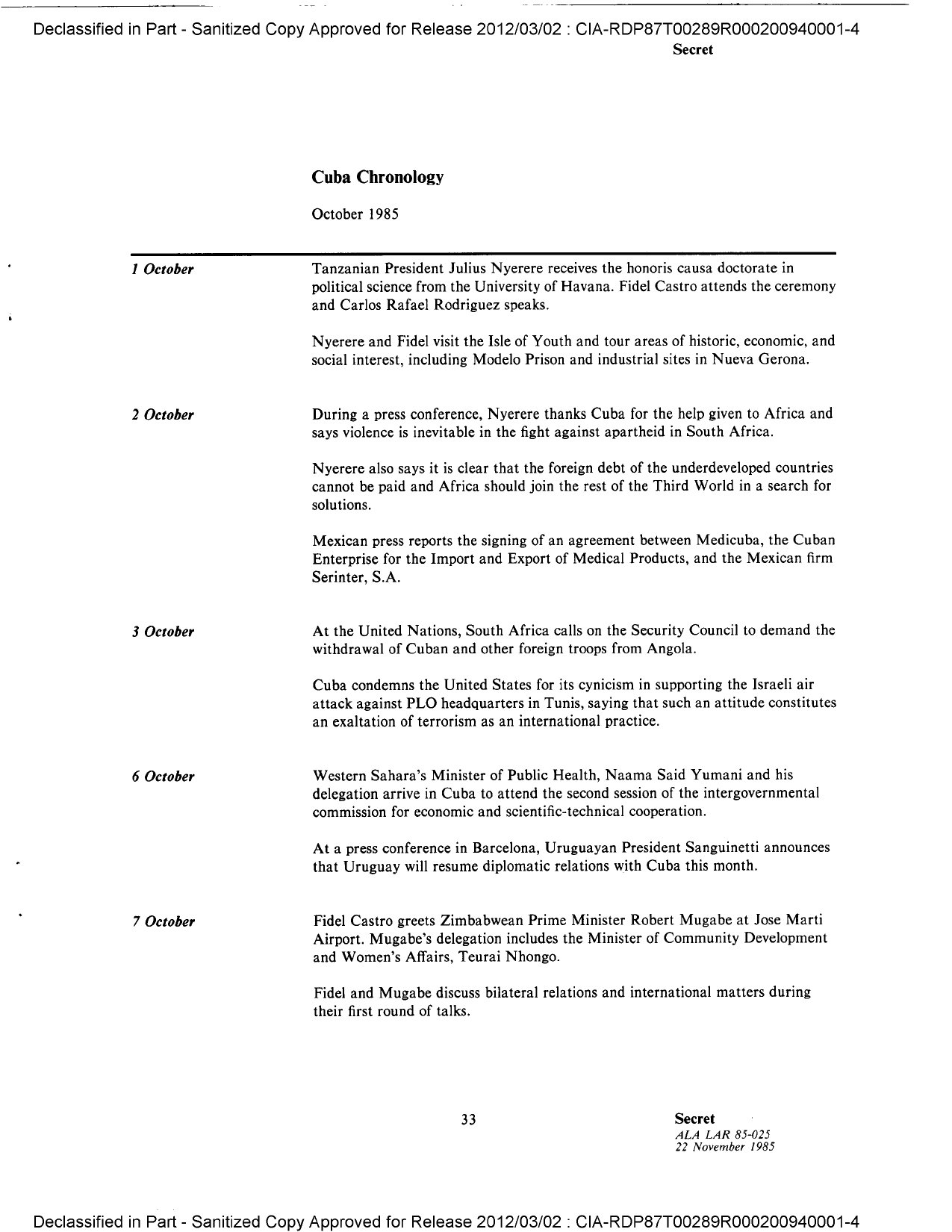
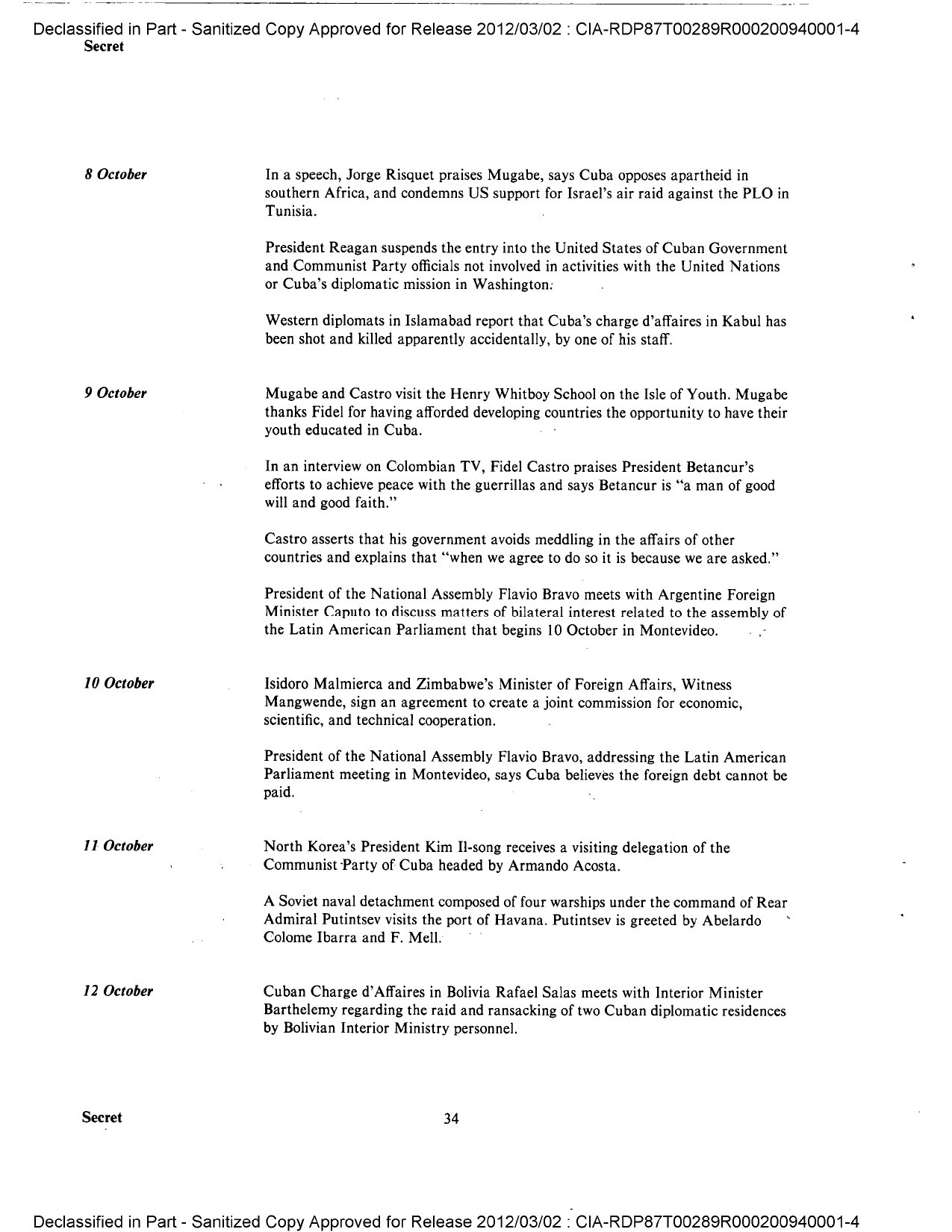
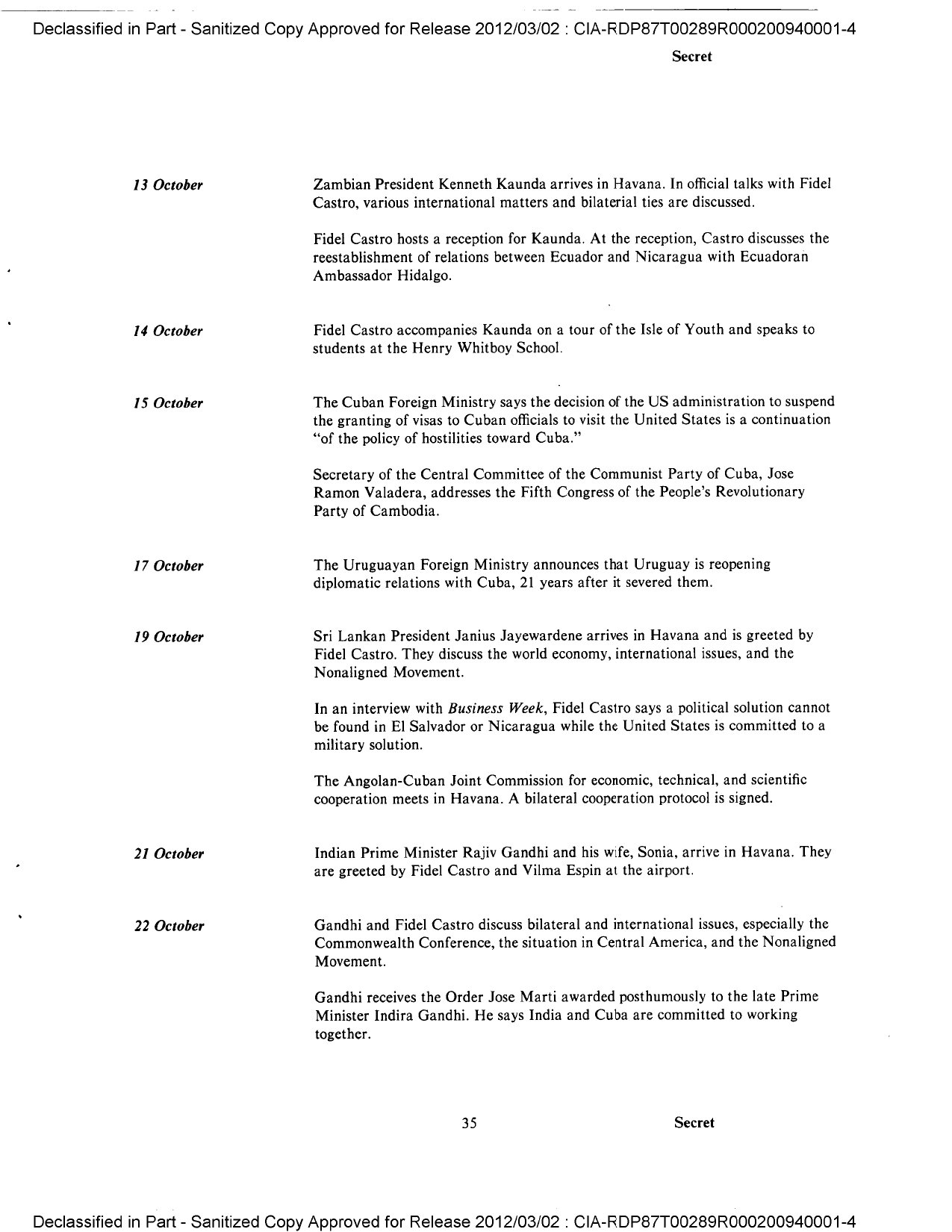
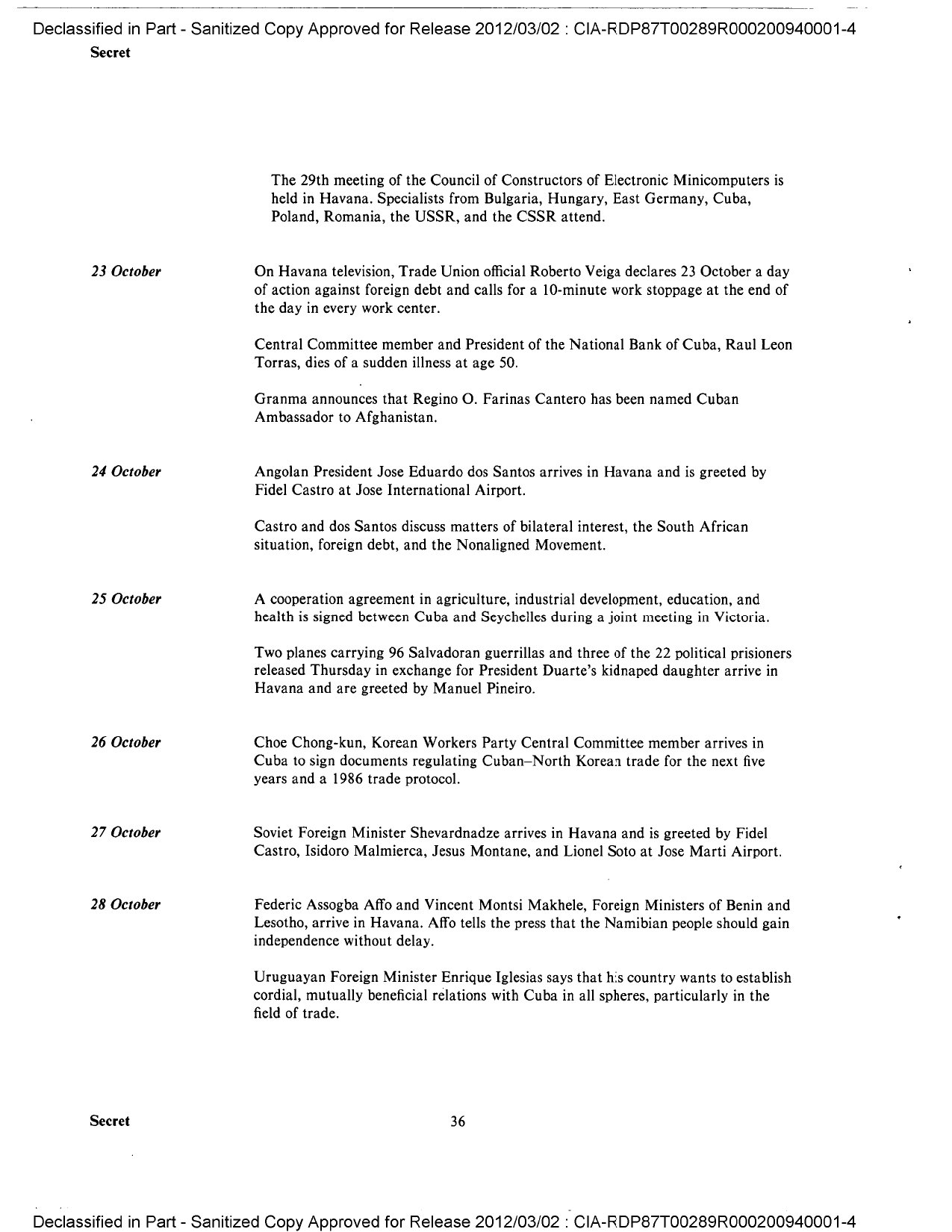
| Cuba Chronology – | – |
Articles have been coordinated as appropriate with other offices within CIA. Comments and queries regarding this publication may be directed to the Chief, Production Staff, Office of African and Latin American Analysis.
Articles
Latin America Review – 22 November 1985
Suriname: Prospects for Democratization
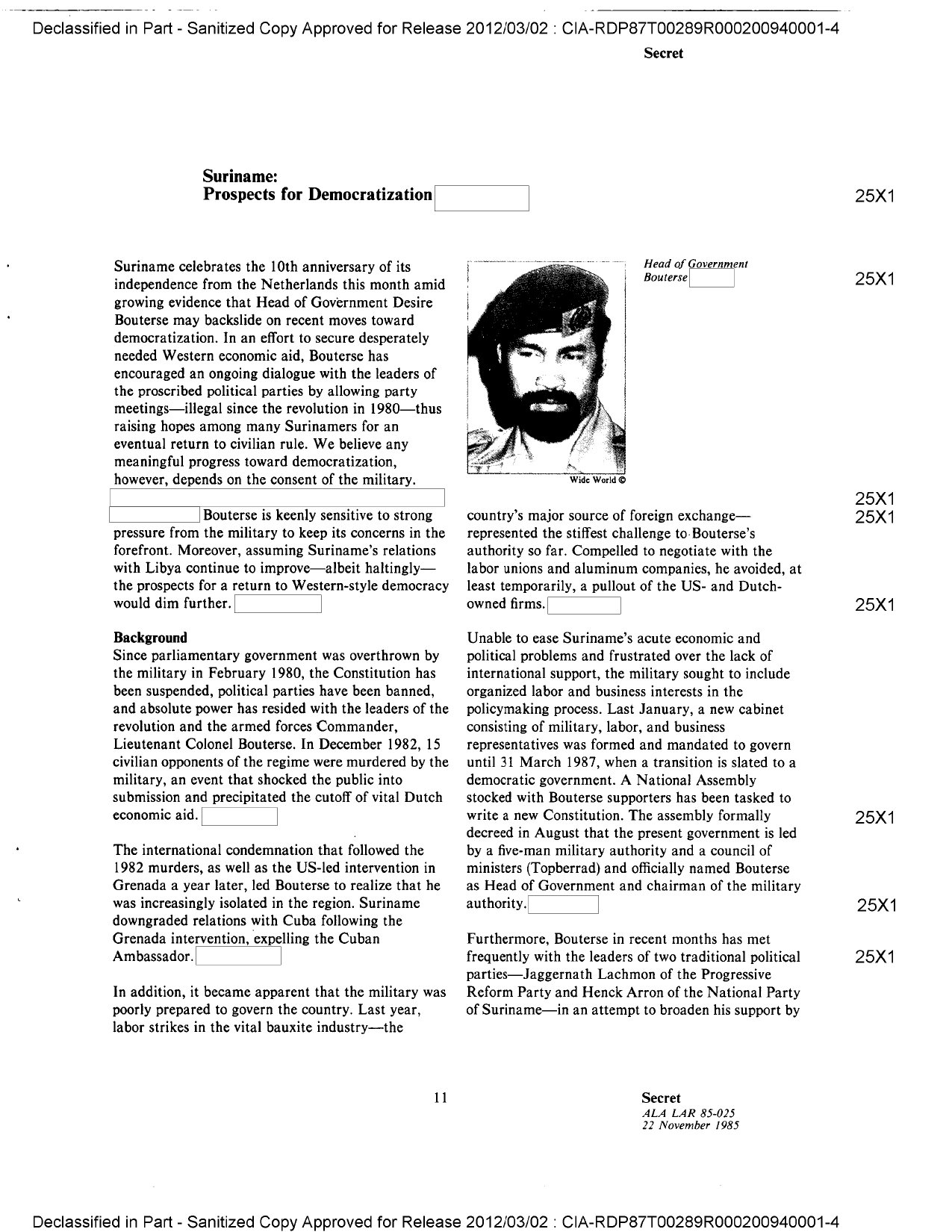
Suriname celebrates the 10th anniversary of its independence from the Netherlands this month amid growing evidence that Head of Government Desire Bouterse may backslide on recent moves toward democratization. In an effort to secure desperately needed Western economic aid, Bouterse has encouraged an ongoing dialogue with the leaders of the proscribed political parties by allowing party meetings—illegal since the revolution in 1980—thus raising hopes among many Surinamers for an eventual return to civilian rule. We believe any meaningful progress toward democratization, however, depends on the consent of the military.
Bouterse is keenly sensitive to strong pressure from the military to keep its concerns in the forefront. Moreover, assuming Suriname’s relations with Libya continue to improve—albeit haltingly—the prospects for a return to Western-style democracy would dim further.
Background
Since parliamentary government was overthrown by the military in February 1980, the Constitution has been suspended, political parties have been banned, and absolute power has resided with the leaders of the revolution and the armed forces Commander, Lieutenant Colonel Bouterse. In December 1982, 15 civilian opponents of the regime were murdered by the military, an event that shocked the public into submission and precipitated the cutoff of vital Dutch economic aid.
The international condemnation that followed the 1982 murders, as well as the US-led intervention in Grenada a year later, led Bouterse to realize that he was increasingly isolated in the region. Suriname downgraded relations with Cuba following the Grenada intervention, expelling the Cuban Ambassador.
In addition, it became apparent that the military was poorly prepared to govern the country. Last year, labor strikes in the vital bauxite industry—the country’s major source of foreign exchange—represented the stiffest challenge to Bouterse’s authority so far. Compelled to negotiate with the labor unions and aluminum companies, he avoided, at least temporarily, a pullout of the US- and Dutch-owned firms.
Unable to ease Suriname’s acute economic and political problems and frustrated over the lack of international support, the military sought to include organized labor and business interests in the policymaking process. Last January, a new cabinet consisting of military, labor, and business representatives was formed and mandated to govern until 31 March 1987, when a transition is slated to a democratic government.
A National Assembly stocked with Bouterse supporters has been tasked to write a new Constitution. The assembly formally decreed in August that the present government is led by a five-man military authority and a council of ministers (Topberrad) and officially named Bouterse as Head of Government and chairman of the military authority.
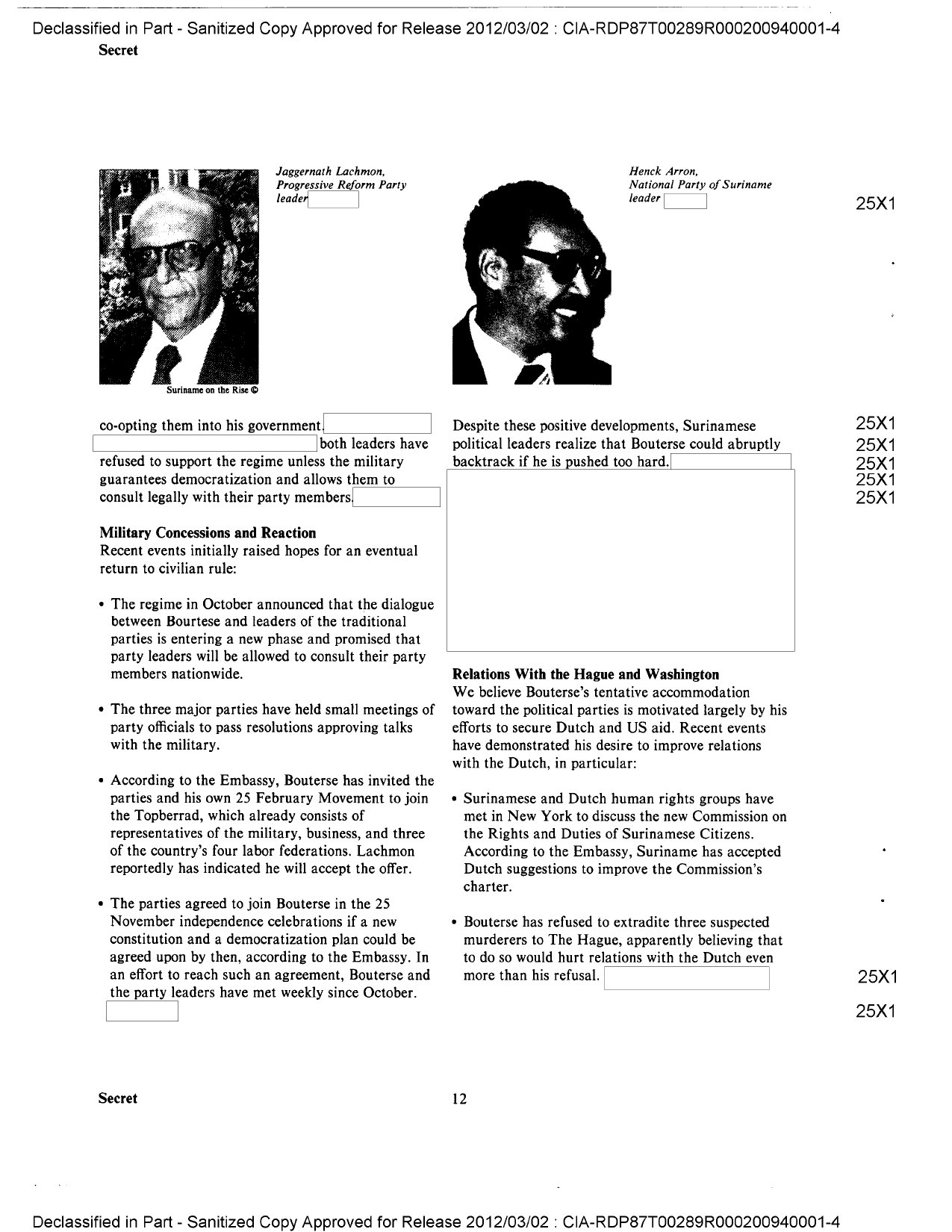
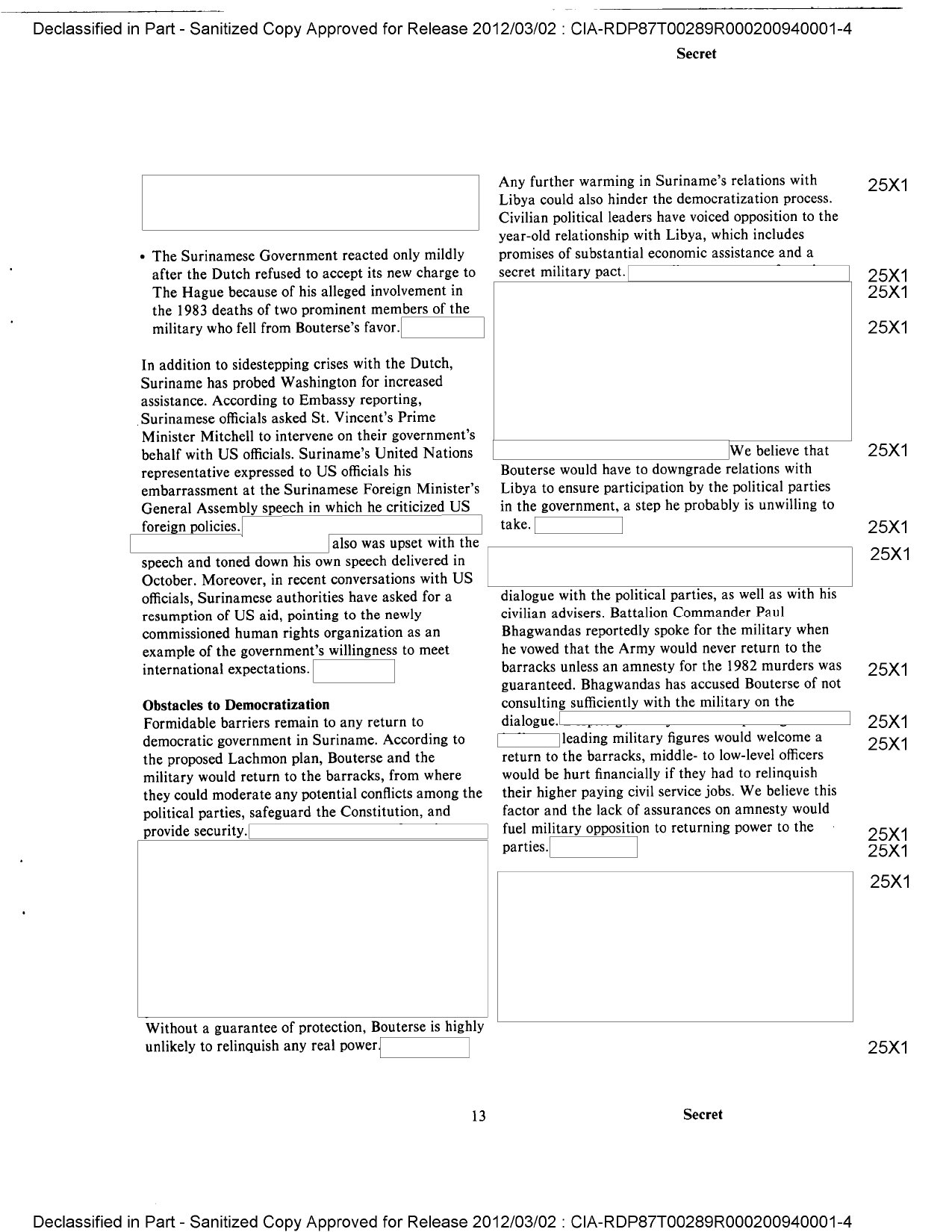
Furthermore, Bouterse in recent months has met frequently with the leaders of two traditional political parties—Jaggernath Lachmon of the Progressive Reform Party and Henck Arron of the National Party of Suriname—in an attempt to broaden his support by co-opting them into his government. Both leaders have refused to support the regime unless the military guarantees democratization and allows them to consult legally with their party members.
Military Concessions and Reaction
Recent events initially raised hopes for an eventual return to civilian rule:
- The regime in October announced that the dialogue between Bouterse and leaders of the traditional parties is entering a new phase and promised that party leaders will be allowed to consult their party members nationwide.
- The three major parties have held small meetings of party officials to pass resolutions approving talks with the military.
According to the Embassy, Bouterse has invited the parties and his own 25 February Movement to join the Topberrad, which already consists of representatives of the military, business, and three of the country’s four labor federations. Lachmon reportedly has indicated he will accept the offer.
- The parties agreed to join Bouterse in the 25 November independence celebrations if a new constitution and a democratization plan could be agreed upon by then, according to the Embassy. In an effort to reach such an agreement, Bouterse and the party leaders have met weekly since October.
Despite these positive developments, Surinamese political leaders realize that Bouterse could abruptly backtrack if he is pushed too hard.
Relations With the Hague and Washington
We believe Bouterse’s tentative accommodation toward the political parties is motivated largely by his efforts to secure Dutch and US aid. Recent events have demonstrated his desire to improve relations with the Dutch, in particular:
- Surinamese and Dutch human rights groups have met in New York to discuss the new Commission on the Rights and Duties of Surinamese Citizens. According to the Embassy, Suriname has accepted Dutch suggestions to improve the Commission’s charter.
- Bouterse has refused to extradite three suspected murderers to The Hague, apparently believing that to do so would hurt relations with the Dutch even more than his refusal.
- [CENSORED]
- The Surinamese Government reacted only mildly after the Dutch refused to accept its new charge to The Hague because of his alleged involvement in the 1983 deaths of two prominent members of the military who fell from Bouterse’s favor.
In addition to sidestepping crises with the Dutch, Suriname has probed Washington for increased assistance. According to Embassy reporting, Surinamese officials asked St. Vincent’s Prime Minister Mitchell to intervene on their government’s behalf with US officials. Suriname’s United Nations representative expressed to US officials his embarrassment at the Surinamese Foreign Minister’s General Assembly speech in which he criticized US foreign policies.
[CENSORED] also was upset with the speech and toned down his own speech delivered in October. Moreover, in recent conversations with US officials, Surinamese authorities have asked for a resumption of US aid, pointing to the newly commissioned human rights organization as an example of the government’s willingness to meet international expectations.
Obstacles to Democratization
Formidable barriers remain to any return to democratic government in Suriname. According to the proposed Lachmon plan, Bouterse and the military would return to the barracks, from where they could moderate any potential conflicts among the political parties, safeguard the Constitution, and provide security. [CENSORED]
[CENSORED]
Without a guarantee of protection, Bouterse is highly unlikely to relinquish any real power.
Any further warming in Suriname’s relations with Libya could also hinder the democratization process. Civilian political leaders have voiced opposition to the year-old relationship with Libya, which includes promises of substantial economic assistance and a secret military pact. [CENSORED]
[CENSORED]
[CENSORED] We believe that [CENSORED] Bouterse would have to downgrade relations with Libya to ensure participation by the political parties in the government, a step he probably is unwilling to take.
[CENSORED] dialogue with the political parties, as well as with his civilian advisers. Battalion Commander Paul Bhagwandas reportedly spoke for the military when he vowed that the Army would never return to the barracks unless an amnesty for the 1982 murders was guaranteed. Bhagwandas has accused Bouterse of not consulting sufficiently with the military on the dialogue.
Leading military figures would welcome a return to the barracks, but middle- to low-level officers would be hurt financially if they had to relinquish their higher paying civil service jobs. We believe this factor and the lack of assurances on amnesty would fuel military opposition to returning power to the parties.
[CENSORED]
Although Bouterse, Bhagwandas, and Gorre apparently have no major policy differences, we believe that, among the three, Bouterse is most inclined to build civilian support for the regime. We doubt, nonetheless, that Bhagwandas or Gorre aspires to replace Bouterse and that neither could command as much loyalty from the military.
We believe that, in light of the military’s concerns, Bouterse has reassessed the dialogue with party leaders.
[CENSORED]
The US Embassy confirms that the military has instructed the parties to limit their meetings to 25 members.
[CENSORED]
Outlook
We believe the democratization process over the next few years will be slow, tentative, and subject to reverses at Bouterse’s whim. Despite the opportunity afforded by this month’s independence celebrations, we judge that Bouterse will do little more than realign his cabinet again and, if possible, try to convince Lachmon and Arron to join the government.
We believe that Bouterse wants the political parties to merge and to join him on the Topberrad, but that this will be rejected by the party leaders. Because they insist on negotiating a formula that will satisfy Dutch demands and restore development aid, they probably are unwilling to join without a clear framework for a return to civilian rule. At the same time, we believe Bouterse will not accept any formula that carries a risk of putting any member of the military on trial. As a result, Bouterse will continue to tilt toward the military in trying to balance its demands with those of the parties.
[CENSORED]
Suriname: Impending Layoffs
Plans by two large Surinamese companies to implement large-scale layoffs present a serious economic dilemma to the Bouterse regime. Suralco, a US-owned aluminum company and Suriname’s largest foreign exchange earner, has announced plans to eliminate at least 500 jobs, while the Kersten Company, a local retailing conglomerate, intends to lay off over 800 workers.
Aware of the precarious financial condition of both companies, the government—which, by law, must approve any layoffs—probably will try to reach a compromise. By allowing sizable job losses, however, the government faces the prospect of rising unemployment—estimated by the Embassy to be 30 percent currently—and increased labor unrest.
Moreover, if the two companies successfully trim their work forces, other firms are also likely to press the government to agree to layoffs.
Source:
Link:
Internal Link:
Date:
November 22, 1986