Suriname: Regime’s Opponents Executed – National Intelligence Daily – 10 December 1982
CIA-RDP84T00301R000600010147-9
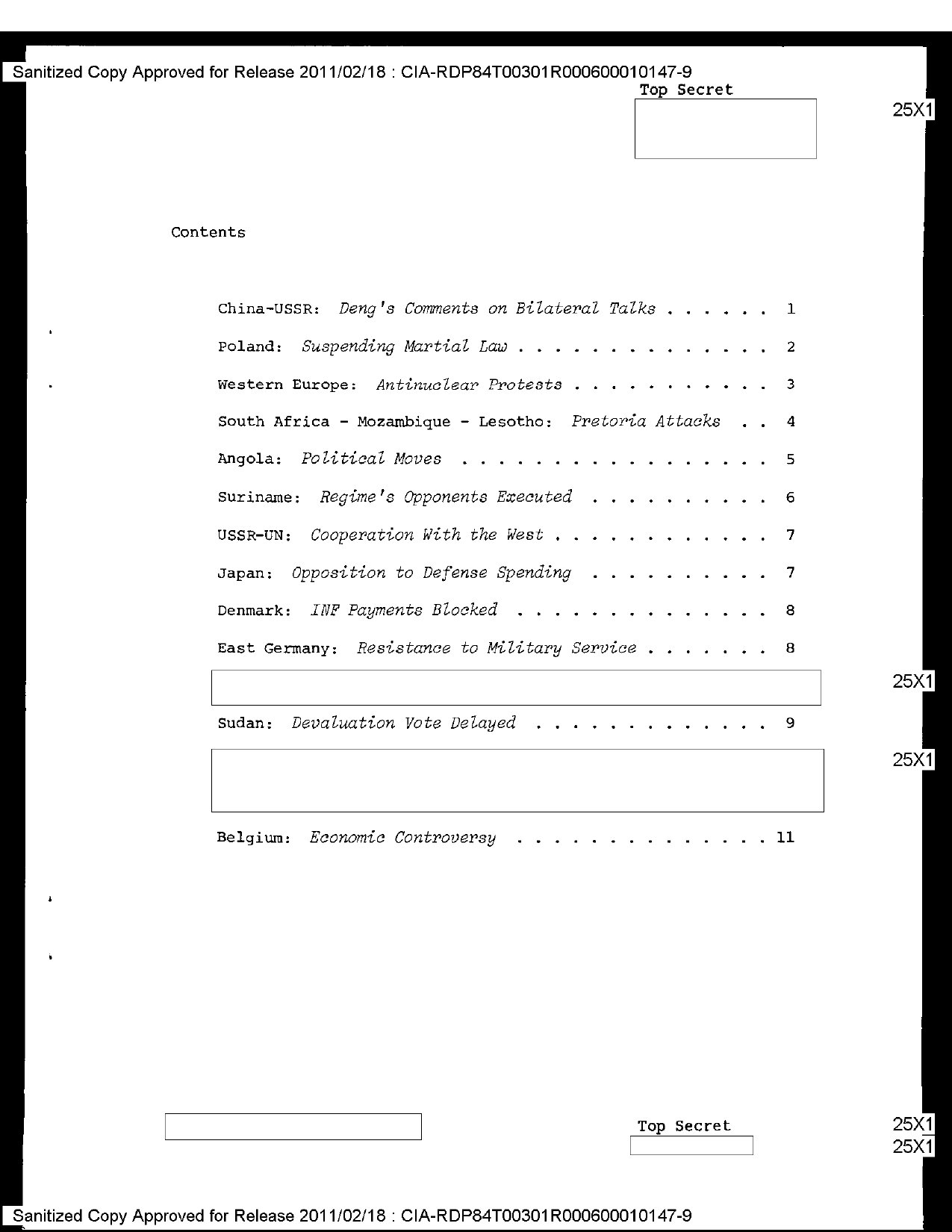
| Country / Topic | Page |
|---|---|
| China-USSR: Deng’s Comments on Bilateral Talks | 1 |
| Poland: Suspending Martial Law | 2 |
| Western Europe: Antinuclear Protests | 3 |
| South Africa – Mozambique – Lesotho: Pretoria Attacks | 4 |
| Angola: Political Moves | 5 |
| Suriname: Regime’s Opponents Executed | 6 |
| USSR-UN: Cooperation With the West | 7 |
| Japan: Opposition to Defense Spending | 7 |
| Denmark: INF Payments Blocked | 8 |
| East Germany: Resistance to Military Service | 8 |
| Sudan: Devaluation Vote Delayed | 9 |
| Belgium: Economic Controversy | 11 |
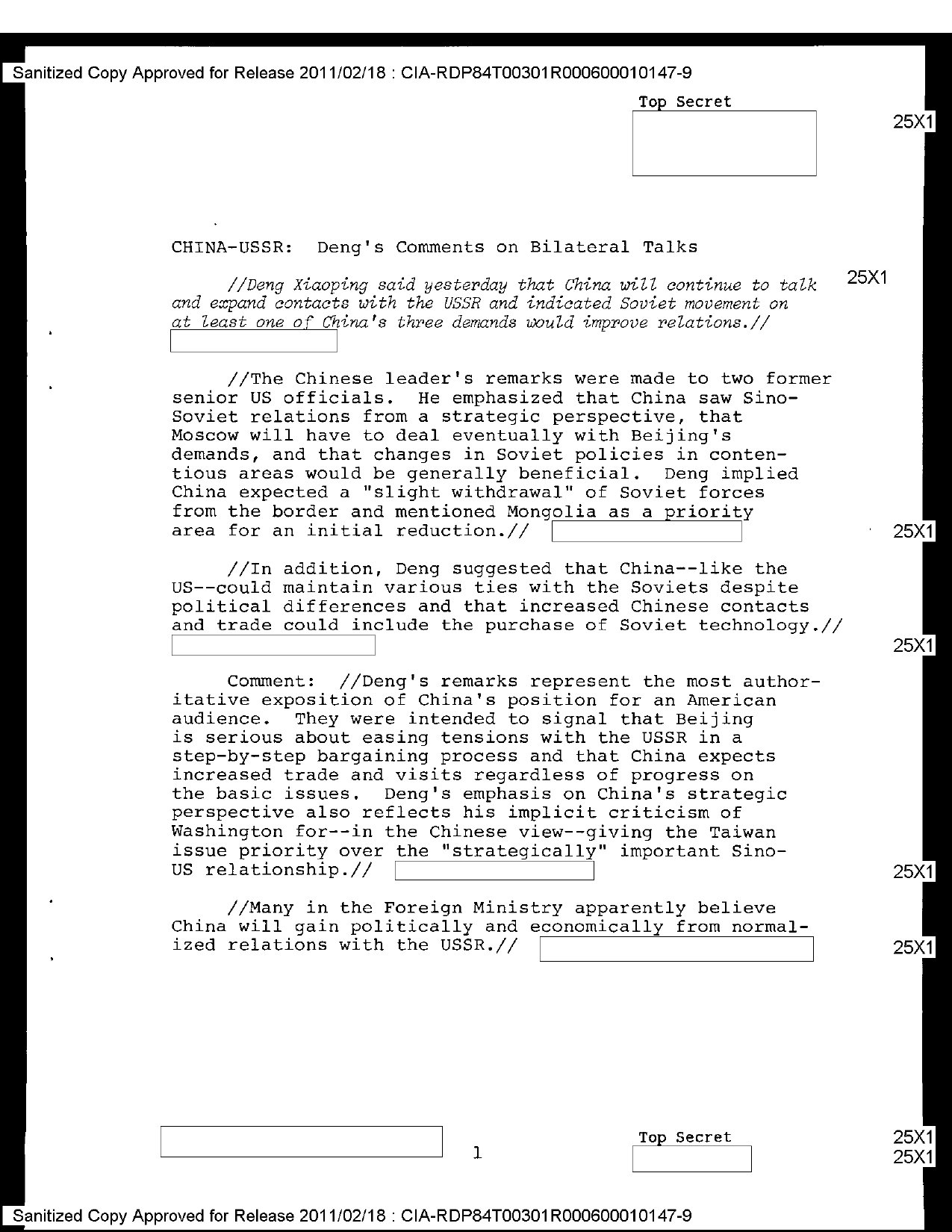
CHINA-USSR: Deng’s Comments on Bilateral Talks
//Deng Xiaoping said yesterday that China will continue to talk and expand contacts with the USSR and indicated Soviet movement on at least one of China’s three demands would improve relations.//
The Chinese leader’s remarks were made to two former senior US officials. He emphasized that China saw Sino-Soviet relations from a strategic perspective, that Moscow will have to deal eventually with Beijing’s demands, and that changes in Soviet policies in contentious areas would be generally beneficial. Deng implied China expected a “slight withdrawal” of Soviet forces from the border and mentioned Mongolia as a priority area for an initial reduction.//
In addition, Deng suggested that China—like the US—could maintain various ties with the Soviets despite political differences and that increased Chinese contacts and trade could include the purchase of Soviet technology.//
Comment: //Deng’s remarks represent the most authoritative exposition of China’s position for an American audience. They were intended to signal that Beijing is serious about easing tensions with the USSR in a step-by-step bargaining process and that China expects increased trade and visits regardless of progress on the basic issues. Deng’s emphasis on China’s strategic perspective also reflects his implicit criticism of Washington for—in the Chinese view—giving the Taiwan issue priority over the “strategically” important Sino-US relationship.//
Many in the Foreign Ministry apparently believe China will gain politically and economically from normalized relations with the USSR.//
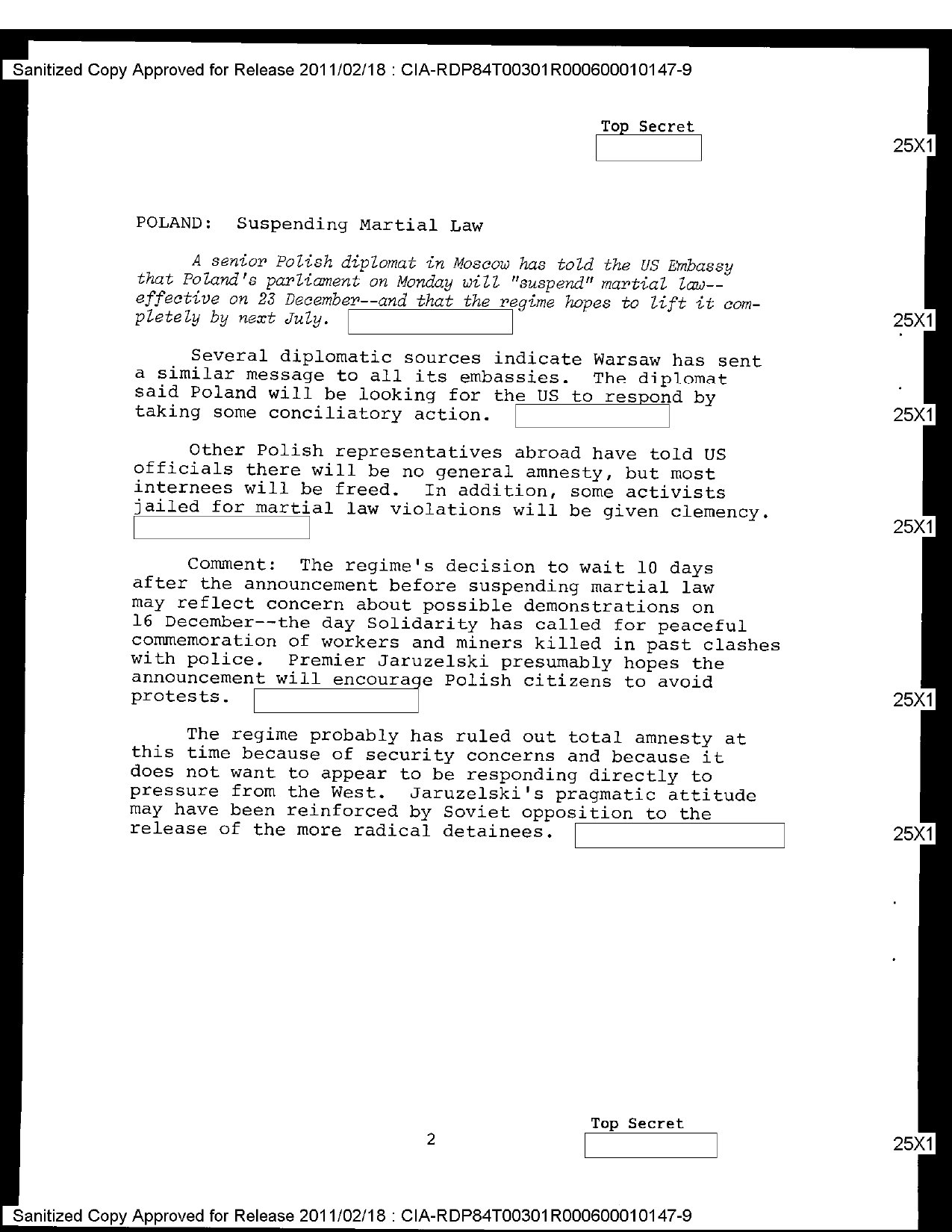
POLAND: Suspending Martial Law
A senior Polish diplomat in Moscow has told the US Embassy that Poland’s parliament on Monday will “suspend” martial law—effective on 23 December—and that the regime hopes to lift it completely by next July.
Several diplomatic sources indicate Warsaw has sent a similar message to all its embassies. The diplomat said Poland will be looking for the US to respond by taking some conciliatory action. Other Polish representatives abroad have told US officials there will be no general amnesty, but most internees will be freed. In addition, some activists jailed for martial law violations will be given clemency.
Comment: The regime’s decision to wait 10 days after the announcement before suspending martial law may reflect concern about possible demonstrations on 16 December—the day Solidarity has called for peaceful commemoration of workers and miners killed in past clashes with police. Premier Jaruzelski presumably hopes the announcement will encourage Polish citizens to avoid protests.
The regime probably has ruled out total amnesty at this time because of security concerns and because it does not want to appear to be responding directly to pressure from the West. Jaruzelski’s pragmatic attitude may have been reinforced by Soviet opposition to the release of the more radical detainees.
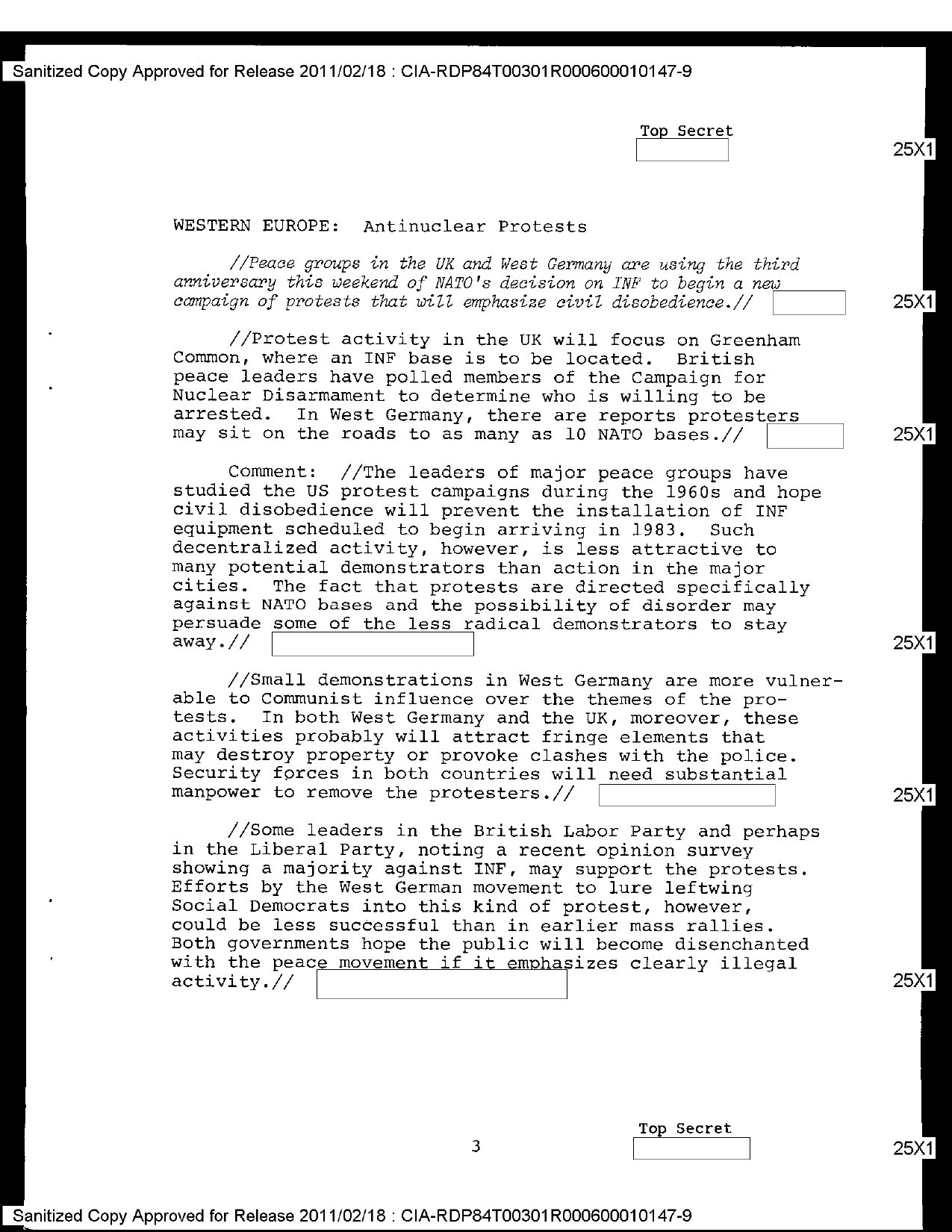
WESTERN EUROPE: Antinuclear Protests
//Peace groups in the UK and West Germany are using the third anniversary this weekend of NATO’s decision on INF to begin a new campaign of protests that will emphasize civil disobedience.//
Protest activity in the UK will focus on Greenham Common, where an INF base is to be located. British peace leaders have polled members of the Campaign for Nuclear Disarmament to determine who is willing to be arrested. In West Germany, there are reports protesters may sit on the roads to as many as 10 NATO bases.//
Comment: The leaders of major peace groups have studied the US protest campaigns during the 1960s and hope civil disobedience will prevent the installation of INF equipment scheduled to begin arriving in 1983. Such decentralized activity, however, is less attractive to many potential demonstrators than action in the major cities. The fact that protests are directed specifically against NATO bases and the possibility of disorder may persuade some of the less radical demonstrators to stay away.
Small demonstrations in West Germany are more vulnerable to Communist influence over the themes of the protests. In both West Germany and the UK, moreover, these activities probably will attract fringe elements that may destroy property or provoke clashes with the police. Security forces in both countries will need substantial manpower to remove the protesters.
Some leaders in the British Labor Party and perhaps in the Liberal Party, noting a recent opinion survey showing a majority against INF, may support the protests. Efforts by the West German movement to lure leftwing Social Democrats into this kind of protest, however, could be less successful than in earlier mass rallies. Both governments hope the public will become disenchanted with the peace movement if it emphasizes clearly illegal activity.//
SOUTH AFRICA – MOZAMBIQUE – LESOTHO: Pretoria Attacks
//South Africa’s attacks this week on facilities in Mozambique and Lesotho are the most recent manifestations of its tougher policy toward its neighbors.//
A major fire that began on Tuesday in the Mozambican port of Beira has caused extensive damage to the country’s main oil depot. The blaze will disrupt the flow of oil through a pipeline from the port to Mutare, ensuring Zimbabwe’s dependence on South Africa for oil supplies.//
South African commandos, during a raid yesterday in Lesotho, killed some 30 guerrillas of the African National Congress, the principal South African insurgent group. Pretoria says the operation—the first such attack into Lesotho—was aimed at preempting insurgent attacks planned for the holiday season. It follows Foreign Minister Botha’s public statement last week that Pretoria would not tolerate the harboring of terrorists by its neighbors. Lesotho has asked for a UN Security Council meeting.//
Comment: Mozambican insurgents backed by South Africa probably will claim credit for the fire in Beira. The South Africans, however, almost certainly are responsible for the operation.
The attack in Beira will heighten the sense of panic that has been growing in Maputo since last month in the aftermath of a series of shooting incidents between Mozambican and South African troops along the border.//
ANGOLA: Political Moves
//The ruling party has taken some steps to increase President dos Santos’s power to deal with Angola’s domestic and regional problems, but he still does not seem to be in a position to push decisively for a settlement on Namibia.//
The party’s Central Committee this week voted unanimously to grant dos Santos special powers to deal with the “grave situation” facing the country, but the nature of the powers was not specified. The action was announced shortly after dos Santos had sent a cabinet-level delegation to Cape Verde for talks with South African officials on Namibia and related issues.
The Central Committee also removed a prominent pro-Soviet hardliner from the Politburo and from his position as party secretary for ideology. Two other officials, one of whom is said to be among Angola’s top economists, were promoted to influential party posts.
Comment: The granting of special powers and the personnel shifts may give dos Santos more leeway to show some flexibility toward South Africa and to deal with the economy. In recent months he has appointed several of his supporters to key positions.
Dos Santos, however, probably will not be able to use his new powers any time soon to make major concessions on Namibia and the related question of a Cuban troop withdrawal from Angola. Cuban- and Soviet-backed hardliners in the party leadership almost certainly can still veto a large-scale withdrawal of Cuban forces. The hardliners’ continuing influence was reflected in another Central Committee announcement reaffirming Angola’s rejection of any linkage between the Namibian and Cuban issues.
The hardliners may have permitted dos Santos’s representatives at the Cape Verde talks to offer some concessions, perhaps including a mutual pullback of forces or even a limited Cuban withdrawal. South Africa, however, probably remained adamant that all Cubans have to depart.//
SURINAME: Regime’s Opponents Executed
//Army Commander Bouterse’s forces have executed 24 of the regime opponents arrested on Wednesday, including labor leader Daal and the head of the Bar Association.//
The state radio reported yesterday that the arrests had been made to forestall a coup attempt and that those killed were shot while trying to escape. The entire civilian cabinet has resigned.
Bouterse has imposed martial law. A curfew is in effect, gatherings of more than three persons are prohibited, and Suriname’s borders are sealed.
Comment: Bouterse’s brutal actions have silenced the nation’s most widely respected and moderate proponents of change. Surinamers will be shocked and angered by the killings, but their normal passivity and growing fear of the regime’s ruthlessness may restrain spontaneous, large-scale protests. If a moderate from the military establishment or some other strong personality challenges Bouterse, however, a majority of the people would be likely to rise up against him.
If Bouterse perceives no strong opposition, he is likely to take further measures to consolidate his control. Nevertheless, the killings could jeopardize further disbursements of the $1.5-billion aid package from the Netherlands, Suriname’s former colonial ruler. If he loses this aid, Bouterse would be likely to turn to his friends in Cuba for assistance.
USSR-UN: Cooperation With the West
The USSR is cooperating with the US and other Western states at the UN to block a resolution favored by Nonaligned states to encourage the transfer of peaceful nuclear technology and material. The resolution, scheduled for debate and possible vote this week, urges the Conference on the Peaceful Uses of Nuclear Energy planned for next summer to focus on facilitating transfers to Third World nations. It also would move the preparatory meeting for the conference from Vienna to New York. The Soviet delegation told the Dutch Ambassador to the UN that he could associate the USSR with the Western position on all major points in negotiations with the Group of 77.
Comment: The USSR, the US, and nearly all Western states oppose the resolution because it would encourage Third World demands for technology transfers and for new institutions that would weaken the current safeguards system of the IAEA. Holding the preparatory meeting in New York would enable more Nonaligned states to participate and to put pressure on developed states to make concessions. A solid Nonaligned vote could pass the resolution, but many Nonaligned states believe passage would result in postponement of the conference or its boycott by supplier states.//
JAPAN: Opposition to Defense Spending
There is broad opposition to any increase in the defense budget for next year, according to a recent public opinion poll in a major Japanese newspaper. A vast majority of those polled believe the current defense budget is adequate or should be reduced further.
Comment: The poll demonstrates there is limited public agreement with Prime Minister Nakasone’s view that Japan should improve its Self-Defense Forces. This will make it difficult for him to increase the defense budget to the proposed maximum of 7.34 percent, let alone exceed it as the US has requested. Budget officials already are looking for ways to cut spending next year as Tokyo tries to hold the line on the large deficit.
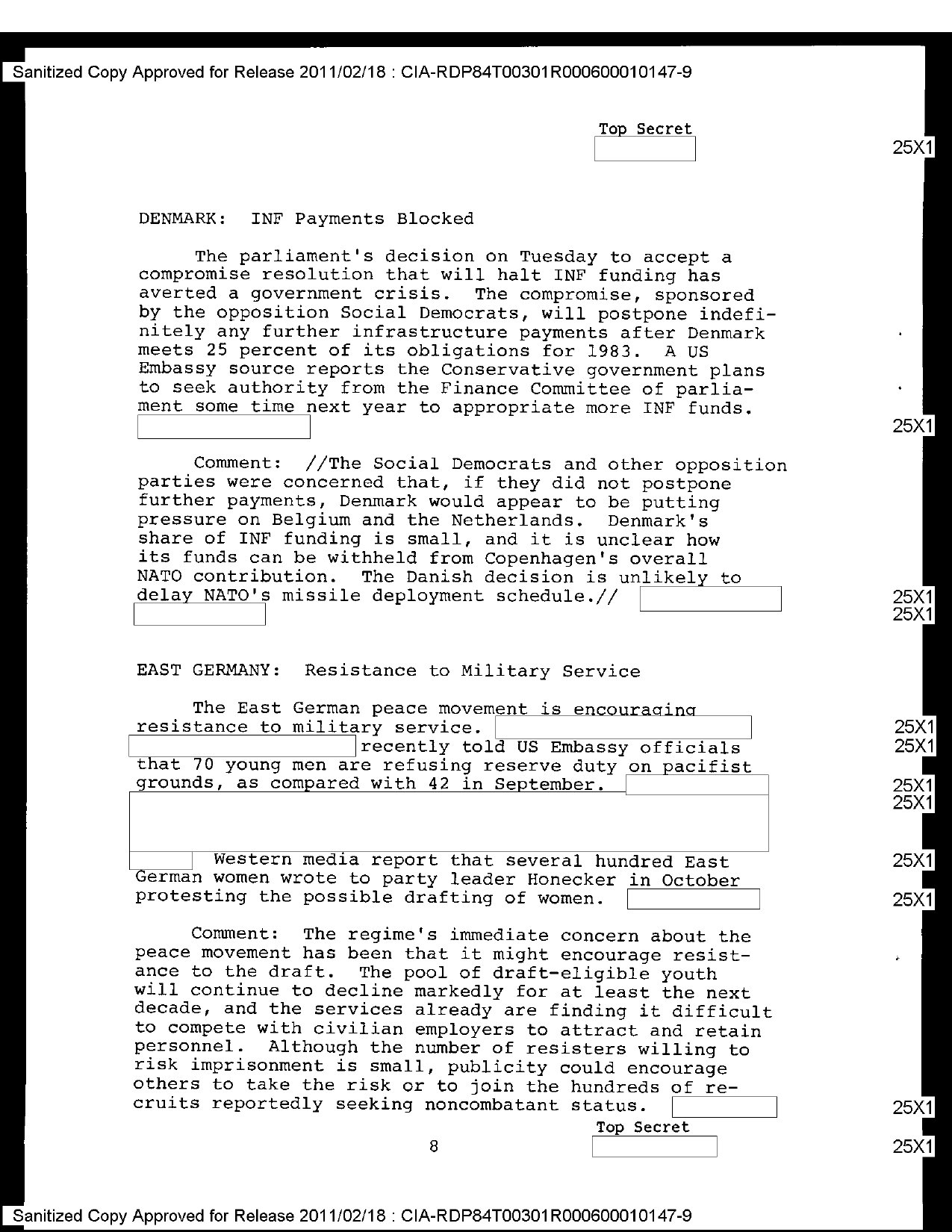
DENMARK: INF Payments Blocked
The parliament’s decision on Tuesday to accept a compromise resolution that will halt INF funding has averted a government crisis. The compromise, sponsored by the opposition Social Democrats, will postpone indefinitely any further infrastructure payments after Denmark meets 25 percent of its obligations for 1983. A US Embassy source reports the Conservative government plans to seek authority from the Finance Committee of parliament some time next year to appropriate more INF funds.
Comment: The Social Democrats and other opposition parties were concerned that, if they did not postpone further payments, Denmark would appear to be putting pressure on Belgium and the Netherlands. Denmark’s share of INF funding is small, and it is unclear how its funds can be withheld from Copenhagen’s overall NATO contribution. The Danish decision is unlikely to delay NATO’s missile deployment schedule.//
EAST GERMANY: Resistance to Military Service
The East German peace movement is encouraging resistance to military service.
Recent reports told US Embassy officials that 70 young men are refusing reserve duty on pacifist grounds, as compared with 42 in September. Western media report that several hundred East German women wrote to party leader Honecker in October protesting the possible drafting of women.
Comment: The regime’s immediate concern about the peace movement has been that it might encourage resistance to the draft. The pool of draft-eligible youth will continue to decline markedly for at least the next decade, and the services already are finding it difficult to compete with civilian employers to attract and retain personnel. Although the number of resisters willing to risk imprisonment is small, publicity could encourage others to take the risk or to join the hundreds of recruits reportedly seeking noncombatant status.
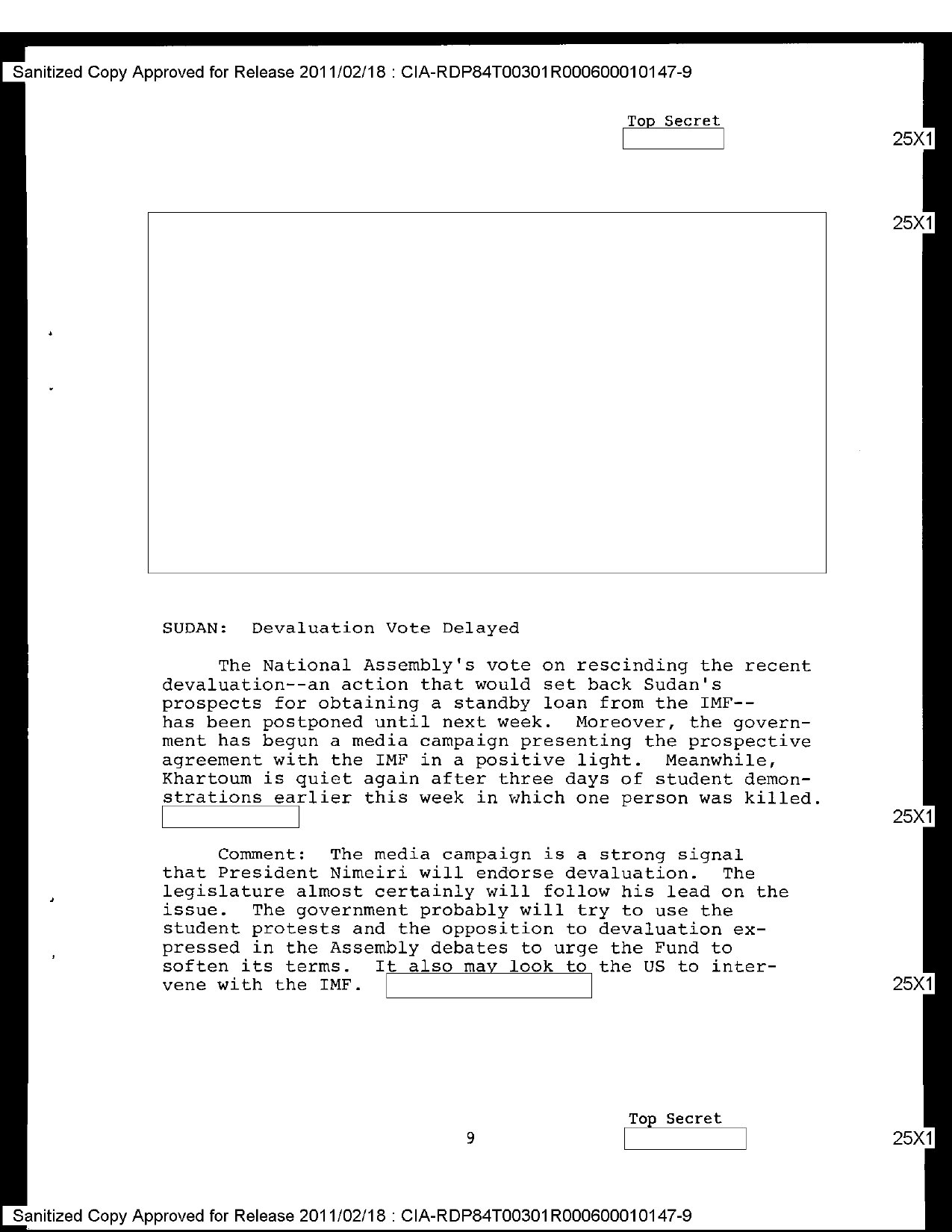
SUDAN: Devaluation Vote Delayed
The National Assembly’s vote on rescinding the recent devaluation—an action that would set back Sudan’s prospects for obtaining a standby loan from the IMF—has been postponed until next week. Moreover, the government has begun a media campaign presenting the prospective agreement with the IMF in a positive light. Meanwhile, Khartoum is quiet again after three days of student demonstrations earlier this week in which one person was killed.
Comment: The media campaign is a strong signal that President Nimeiri will endorse devaluation. The legislature almost certainly will follow his lead on the issue. The government probably will try to use the student protests and the opposition to devaluation expressed in the Assembly debates to urge the Fund to soften its terms. It also may look to the US to intervene with the IMF.
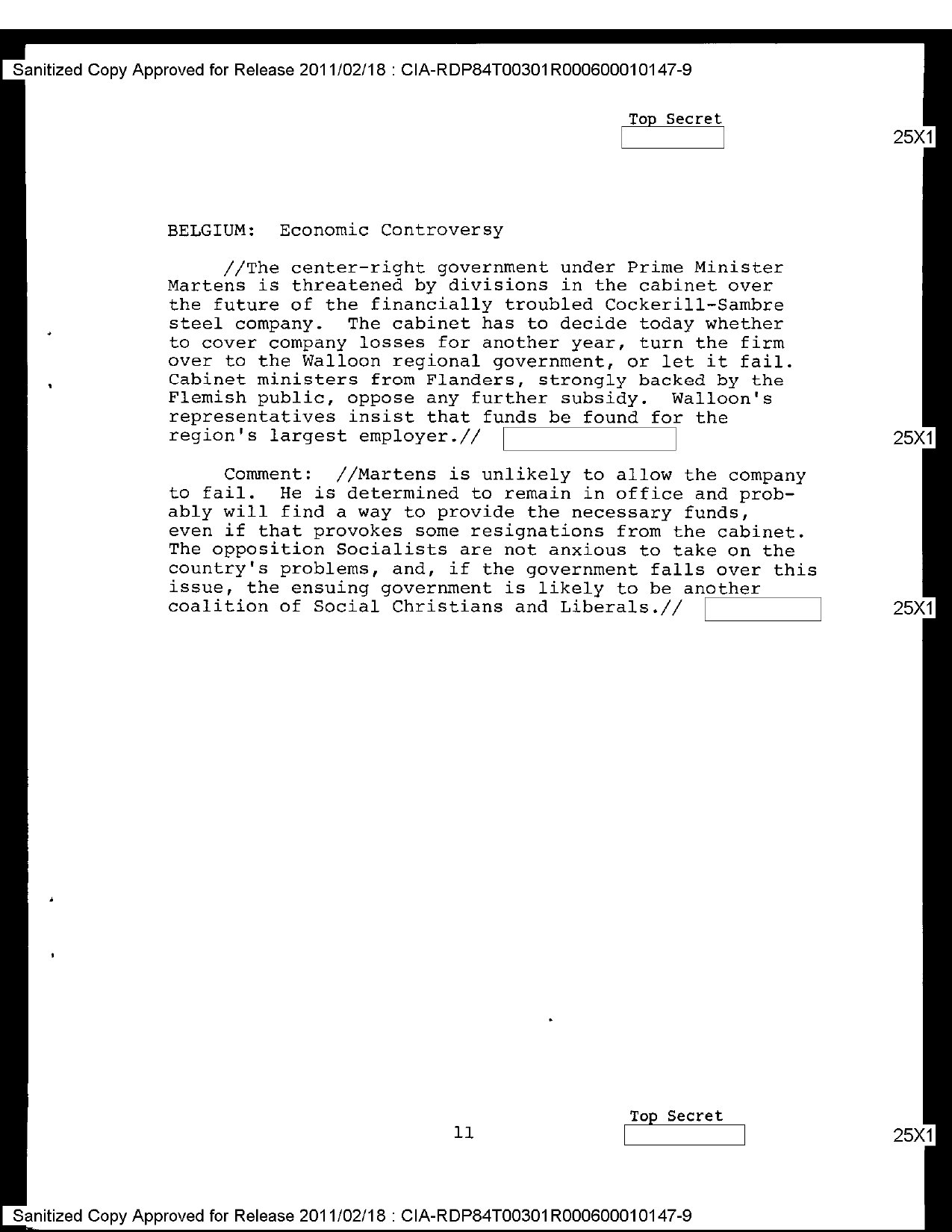
BELGIUM: Economic Controversy
//The center-right government under Prime Minister Martens is threatened by divisions in the cabinet over the future of the financially troubled Cockerill-Sambre steel company. The cabinet has to decide today whether to cover company losses for another year, turn the firm over to the Walloon regional government, or let it fail. Cabinet ministers from Flanders, strongly backed by the Flemish public, oppose any further subsidy. Walloon’s representatives insist that funds be found for the region’s largest employer.//
Comment: Martens is unlikely to allow the company to fail. He is determined to remain in office and probably will find a way to provide the necessary funds, even if that provokes some resignations from the cabinet. The opposition Socialists are not anxious to take on the country’s problems, and, if the government falls over this issue, the ensuing government is likely to be another coalition of Social Christians and Liberals.//
Source:
Link:
Internal Link:
Date:
December 10, 1982