Suriname: Threats to the Bouterse Regime – 25 September 1986 (better version)
CIA-RDP86T01017R000707410001-1
Washington DC 20505
DIRECTORATE OF INTELLIGENCE
25 September 1986
DATE: 9/26/84
FILE
DOC NO: ALA M 86-20048
OIR: 3
P &PD/
SURINAME: THREATS TO THE BOUTERSE REGIME
Summary
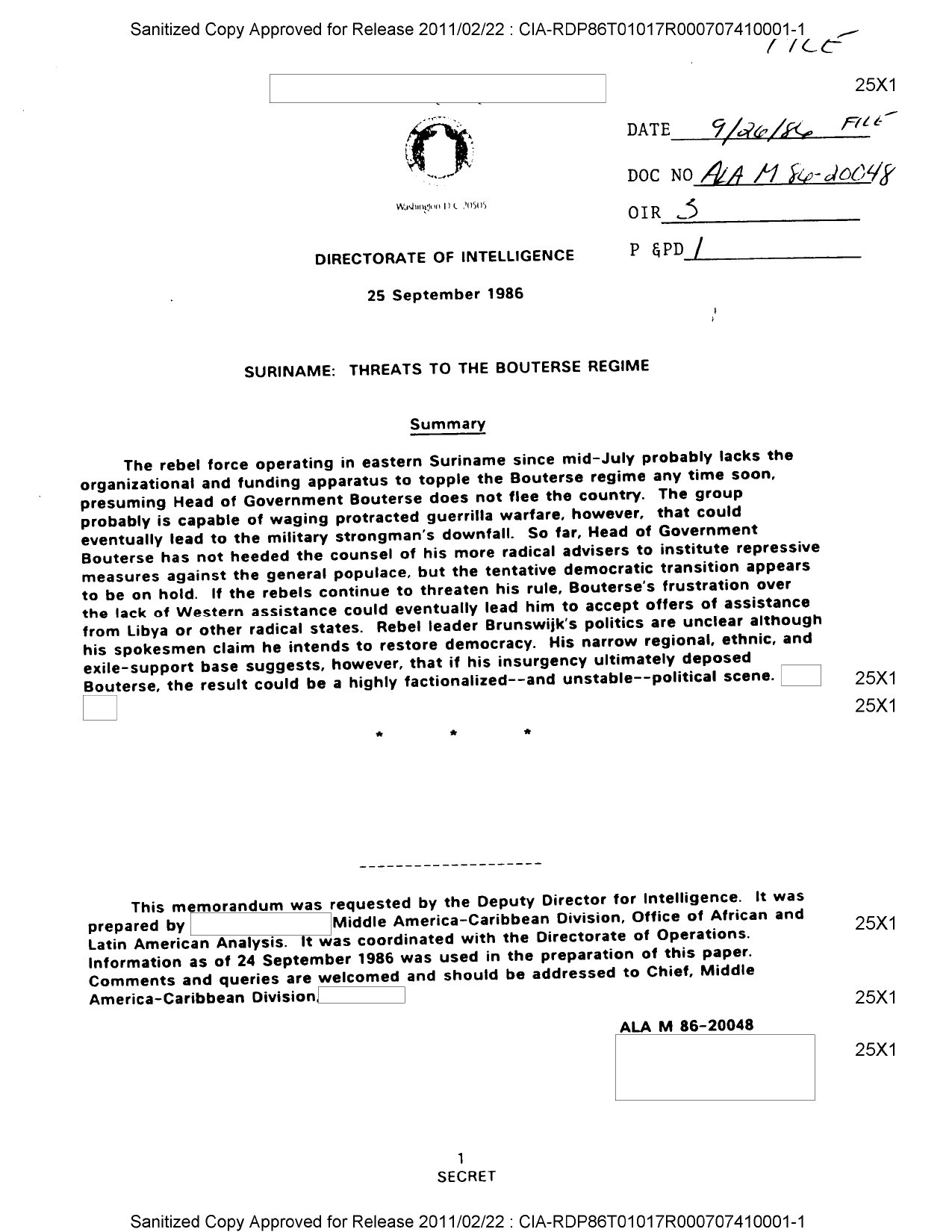
The rebel force operating in eastern Suriname since mid-July probably lacks the organizational and funding apparatus to topple the Bouterse regime any time soon, presuming Head of Government Bouterse does not flee the country. The group probably is capable of waging protracted guerrilla warfare, however, that could eventually lead to the military strongman’s downfall.
So far, Head of Government Bouterse has not heeded the counsel of his more radical advisers to institute repressive measures against the general populace, but the tentative democratic transition appears to be on hold. If the rebels continue to threaten his rule, Bouterse’s frustration over the lack of Western assistance could eventually lead him to accept offers of assistance from Libya or other radical states.
Rebel leader Brunswijk’s politics are unclear although his spokesmen claim he intends to restore democracy. His narrow regional, ethnic, and exile-support base suggests, however, that if his insurgency ultimately deposed Bouterse, the result could be a highly factionalized—and unstable—political scene.
This memorandum was requested by the Deputy Director for Intelligence. It was prepared by Middle America-Caribbean Division, Office of African and Latin American Analysis. It was coordinated with the Directorate of Operations. Information as of 24 September 1986 was used in the preparation of this paper.
Comments and queries are welcomed and should be addressed to Chief, Middle America-Caribbean Division.
SECRET
[CENSORED] [CENSORED] [CENSORED] [CENSORED]
ALA M 86-20048
[CENSORED]
State of the Insurgency
Since mid-July, at least seven confirmed rebel attacks have occurred in eastern Suriname, bringing acknowledged military casualties to about 19 and possible defections to more than a dozen in the 2,000-man Army. There have been no confirmed reports of casualties in the rebel force. Since the last substantiated rebel attack occurred in early September, rumors of continued fighting in the east have persisted.
Several factors could help rebel leader Ronnie Brunswijk sustain an insurgency indefinitely in the east:
- Brunswijk, a Bush Negro, is operating in jungle area he knows well and reportedly is receiving at least some assistance from the Bush Negroes who control much of eastern Suriname.
- Suriname’s porous border with French Guiana should allow Brunswijk to maintain open supply and communications lines.
- His hit-and-run guerrilla tactics will probably keep the Surinamese Army off-balance.
- Brunswijk’s escape from imprisonment for an alleged bank robbery and his ability to elude capture have added to his mystique—some Surinamese soldiers reportedly even believe he holds supernatural powers.
- Brunswijk is receiving some financial, organizational, and propaganda support from Surinamese exile groups headquartered in the Netherlands, although the extent of their assistance to and control over Brunswijk is unclear.
Despite these strengths, Brunswijk’s military and political capabilities appear limited at present.
He lacks the funds, supplies, and manpower necessary to launch a major offensive on the capital of Paramaribo.
- In addition, we have no reliable reporting that exile leaders or Brunswijk have developed ties with Bouterse’s potential opponents within Suriname’s political and military establishment, or that they have tried to pave the way for a takeover by cultivating the support of the general populace.
- The longer-term prospects for Brunswijk’s insurgency are also hampered by his Bush Negro background and reputation as a common criminal. Bush Negroes constitute only about 10 percent of the Surinamese population and have never been important players in Surinamese politics, which are dominated by Hindustanis and Creoles.
[CENSORED] [CENSORED] [CENSORED] [CENSORED] [CENSORED]
SECRET
Bouterse’s Reaction
Despite the deployment of sizable military resources to eastern Suriname, the Army has yet to achieve a single clear-cut victory against the guerrillas or to capture any rebel leaders. Bouterse probably became convinced in August of the severity of the situation, when his most capable fighting force suffered as many as 15 casualties in a 50-man unit, and the unit’s commander reportedly defected.
Bouterse has apparently become concerned enough about the security situation to send his family to the US, ostensibly on a vacation.
Bouterse has not yet used the security crisis as an excuse to formally halt the democratization process. Nevertheless, he has publicly stated that the insurgency must be put down before democracy can be restored.
Civilian support for the regime is thin and may erode quickly if Bouterse follows the advice of some hardliners to take harsher measures against the general populace. Many Bush Negroes have already become openly hostile to the government. Leaders of Suriname’s traditional parties and some labor unions have publicly supported Bouterse during the crisis, partly out of fear, but the populace has not rallied behind the Surinamese leader.
Foreign Involvement
Bouterse has sought military and economic assistance from the US, Brazil, France and the Netherlands to defeat the rebels, as well as cooperation from the French and Dutch in stopping rebel and exile activity on their soil.
So far, no Western country has given Bouterse material aid expressly for this purpose, nor have the French or Dutch curtailed exile or rebel activity in their jurisdictions. At the same time, we have no firm evidence that any Western power is lending Brunswijk material assistance.
SECRET
[CENSORED] [CENSORED] [CENSORED] [CENSORED] [CENSORED] [CENSORED] [CENSORED] [CENSORED]
Prospects and Alternative Scenarios
The regime seems unlikely to fall in the near-term unless Bouterse continues to lose the support of the military or the rebels dramatically improve their fundraising, supply, and political organization efforts. Nevertheless, if Bouterse were to leave the scene, there would be a substantial chance of prolonged instability. Unlike the case in 1980, when Bouterse and his group of sergeants seized power, the Army probably would not be united.
In the unlikely event that Brunswijk seized power, he would probably lack enough support in the military and civilian circles to consolidate his position. Little is known about Brunswijk’s political ideology or that of his associates. The claim that he has a political program calling for a return to democracy and severance of relations with such countries as Libya is obviously designed to win Western backing.
If the rebels were to turn to exile leaders to govern, factionalism among the disparate foreign groups would damage their ability to govern. Moreover, the traditional parties and labor unions that recently won some political concessions from Bouterse would be wary of cooperating with exiles, who lack internal support.
SECRET
[CENSORED] [CENSORED] [CENSORED] [CENSORED] [CENSORED] [CENSORED]
Distribution List
Orig – Requestor
1 – NIO
1 – NIC/AG, 2G40
1 – PDB Staff, 7F30
1 – C/PES, 6F44
1 – DDI/CPAS/ISS, 7G50
1 – D/ALA
2 – ALA/PS, 4F21 (1 copy with distribution list attached) (1 sourced copy)
1 – ALA Research Director, 3F44
4 – CPAS/IMC/CB, 7G07
1 – Division Files
1 – Branch Files
Source:
Link:
Internal Link:
Date:
September 25, 1986