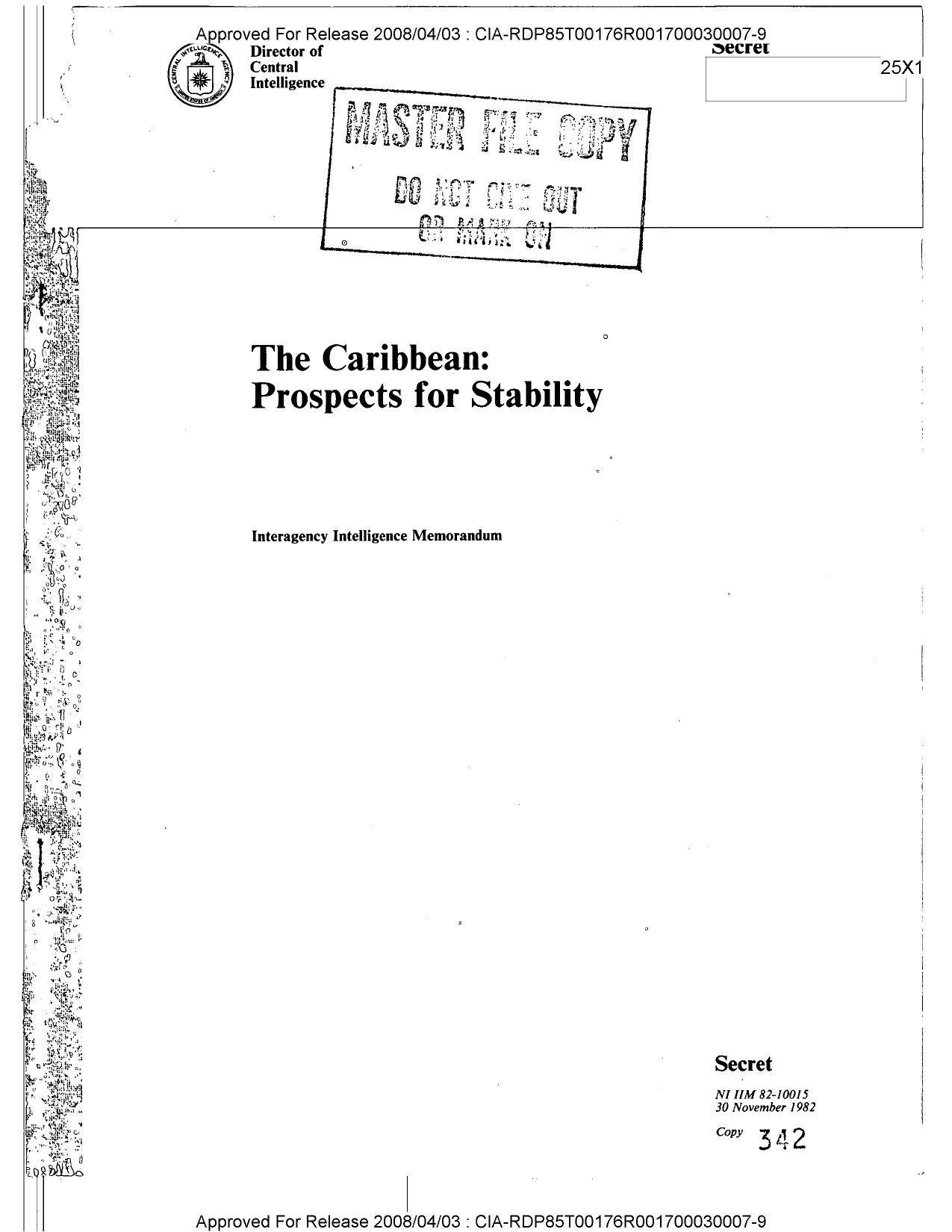
The Caribbean: Prospects for Stability 1982
CIA-RDP85T00176R001700030007-9
Scope Note
The United States has a significant interest in the Caribbean region because of economic and strategic considerations. The stability of the region is threatened by substantial economic pressures and by the attempts of unfriendly foreign countries, particularly Cuba, to expand their influence. An understanding of the forces that threaten Caribbean stability is essential for the framing of a US Caribbean policy that would best promote national objectives and the viability of the region. This report analyzes these forces and their impact over the next three years.
Preface
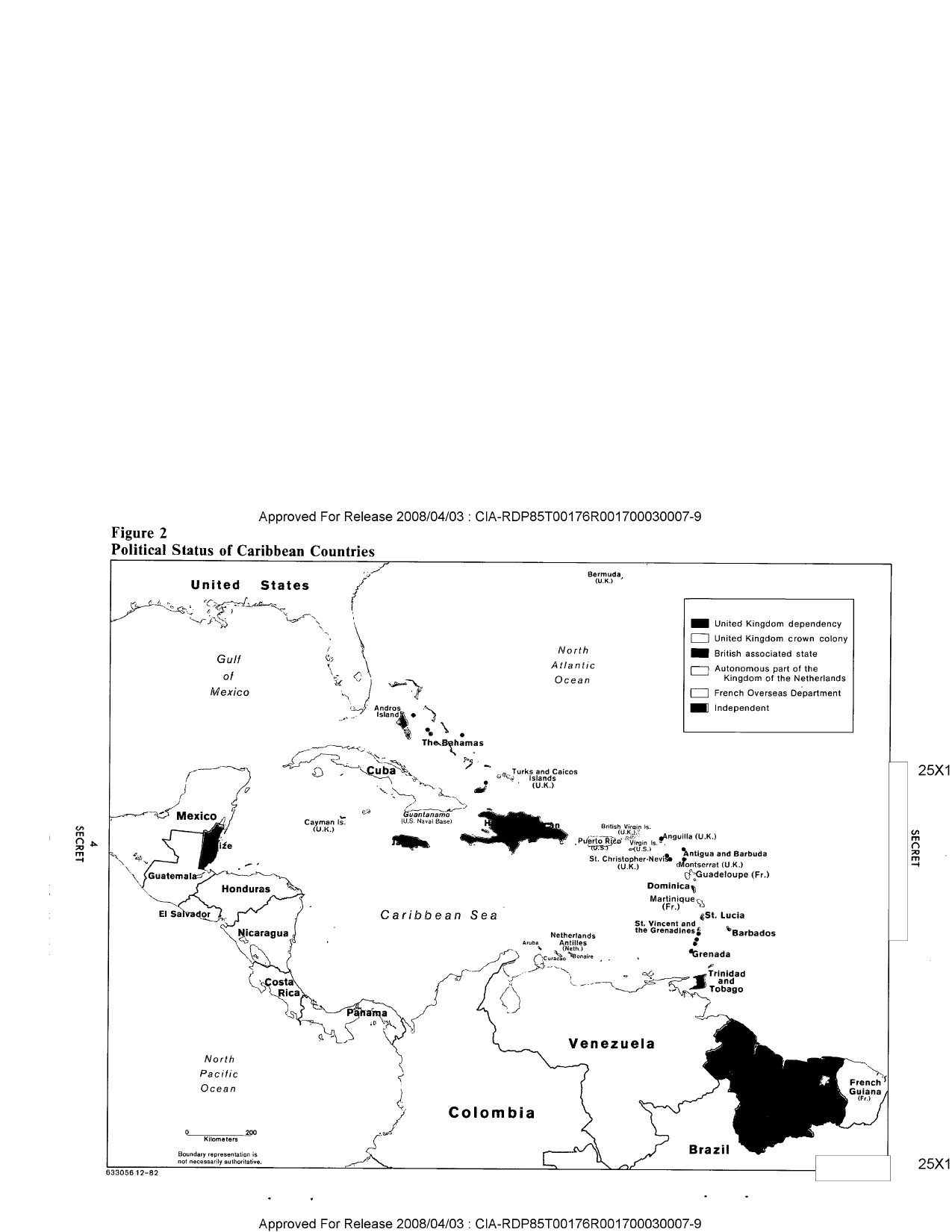
There are three broad geographical concepts of the Caribbean region: the Commonwealth Caribbean, the Caribbean archipelago, and the Caribbean Basin.
- The Commonwealth Caribbean refers to the English-speaking countries and territories of the region, including the mainland countries of Belize and Guyana.
- The archipelagic concept of the Caribbean loosely includes:
- all the islands in the Caribbean Sea,
- the Bahamas and the Turks and Caicos Islands in the Atlantic Ocean, and
- the mainland areas of Belize, Guyana, French Guiana, and Suriname.
- In its broadest sense, the Caribbean Basin includes all countries and territories of the Caribbean archipelago, plus all other mainland countries adjacent to the Caribbean Sea, from Mexico southward to Venezuela.¹
In this report, the Caribbean is defined as the countries of the Caribbean archipelago, excluding Cuba, Puerto Rico, and the US Virgin Islands. As US dependencies, Puerto Rico and the US Virgin Islands fall outside the scope of this report. Cuba is excluded, per se, to permit a focus on the Cuban influence on stability in the Caribbean, as opposed to prospects for stability within Cuba itself.
The Latin republics of Central America are omitted from the report because the dimensions of potential instability in those countries are markedly different from those of the Caribbean archipelago.
These geographical concepts are themselves flexible. For example, Bermuda is occasionally erroneously identified as a Caribbean country, as is El Salvador.
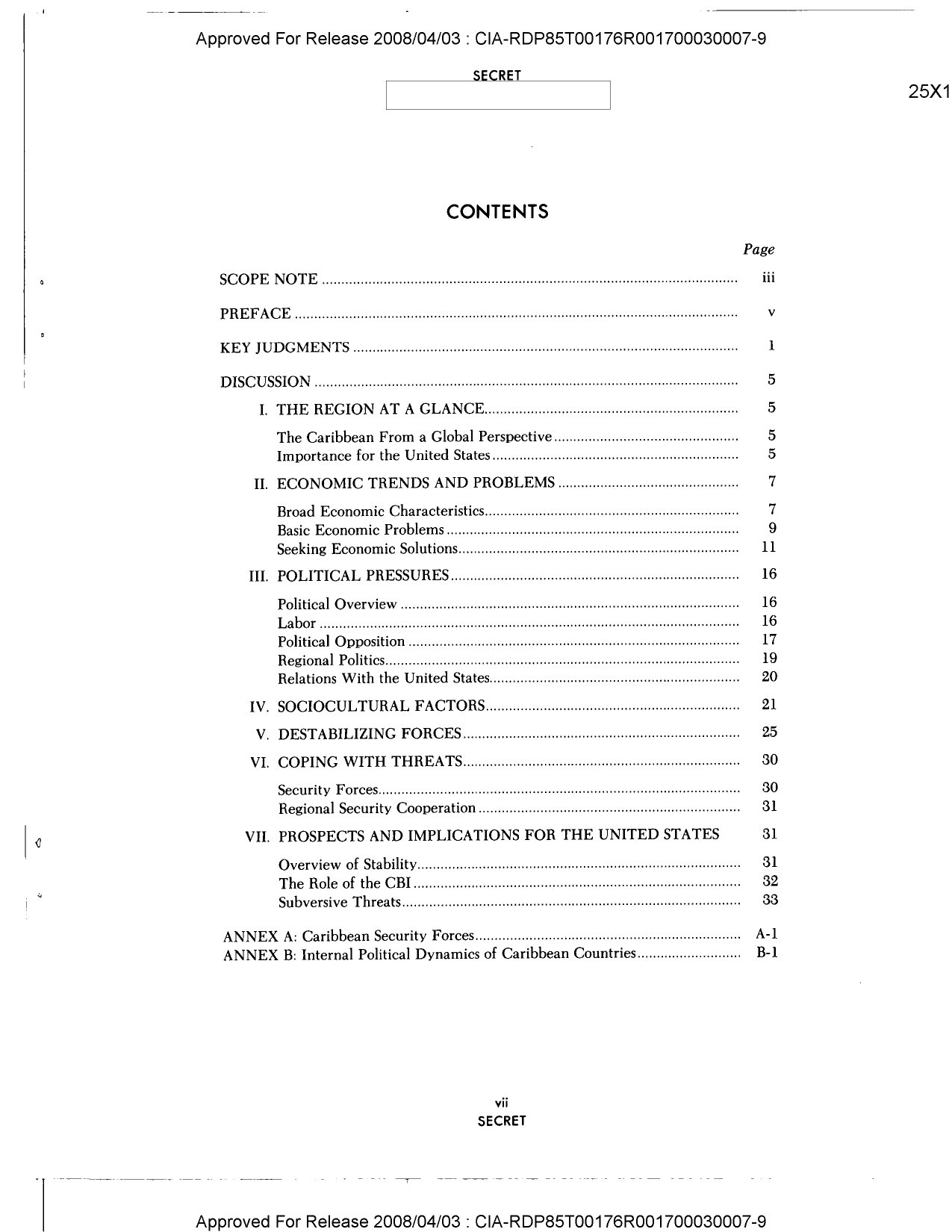
| Section | Subsection | Page |
|---|---|---|
| SCOPE NOTE | iii | |
| PREFACE | V | |
| KEY JUDGMENTS | 1 | |
| DISCUSSION | 5 | |
| I. THE REGION AT A GLANCE | The Caribbean From a Global Perspective | 5 |
| Importance for the United States | 5 | |
| II. ECONOMIC TRENDS AND PROBLEMS | Broad Economic Characteristics | 5 |
| Basic Economic Problems | 7 | |
| Seeking Economic Solutions | 7 | |
| III. POLITICAL PRESSURES | Political Overview | 9 |
| Labor | 11 | |
| Political Opposition | 16 | |
| Regional Politics | 16 | |
| Relations With the United States | 16 | |
| IV. SOCIOCULTURAL FACTORS | 17 | |
| 19 | ||
| 20 | ||
| 21 | ||
| V. DESTABILIZING FORCES | 25 | |
| VI. COPING WITH THREATS | Security Forces | 30 |
| Regional Security Cooperation | 31 | |
| VII. PROSPECTS AND IMPLICATIONS FOR THE UNITED STATES | Overview of Stability | 31 |
| The Role of the CBI | 32 | |
| Subversive Threats | 33 | |
| ANNEX A | Caribbean Security Forces | A-1 |
| ANNEX B | Internal Political Dynamics of Caribbean Countries | B-1 |
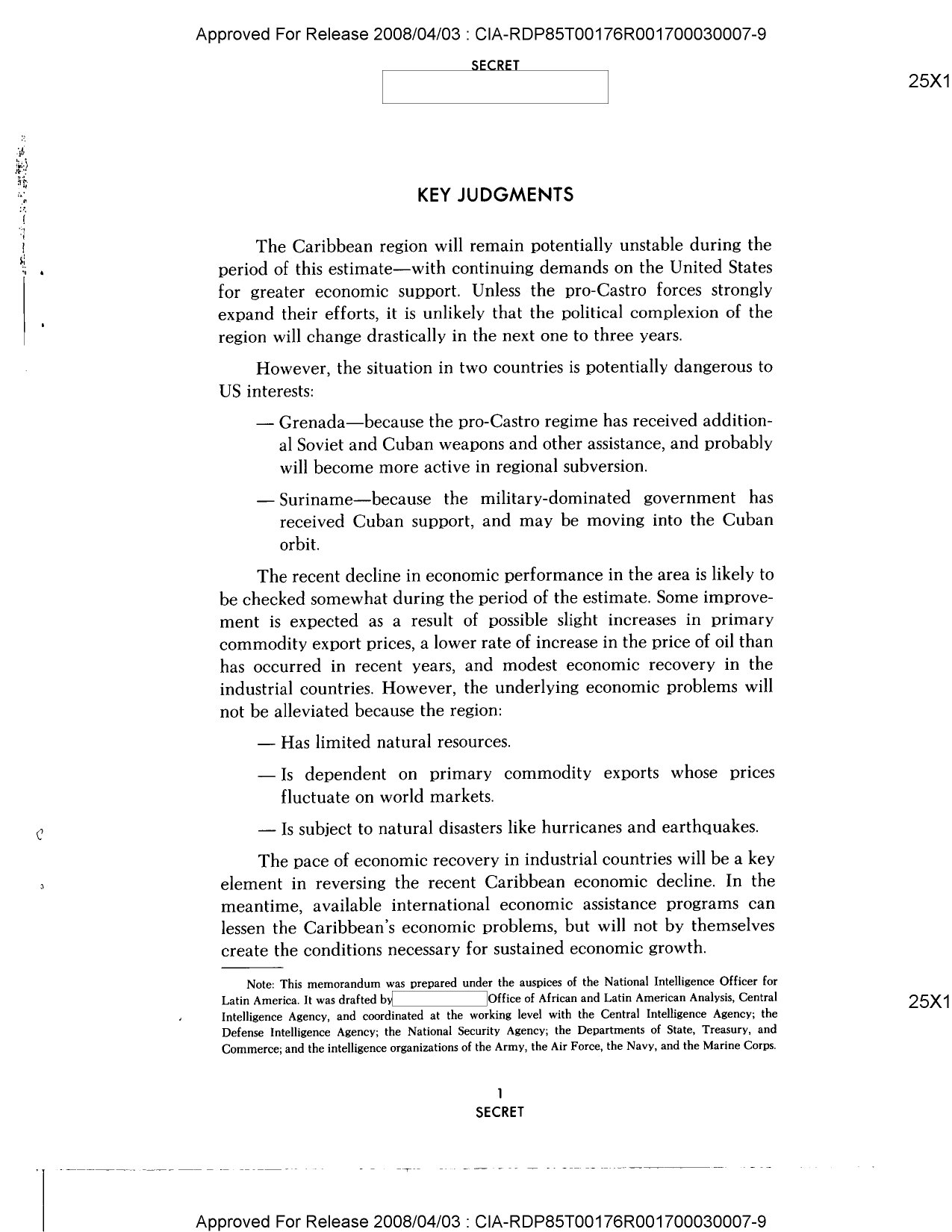
KEY JUDGMENTS
The Caribbean region will remain potentially unstable during the period of this estimate—with continuing demands on the United States for greater economic support. Unless the pro-Castro forces strongly expand their efforts, it is unlikely that the political complexion of the region will change drastically in the next one to three years.
However, the situation in two countries is potentially dangerous to US interests:
- Grenada — because the pro-Castro regime has received additional Soviet and Cuban weapons and other assistance, and probably will become more active in regional subversion.
- Suriname — because the military-dominated government has received Cuban support, and may be moving into the Cuban orbit.
The recent decline in economic performance in the area is likely to be checked somewhat during the period of the estimate. Some improvement is expected as a result of possible slight increases in primary commodity export prices, a lower rate of increase in the price of oil than has occurred in recent years, and modest economic recovery in the industrial countries. However, the underlying economic problems will not be alleviated because the region:
- Has limited natural resources.
- Is dependent on primary commodity exports whose prices fluctuate on world markets.
- Is subject to natural disasters like hurricanes and earthquakes.
The pace of economic recovery in industrial countries will be a key element in reversing the recent Caribbean economic decline. In the meantime, available international economic assistance programs can lessen the Caribbean’s economic problems, but will not by themselves create the conditions necessary for sustained economic growth.
Note: This memorandum was prepared under the auspices of the National Intelligence Officer for Latin America. It was drafted by the Office of African and Latin American Analysis, Central Intelligence Agency, and coordinated at the working level with the Central Intelligence Agency; the Defense Intelligence Agency; the National Security Agency; the Departments of State, Treasury, and Commerce; and the intelligence organizations of the Army, the Air Force, the Navy, and the Marine Corps.
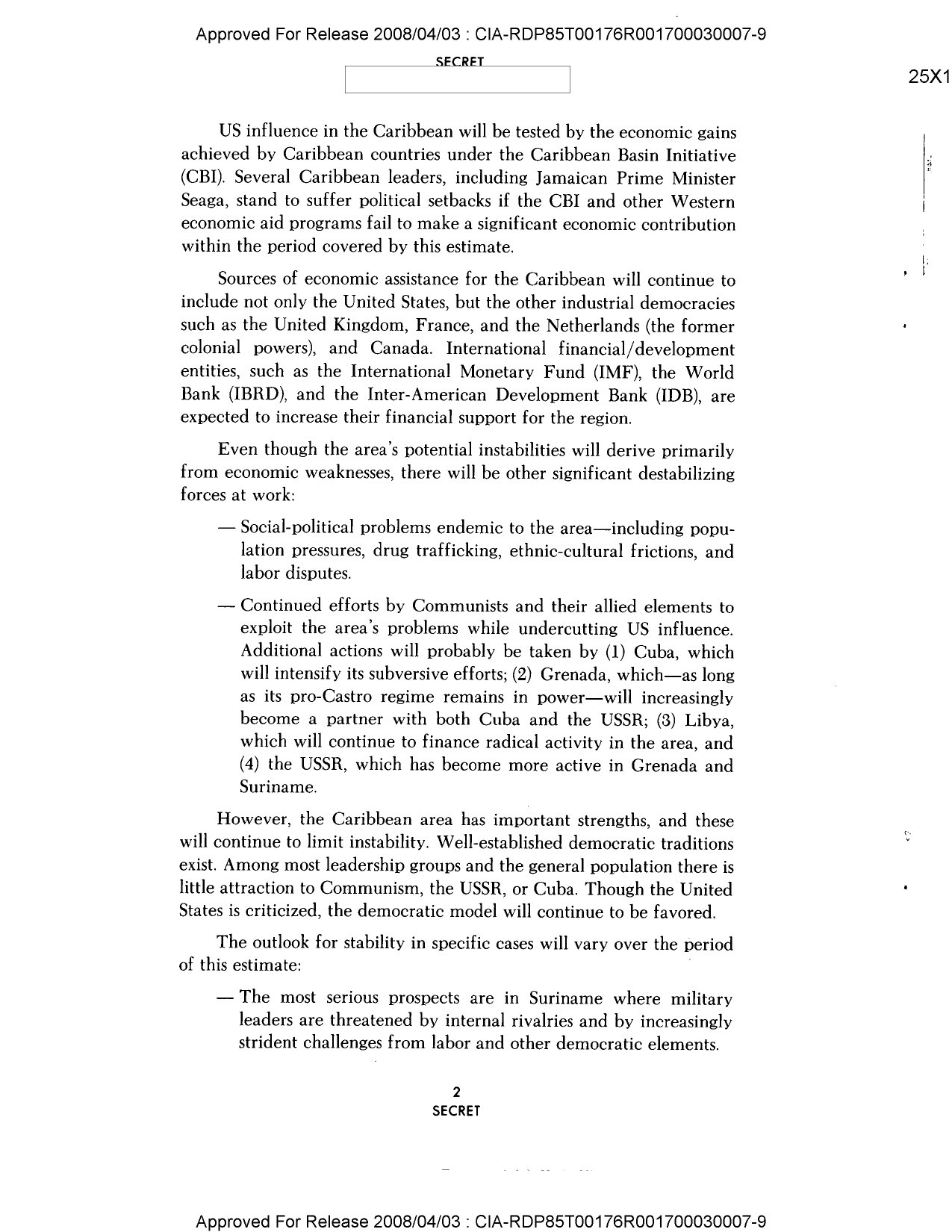
US influence in the Caribbean will be tested by the economic gains achieved by Caribbean countries under the Caribbean Basin Initiative (CBI). Several Caribbean leaders, including Jamaican Prime Minister Seaga, stand to suffer political setbacks if the CBI and other Western economic aid programs fail to make a significant economic contribution within the period covered by this estimate.
Sources of economic assistance for the Caribbean will continue to include not only the United States, but the other industrial democracies such as the United Kingdom, France, and the Netherlands (the former colonial powers), and Canada. International financial/development entities, such as the International Monetary Fund (IMF), the World Bank (IBRD), and the Inter-American Development Bank (IDB), are expected to increase their financial support for the region.
Even though the area’s potential instabilities will derive primarily from economic weaknesses, there will be other significant destabilizing forces at work:
- Social-political problems endemic to the area—including population pressures, drug trafficking, ethnic-cultural frictions, and labor disputes.
- Continued efforts by Communists and their allied elements to exploit the area’s problems while undercutting US influence.
- Additional actions will probably be taken by:
- Cuba, which will intensify its subversive efforts;
- Grenada, which—as long as its pro-Castro regime remains in power—will increasingly become a partner with both Cuba and the USSR;
- Libya, which will continue to finance radical activity in the area; and
- the USSR, which has become more active in Grenada and Suriname.
However, the Caribbean area has important strengths, and these will continue to limit instability. Well-established democratic traditions exist. Among most leadership groups and the general population there is little attraction to Communism, the USSR, or Cuba. Though the United States is criticized, the democratic model will continue to be favored.
The outlook for stability in specific cases will vary over the period of this estimate:
- The most serious prospects are in Suriname, where military leaders are threatened by internal rivalries and by increasingly strident challenges from labor and other democratic elements.
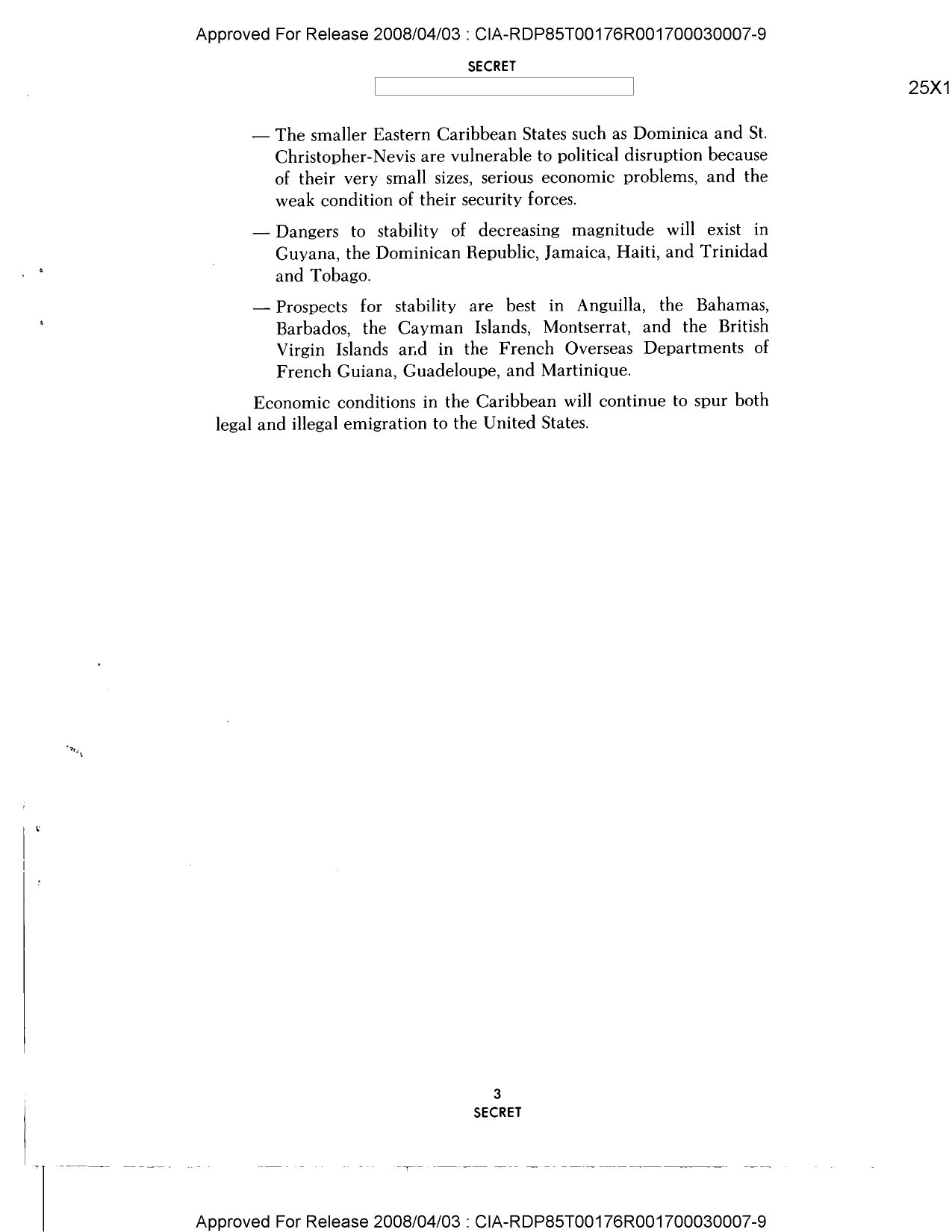
- The smaller Eastern Caribbean States such as Dominica and St. Christopher-Nevis are vulnerable to political disruption because of their very small sizes, serious economic problems, and the weak condition of their security forces.
- Dangers to stability of decreasing magnitude will exist in Guyana, the Dominican Republic, Jamaica, Haiti, and Trinidad and Tobago.
- Prospects for stability are best in Anguilla, the Bahamas, Barbados, the Cayman Islands, Montserrat, and the British Virgin Islands and in the French Overseas Departments: French Guiana, Guadeloupe, and Martinique.
Economic conditions in the Caribbean will continue to spur both legal and illegal emigration to the United States.
DISCUSSION
I. THE REGION AT A GLANCE
The Caribbean From a Global Perspective
The Caribbean has the world’s highest concentration of national governments relative to population or land area, with 14 independent nations among the 24 countries and territories in the region. The total population is a mere 18 million, about the same as New York State. If the four mainland countries (Belize, French Guiana, Guyana, and Suriname) are excluded, the remaining 20 countries and territories occupy a combined area of 111,000 square kilometers—about the size of Tennessee.
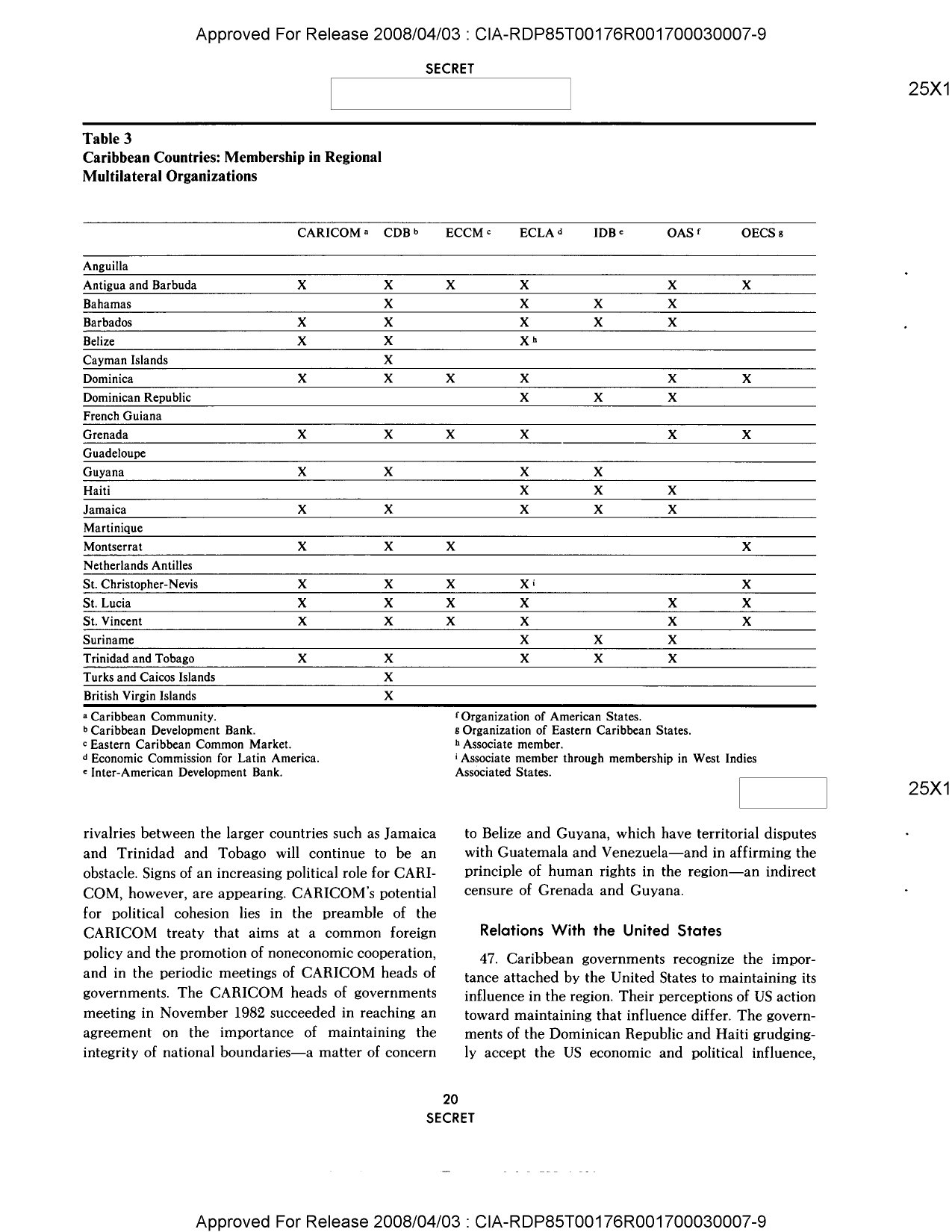
By their increasing presence in Latin American regional organizations like the Organization of American States (OAS), the Inter-American Development Bank (IDB), and the United Nations Economic Commission for Latin America (ECLA), Caribbean countries have acquired a growing potential for changing the original Latin characteristic of these organizations and for diluting the influence of the traditional members. They recognize the geographical rationale for linkages to Latin America, continue to maintain fairly close relationships with their former European colonizers, and are highly dependent on US trade and investment. With this choice of at least three political hats to wear in their external relations, Caribbean countries are potentially among the most inconsistent in their positions on specific issues of international politics.
Generally, they have pursued a policy of nonalignment in their external relations, but they remain pragmatic in these linkages and are interested in broadening relations with countries outside the region.
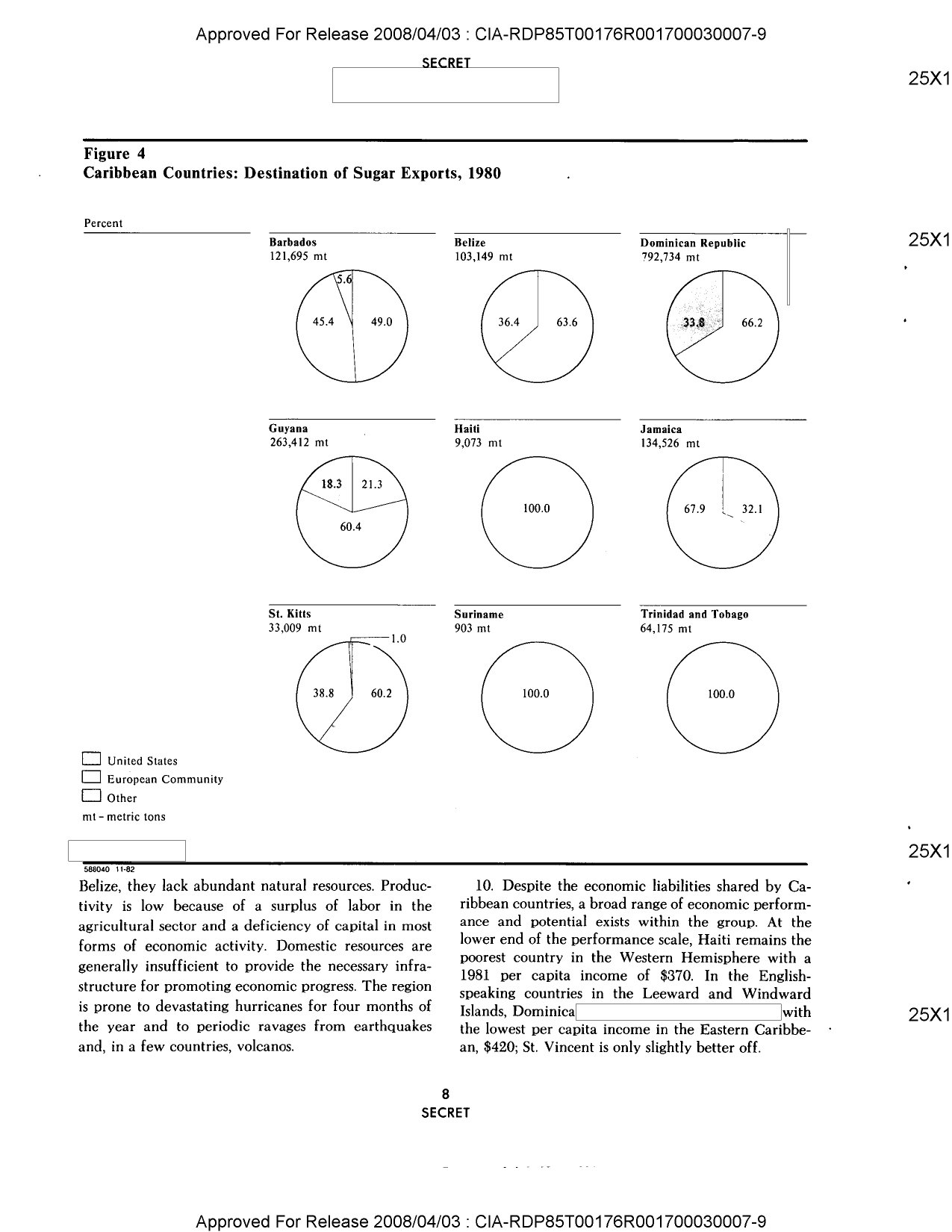
Caribbean countries produce less than 0.2 percent of the world’s total output and account for only 3 percent of the total gross national product (GNP) of Latin America. They are highly dependent on agricultural exports to the United States and the European Community (EC), but these exports are not crucial to the total supply in the importing countries. Sugar production, for example, is the largest source of employment in the Caribbean, and the region accounts for 45 percent of EC sugar imports. The EC, however, has a sugar surplus and imports Caribbean sugar under the terms of preferential arrangements made with former European colonies in Africa, the Caribbean, and the Pacific, including Barbados, Guyana, Jamaica, Suriname, and Trinidad and Tobago.
Caribbean banana exports also provide substantial domestic employment and account for 21 percent of EC banana imports, but countries outside the Caribbean have larger potential supplies and better quality fruit. The Caribbean share in the world market for sugar and bananas owes more to EC trade concessions than to competitiveness.
Importance for the United States
Trade and Investment
The United States has significant economic interests in the Caribbean. US net private direct investment in the Caribbean was about $5 billion in 1981, with most of it in the petroleum and bauxite industries. (This total excludes a large negative investment position in the Netherlands Antilles, largely because of US assets held by Netherlands Antilles financial corporations.) US exports to the region in 1981 totaled $4 billion—mainly food, consumer goods, and capital equipment. Imports from the Caribbean were $8 billion, 72 percent of which were oil imports. The region supplies about 80 percent of US imports of bauxite and alumina. The United States is the Caribbean’s most important trading partner, taking about 60 percent of the exports and providing some 16 percent of the imports in 1981.
Strategic Considerations
The Caribbean is adjacent to the southern shores of the United States, contains vital shipping lanes, and provides access to the Panama Canal. Nearly one-half of US trade goes through the Panama Canal and the Gulf of Mexico, including two-thirds of US oil imports and one-half of US imports of strategic minerals. Grenada, Cuba, and Nicaragua form a triangle within which most sea lines of communication in the Caribbean could be threatened in case of general hostilities. In Grenada, the construction of a major airport, expansion of military facilities, and possible expansion of port facilities will improve the Soviet/Cuban capability to project their influence in the region. Cuban use of the airport already is being considered for supporting Havana’s activities in Africa.
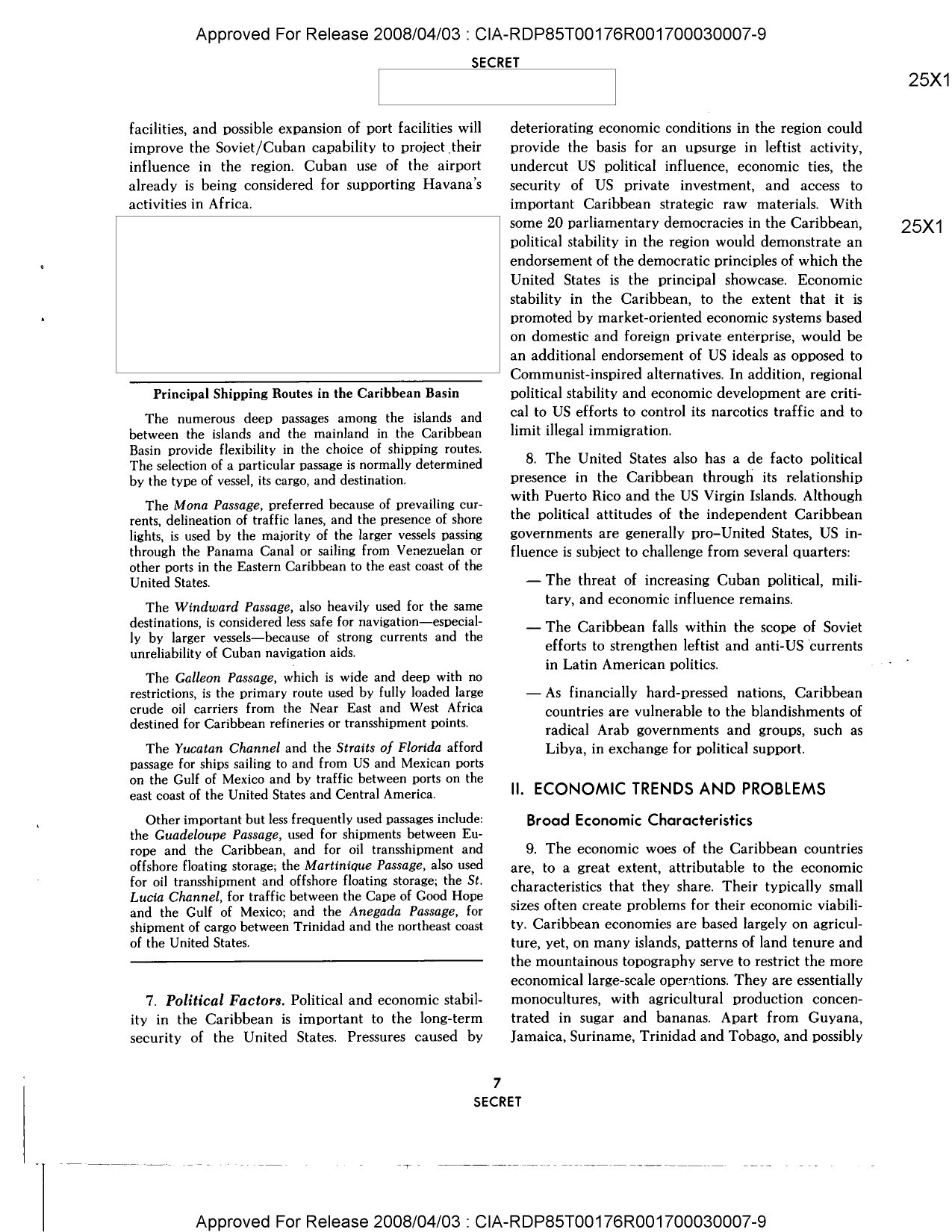
Principal Shipping Routes in the Caribbean Basin
The numerous deep passages among the islands and between the islands and the mainland in the Caribbean Basin provide flexibility in the choice of shipping routes. The selection of a particular passage is normally determined by the type of vessel, its cargo, and destination.
- The Mona Passage, preferred because of prevailing currents, delineation of traffic lanes, and the presence of shore lights, is used by the majority of the larger vessels passing through the Panama Canal or sailing from Venezuelan or other ports in the Eastern Caribbean to the east coast of the United States.
- The Windward Passage, also heavily used for the same destinations, is considered less safe for navigation—especially by larger vessels—because of strong currents and the unreliability of Cuban navigation aids.
- The Galleon Passage, which is wide and deep with no restrictions, is the primary route used by fully loaded large crude oil carriers from the Near East and West Africa destined for Caribbean refineries or transshipment points.
- The Yucatan Channel and the Straits of Florida afford passage for ships sailing to and from US and Mexican ports on the Gulf of Mexico and by traffic between ports on the east coast of the United States and Central America.
Other important but less frequently used passages include:
- The Guadeloupe Passage, used for shipments between Europe and the Caribbean, and for oil transshipment and offshore floating storage;
- The Martinique Passage, also used for oil transshipment and offshore floating storage;
- The St. Lucia Channel, for traffic between the Cape of Good Hope and the Gulf of Mexico; and
- The Anegada Passage, for shipment of cargo between Trinidad and the northeast coast of the United States.
Political Factors
Political and economic stability in the Caribbean is important to the long-term security of the United States. Pressures caused by deteriorating economic conditions in the region could provide the basis for an upsurge in leftist activity, undercut US political influence, economic ties, the security of US private investment, and access to important Caribbean strategic raw materials.
With some 20 parliamentary democracies in the Caribbean, political stability in the region would demonstrate an endorsement of the democratic principles of which the United States is the principal showcase. Economic stability in the Caribbean, to the extent that it is promoted by market-oriented economic systems based on domestic and foreign private enterprise, would be an additional endorsement of US ideals as opposed to Communist-inspired alternatives. In addition, regional political stability and economic development are critical to US efforts to control its narcotics traffic and to limit illegal immigration.
The United States also has a de facto political presence in the Caribbean through its relationship with Puerto Rico and the US Virgin Islands. Although the political attitudes of the independent Caribbean governments are generally pro-United States, US influence is subject to challenge from several quarters:
- The threat of increasing Cuban political, military, and economic influence remains.
- The Caribbean falls within the scope of Soviet efforts to strengthen leftist and anti-US currents in Latin American politics.
- As financially hard-pressed nations, Caribbean countries are vulnerable to the blandishments of radical Arab governments and groups, such as Libya, in exchange for political support.
II. ECONOMIC TRENDS AND PROBLEMS
Broad Economic Characteristics
The economic woes of the Caribbean countries are, to a great extent, attributable to the economic characteristics that they share. Their typically small sizes often create problems for their economic viability. Caribbean economies are based largely on agriculture, yet, on many islands, patterns of land tenure and the mountainous topography serve to restrict the more economical large-scale operations. They are essentially monocultures, with agricultural production concentrated in sugar and bananas. Apart from Guyana, Jamaica, Suriname, Trinidad and Tobago, and possibly Belize, they lack abundant natural resources. Productivity is low because of a surplus of labor in the agricultural sector and a deficiency of capital in most forms of economic activity. Domestic resources are generally insufficient to provide the necessary infrastructure for promoting economic progress. The region is prone to devastating hurricanes for four months of the year and to periodic ravages from earthquakes and, in a few countries, volcanos.
Despite the economic liabilities shared by Caribbean countries, a broad range of economic performance and potential exists within the group. At the lower end of the performance scale, Haiti remains the poorest country in the Western Hemisphere with a 1981 per capita income of $370. In the English-speaking countries in the Leeward and Windward Islands, Dominica has the lowest per capita income in the Eastern Caribbean, $420; St. Vincent is only slightly better off.
The Bahamas is among the more successful countries, with the highest per capita income in the region ($7,200 in 1981) and an economy based on tourism and offshore banking. Because of oil, Trinidad and Tobago has international reserves of $3 billion—75 percent of the region’s total. Barbados, although currently hurting from the global recession, has the third highest per capita income, largely due to effective government and gains in tourism and light manufactures.
The French Overseas Departments of Guadeloupe, Martinique, and French Guiana are among the front rank of Caribbean countries in terms of economic performance. In Martinique and Guadeloupe the infrastructure is fairly well developed. Wage levels and social services are comparable with those of metropolitan France because of French Government policy, and large injections of economic assistance from the metropole help to bolster the economies. The Netherlands Antilles also is relatively prosperous, due to Dutch generosity, petroleum refining, and a vibrant tourist industry.
Basic Economic Problems
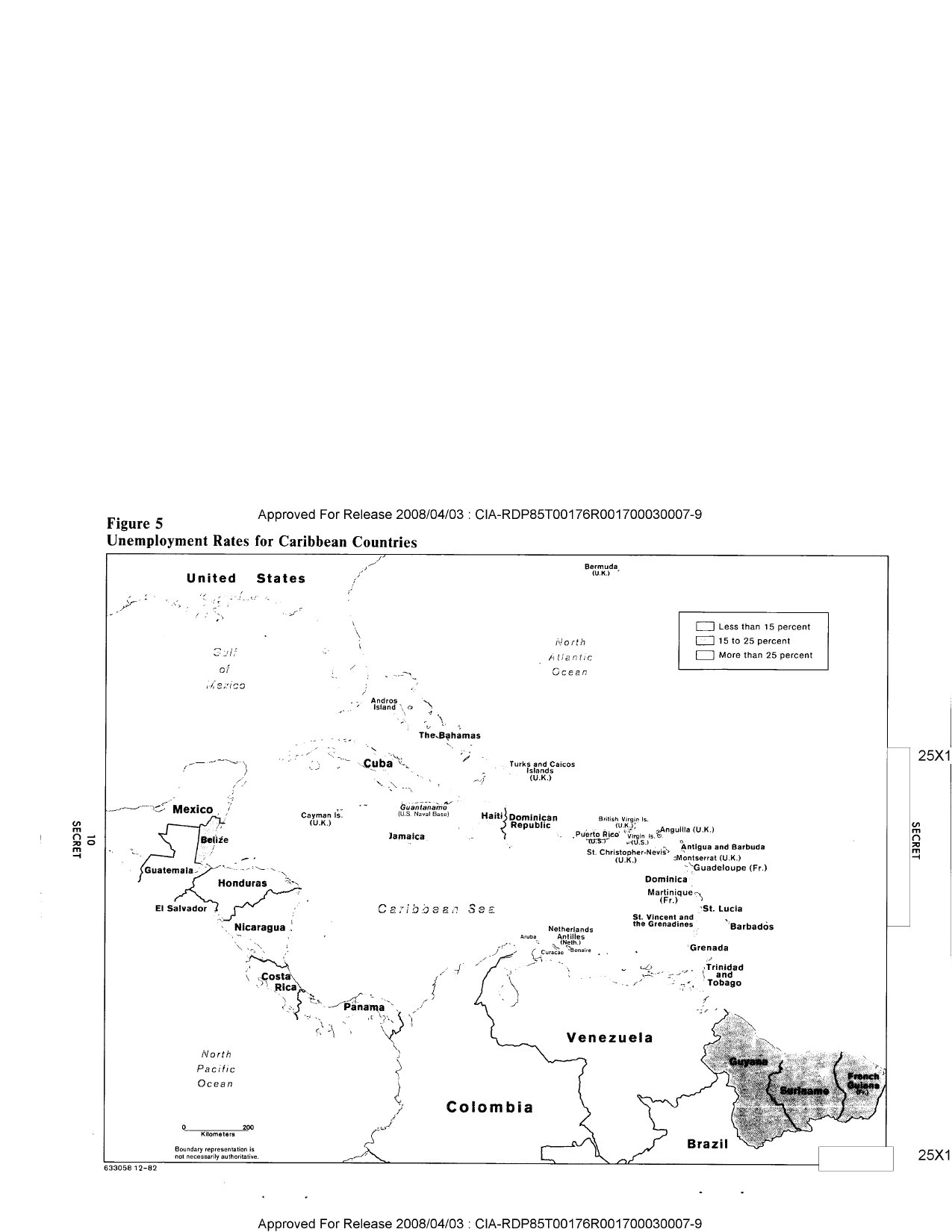
Caribbean governments are all confronted with rapid population growth (eased only by migration), a rising proportion of young people in the population, chronic unemployment that is typically 25 percent of the labor force, inadequate infrastructures—particularly for transportation and power supply—and a hemorrhage of professional and managerial talent seeking better conditions abroad. Unfavorable external trade relations also have contributed to the internal economic problems of the Caribbean countries as a group.
They are buffeted by high prices for imported oil and manufactured goods that help to fuel domestic inflation and by fluctuating world market prices for their exported commodities. Chronic balance-of-payments deficits are the rule, even when commodity prices move in their favor. As a result, foreign capital inflows are vital for keeping the Caribbean economies afloat.
As Caribbean countries try to promote their economic development, they are caught in a web of budgetary deficits and rising external debt.
Jamaica is having a difficult time reversing almost a decade of economic decline. Economic growth of 2 percent in 1981 was largely attributable to massive injections of foreign aid. The direct foreign investment inflows that the Jamaican authorities expect to spur economic recovery have not yet been forthcoming, despite hundreds of projects on the drawing boards. Sagging world demand for aluminum has led to drastic cuts in bauxite and alumina production—Jamaica’s largest foreign exchange earner. Agricultural production continues to falter. The country has been unable to fill its guaranteed United Kingdom banana import quota. The manufacturing sector is still plagued with a shortage of imported raw materials because of foreign exchange pressures. Chronic electric power failures due to rundown equipment have so disrupted manufacturing, tourism, and the economy in general that a US-owned power barge has been temporarily brought in from Guam to support the local power grid. Unemployment remains high, at over 25 percent of the labor force.
The Dominican Republic’s economy is caught in a pincer of falling sugar export prices (due to a glut on world markets and the projected impact of US import quota reductions) and high prices for imported oil. Sugar export prices are presently 60 percent lower than in 1980. The market for ferronickel, the second largest export, also is weak. Unemployment is running at over 25 percent of the labor force. The longer term outlook for Dominican sugar is not good as corn sweeteners continue to make inroads in the US market to which the Dominican Republic is the chief exporter.
Trinidad and Tobago, with an economy dominated by petroleum, has been experiencing declining petroleum sector production since 1978 because of natural depletion, technical difficulties, and government conservation policies. Largely as a result, real economic growth fell to 1 percent in 1981 compared to an average 4 percent in 1977–80. Agricultural production declined for five consecutive years through 1981, and the Trinidadian economy is saddled with a decrepit infrastructure (particularly in telecommunications and electricity services), a relatively high inflation rate of 12 percent (despite price controls and government subsidies), and escalating labor costs as labor unions try to maintain real wage levels.
Guyana’s economic situation is perilous because of weak exports and government policies aimed at suppressing the private sector—inefficient state-run enterprises account for 80 percent of economic activity. Principal exports (sugar and bauxite) have been hard hit by declining world markets, and rice production is down. There is a shortage of food, spare parts, and other essential items. The economy is on the verge of bankruptcy with international reserves of $6 million, equal to less than one week’s imports.
In the Eastern Caribbean, Barbados remains heavily dependent on tourism and sugar, and the expanding light industry sector is not yet robust enough to cushion a simultaneous decline in these two economic mainstays. Dominica’s ramshackle infrastructure, ravaged by hurricanes in 1979 and 1980, remains a serious impediment to new foreign investment and the marketing of agricultural products. St. Vincent has one of the more fragile economies in the region based on agricultural exports, principally bananas, that are under a standing threat from hurricanes and volcanic activity.
Elsewhere, Haiti is undergoing persistent economic deterioration, exacerbated since 1980 by a plunge in coffee production and prices, unfavorable weather conditions, and some loss of private-sector confidence in the government’s economic management. The economy of Suriname has been stagnant since 1979, with declining demand in the bauxite sector and general economic uncertainty among foreign investors following the 1980 military takeover.
Seeking Economic Solutions
Broad Economic Policies
Caribbean governments have adopted similar broad policies toward solving their economic problems. Nearly all of them need to adopt economic stabilization measures to reduce their current account deficits. Some have IMF agreements on stabilization, but performance has been uneven.
Most Caribbean countries frame their economic development plans in terms of revitalizing and diversifying agricultural production, expanding light manufacturing for export, and promoting tourism. The adverse impact of recession in industrial nations on economic conditions in Caribbean countries has prompted many governments to attempt a more efficient approach to economic management. The level of commitment to change varies because of the possible political repercussions of curbed government spending. There has been no shift away from government social programs, despite financial constraints. Substantial public-sector wage increases have been granted and appear to have been aimed at tempering unrest as well as correcting past deficiencies. In Barbados, central government current expenditures rose 31 percent in 1981, largely because of higher welfare payments and an increased government payroll. Wage increases significantly contributed to deteriorated public finances in St. Christopher-Nevis (St. Kitts) and St. Lucia. Montserrat, on the other hand, so improved its public finances through good revenue performances and prudent expenditures that it decided to discontinue the grant-aided status formerly accorded it by the United Kingdom.
Foreign Investment
The receptiveness of Caribbean governments to foreign investment is warming, prodded by economic necessity. They have been vociferous proponents of the New International Economic Order (NIEO) that advocates massive transfers of resources from industrial to Third World countries. Because these transfers have not been forthcoming, most Caribbean leaders now recognize that self-determination by Caribbean countries has little substance as long as the region remains a collection of mendicant nations. Also, direct investment inflows usefully supplement the grants and concessional loans that Caribbean countries have long relied on to finance their balance-of-payments deficits and promote economic growth. These grants and concessional loans have become less freely available because of slow economic growth and official budgetary restraint in countries of the Organization for Economic Cooperation and Development (OECD).
The general Caribbean economic environment is one of state capitalism and centralized government, with private-sector activity required to be compatible with national objectives. This policy of state capitalism is implemented even in those countries that promote private enterprise. For example, Jamaica owns substantial interests in the bauxite industry, provides telecommunication, railroad, and electricity services, and is involved in several other ventures, including the sugar industry and the national airline. The Bahamas owns a large share of the local hotel business, and the government of Trinidad and Tobago has full or part ownership of over 50 domestic companies.
Job Creation
In their efforts to promote economic development, Caribbean governments operate under institutional handicaps, in addition to natural ones. They suffer from a shortage of managerial and technical personnel and from cumbersome public administration. In the English-speaking countries, educational systems are out of tune with the vocational requirements of economic expansion in agriculture, industry, and tourism. Secondary school enrollment rates are much higher than they were in 1960, but the percentage enrollment in vocational training remains low. For example, it is 4 percent in Jamaica and 9 percent in Trinidad. (In South Korea and Taiwan, where rapid economic development has taken place, the vocational enrollment ratio is 16 to 18 percent.)
The result is large numbers of newly minted Caribbean secondary school graduates with aspirations to white-collar jobs that are not available or with skills that are not highly marketable.
Caribbean governments have belatedly recognized the problem of inadequate job training and are taking steps to correct it. In a new emphasis on technical and vocational education, Barbados—regarded as a regional leader in economic planning—opened a $10 million complex in May 1982 capable of training 3,000 students annually. Applications for admission have exceeded 4,000. In Jamaica, the Seaga government has launched a Human Employment and Resource Training Program (H.E.A.R.T.) to improve the marketable skills of job seekers.
Dependence on Foreign Resources
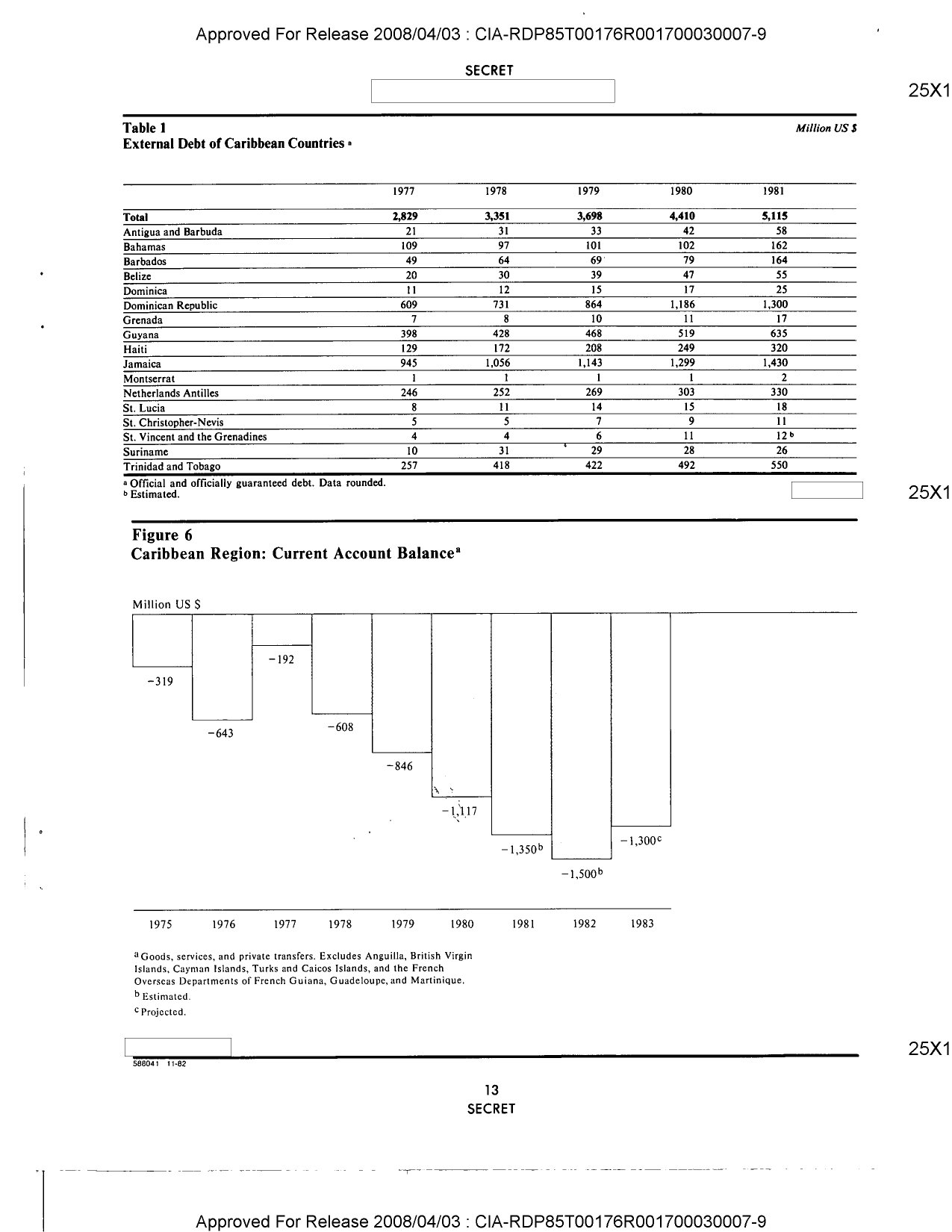
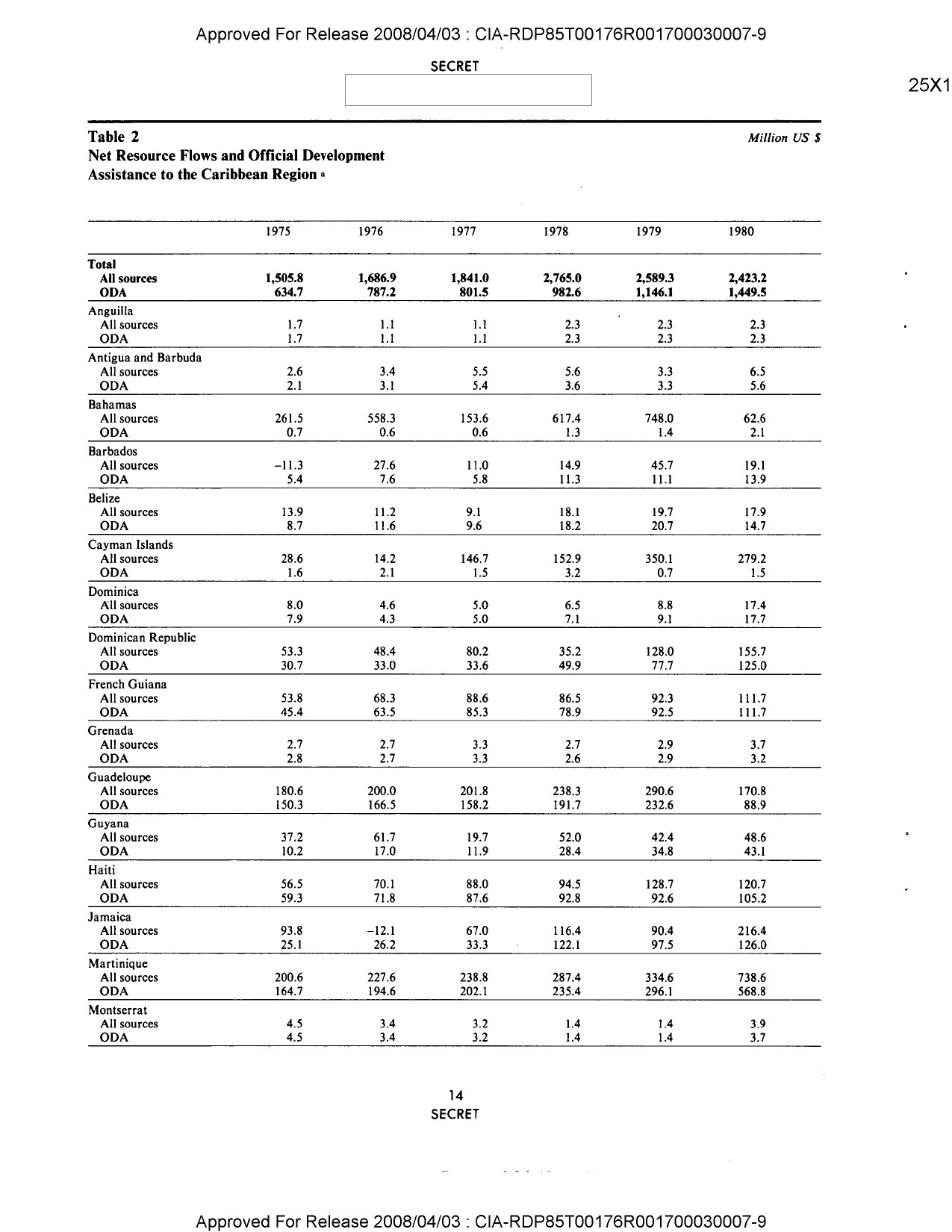
The combined balance-of-payments deficit of the Caribbean region has taken an alarming turn in recent years, with prolonged recession in industrial countries and a weakening in commodity export prices and tourism receipts. Excluding the French Overseas Departments and some minor territories, the current account deficit climbed progressively from $192 million in 1977 to an estimated $1.3 billion in 1981. Most of this deterioration was accounted for by the Dominican Republic and Jamaica.
As the Caribbean countries increased their borrowing to help finance the worsening current account positions, their total medium- and long-term external debt soared from $3 billion to $5 billion over the same period. We expect the current account deficit to rise to $1.5 billion this year, before falling back to $1.3 billion in 1983.
Caribbean countries have continued to rely heavily on external financing to keep their economies afloat. The net inflow of direct investment, loans, and official grants has been averaging a little over $1.6 billion annually since 1977 (excluding the three French Overseas Departments in the region). These inflows, however, have been falling relative to external financing requirements. Between 1977 and 1981, these external financing requirements, measured by the sum of current account deficits and official external debt amortization payments, soared from $392 million to $1.8 billion. For 1982, net inflows are projected at slightly over $1.5 billion compared with financing requirements of $2.0 billion.
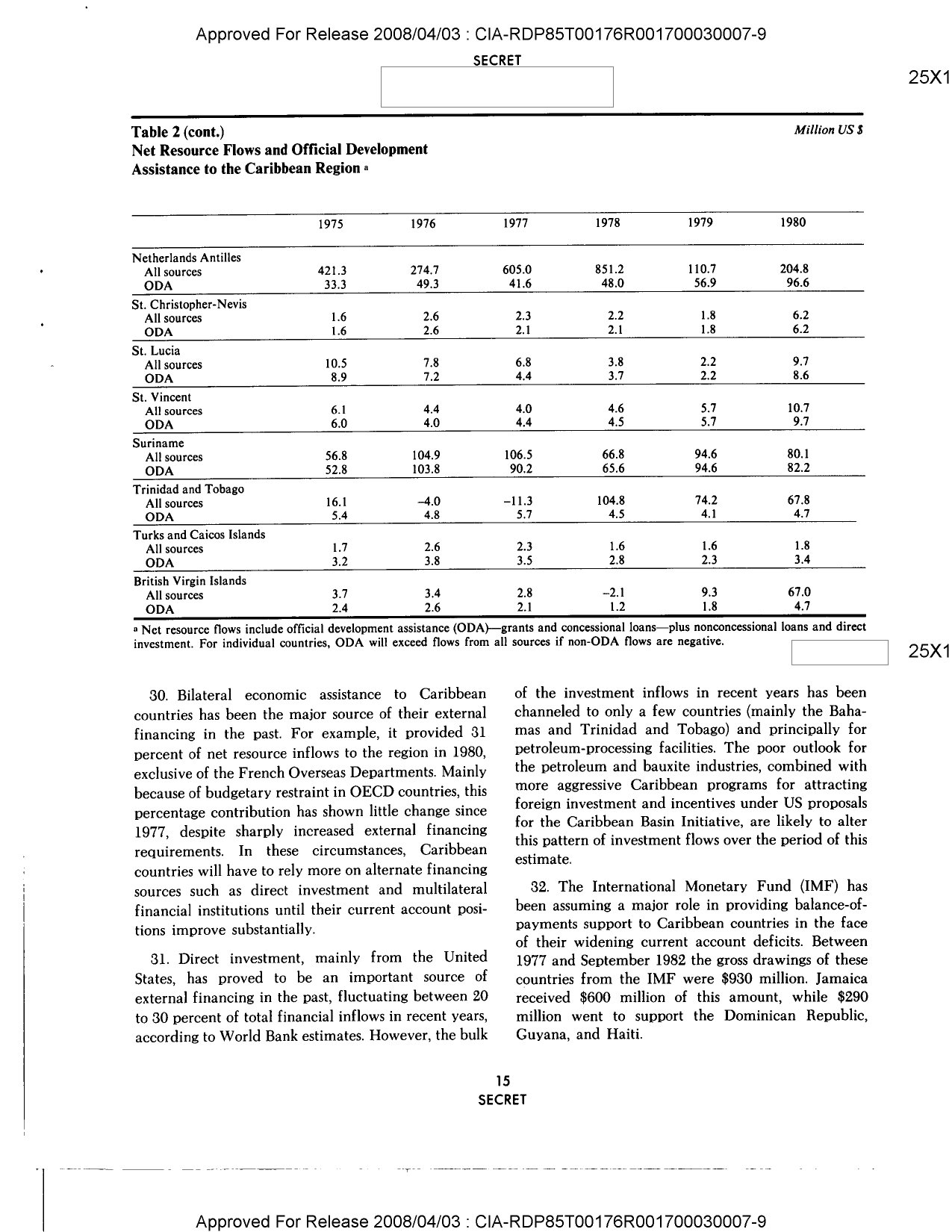
Official development assistance has been the major source of their external financing in the past. For example, it provided 31 percent of net resource inflows to the region in 1980, exclusive of the French Overseas Departments. Mainly because of budgetary restraint in OECD countries, this percentage contribution has shown little change since 1977, despite sharply increased external financing requirements. In these circumstances, Caribbean countries will have to rely more on alternate financing sources such as direct investment and multilateral financial institutions until their current account positions improve substantially.
Direct investment, mainly from the United States, has proved to be an important source of external financing in the past, fluctuating between 20 to 30 percent of total financial inflows in recent years, according to World Bank estimates. However, the bulk of the investment inflows in recent years has been channeled to only a few countries (mainly the Bahamas and Trinidad and Tobago) and principally for petroleum-processing facilities. The poor outlook for the petroleum and bauxite industries, combined with more aggressive Caribbean programs for attracting foreign investment and incentives under US proposals for the Caribbean Basin Initiative, are likely to alter this pattern of investment flows over the period of this estimate.
The International Monetary Fund (IMF) has been assuming a major role in providing balance-of-payments support to Caribbean countries in the face of their widening current account deficits. Between 1977 and September 1982, the gross drawings of these countries from the IMF were $930 million. Jamaica received $600 million of this amount, while $290 million went to support the Dominican Republic, Guyana, and Haiti.
The role of multilateral economic development institutions in Caribbean external financing is expanding but has not yet assumed major proportions. For example, 1981 loan approvals for Caribbean countries by the Caribbean Development Bank were $48 million. The Inter-American Development Bank approved $206 million. World Bank loan approvals for the region during its 1981–82 fiscal year totaled $192 million.
III. POLITICAL PRESSURES
Political Overview
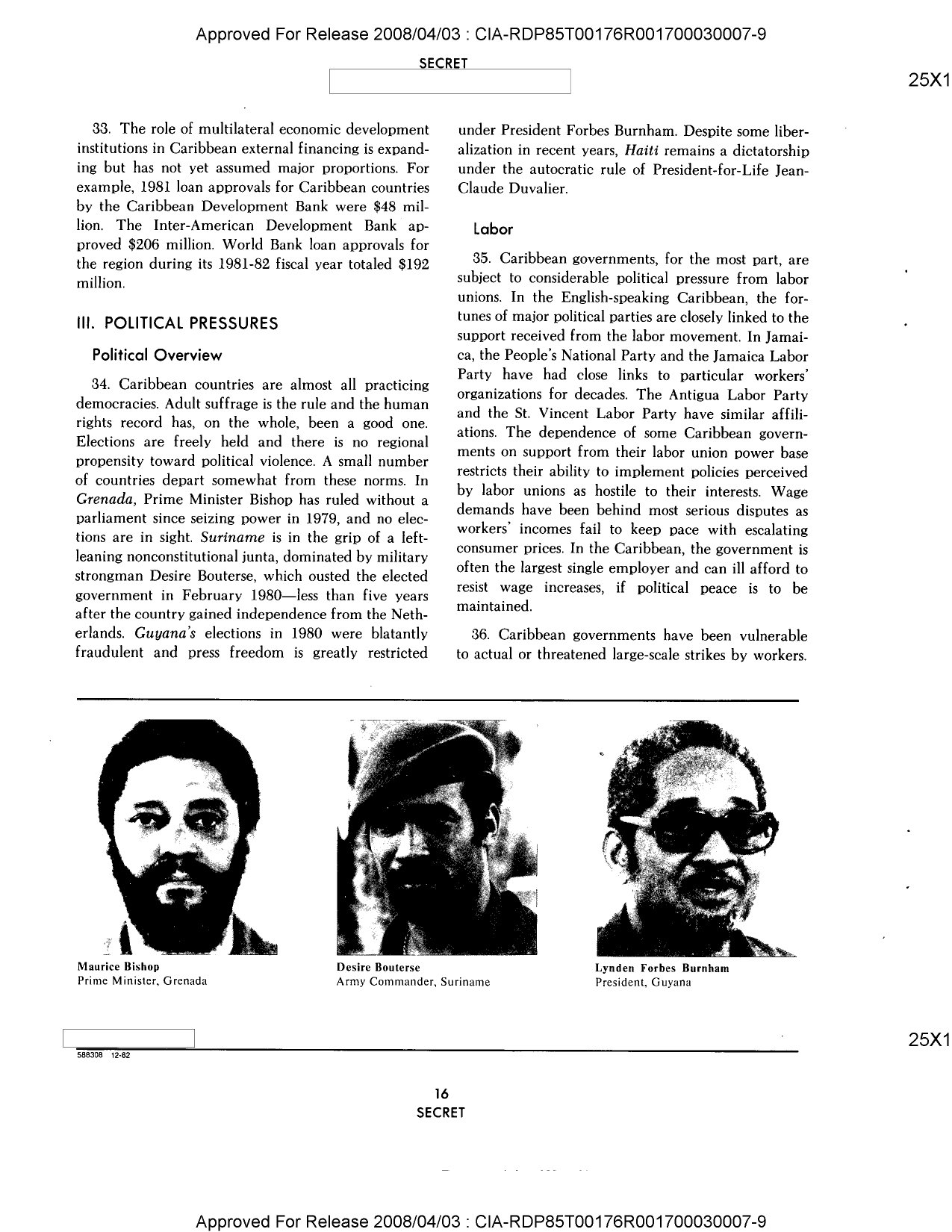
Caribbean countries are almost all practicing democracies. Adult suffrage is the rule and the human rights record has, on the whole, been a good one. Elections are freely held and there is no regional propensity toward political violence. A small number of countries depart somewhat from these norms.
- Grenada: Prime Minister Bishop has ruled without a parliament since seizing power in 1979, and no elections are in sight.
- Suriname: In the grip of a left-leaning nonconstitutional junta, dominated by military strongman Desire Bouterse, which ousted the elected government in February 1980—less than five years after the country gained independence from the Netherlands.
- Guyana: Elections in 1980 were blatantly fraudulent, and press freedom is greatly restricted under President Forbes Burnham.
- Haiti: Despite some liberalization in recent years, Haiti remains a dictatorship under the autocratic rule of President-for-Life Jean-Claude Duvalier.
Labor
Caribbean governments, for the most part, are subject to considerable political pressure from labor unions. In the English-speaking Caribbean, the fortunes of major political parties are closely linked to the support received from the labor movement.
- Jamaica: The People’s National Party (PNP) and the Jamaica Labor Party (JLP) have had close links to particular workers’ organizations for decades.
- Antigua: The Antigua Labor Party (ALP) has similar affiliations.
- St. Vincent: The St. Vincent Labor Party has similar affiliations.
The dependence of some Caribbean governments on support from their labor union power base restricts their ability to implement policies perceived by labor unions as hostile to their interests. Wage demands have been behind most serious disputes as workers’ incomes fail to keep pace with escalating consumer prices.
In the Caribbean, the government is often the largest single employer and can ill afford to resist wage increases if political peace is to be maintained. Caribbean governments have been vulnerable to actual or threatened large-scale strikes by workers.
- Dominica (1979): A two-week general strike that shut down the economy forced former Prime Minister Patrick John to agree to large wage increases that the economy could ill afford. The dispute precipitated John’s resignation. John’s successor, Oliver Seraphine, quickly reversed his repudiation of the wage increases under threat of another strike by the powerful Civil Service Association.
- Dominican Republic (1979): A violent two-day taxi drivers’ strike protesting the third gasoline price increase that year caused former President Antonio Guzman to offer gasoline price subsidies (terminated in late 1980) to taxicab operators.
- St. Lucia (1982): Newly elected Prime Minister John Compton’s efforts to promote economic recovery and a stable industrial climate are being stymied by trade union calls for an indefinite shelving of Compton’s proposal for a ceiling on wage increases.
Political Opposition
Nongoverning political parties and groups have ample opportunity to capitalize on economic conditions in the Caribbean by blaming incumbent governments or by promising better economic alternatives.
The leverage of nongoverning political parties is strongest in the small English-speaking Caribbean islands, where struggles between political factions in national legislatures of less than 20 members can cause parliamentary majorities to vanish overnight.
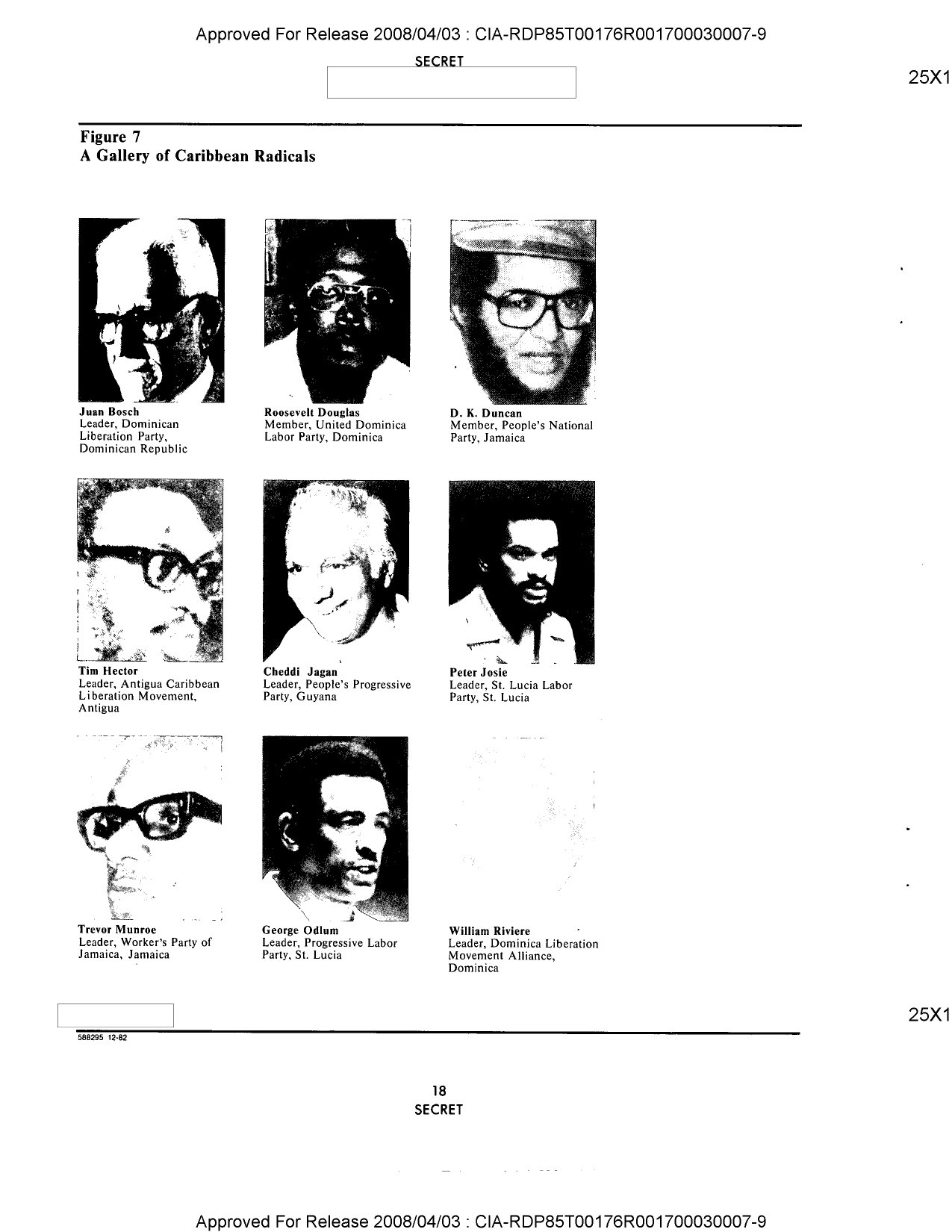
- Antigua: Pro-West Prime Minister Vere Bird’s ALP is weakened by internal factions, while opposition Progressive Labor Movement (PLM) infighting gives a lease on life to the ALP. Tim Hector’s Antigua-Caribbean Liberation Movement (ACLM) is active in spreading propaganda, publishes a widely read newspaper, and organizes among local youth and women.
- St. Lucia: Prime Minister John Compton’s principal opposition are radicals George Odlum (PLP) and Peter Josie (SLP). Despite Libyan funding, they sustained crushing defeats in May 1982 elections (3 of 17 seats). They maintain ties to Cuba and Grenada and have demonstrated capability for organizing violent protest.
- Dominica: Prime Minister Eugenia Charles and her Dominica Freedom Party (DFP) face massive economic problems. Plots to overthrow her government were thwarted twice in 1981. Opposition parties include Dominica Labor Party (DOMLAB), United Dominica Labor Party (UDLP), and Dominican Liberation Movement Alliance (DLMA).
- Jamaica: PNP left wing, including Marxist D. K. Duncan, could try to discredit the Seaga government. Industrial strife involves JLP-affiliated BITU, PNP-affiliated NWU, and smaller trade unions. The Communist Workers Party of Jamaica continues to build a base.
- Suriname: Military authority outlawed traditional opposition parties after the February 1980 coup. Opposition sentiment has been expressed through organized labor, primarily the Moederbond, with support from private media, businessmen, and lawyers’ organizations. A general strike challenged the regime in late October 1982.
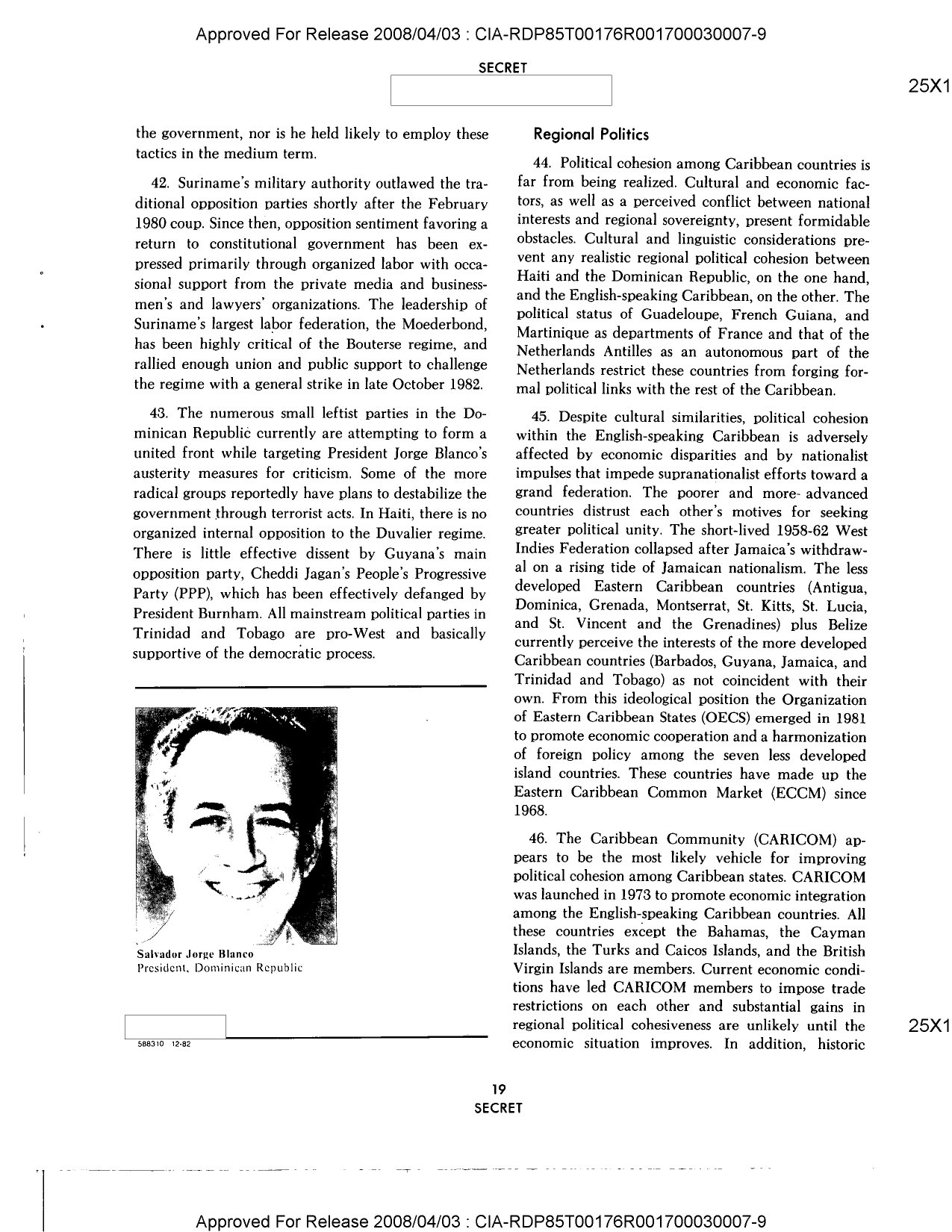
- Dominican Republic: Small leftist parties attempt to form a united front while targeting President Jorge Blanco’s austerity measures.
- Haiti: No organized internal opposition to the Duvalier regime.
- Guyana: Main opposition party, PPP, effectively defanged by President Burnham.
- Trinidad and Tobago: All mainstream political parties are pro-West and supportive of democracy.
Regional Politics
Political cohesion among Caribbean countries is far from being realized. Cultural and economic factors, as well as perceived conflicts between national interests and regional sovereignty, present formidable obstacles.
- Cultural and linguistic considerations prevent realistic cohesion between Haiti, the Dominican Republic, and the English-speaking Caribbean.
- Guadeloupe, French Guiana, Martinique, and the Netherlands Antilles are restricted in forging formal political links due to their political status as parts of France or the Netherlands.
Despite similarities, political cohesion in the English-speaking Caribbean is affected by economic disparities and nationalist impulses.
- Eastern Caribbean: Less developed countries (Antigua, Dominica, Grenada, Montserrat, St. Kitts, St. Lucia, St. Vincent and the Grenadines) and Belize perceive the interests of more developed countries (Barbados, Guyana, Jamaica, Trinidad and Tobago) as not coincident with their own. OECS (1981) emerged to promote economic cooperation and harmonization of foreign policy.
- CARICOM: Launched in 1973 for economic integration of English-speaking Caribbean. Most countries are members except Bahamas, Cayman Islands, Turks and Caicos, British Virgin Islands. Current economic conditions have led to trade restrictions among members, limiting political cohesion. The November 1982 CARICOM heads of government meeting reaffirmed the integrity of national boundaries and human rights.
Relations With the United States
Caribbean governments recognize the importance attached by the United States to maintaining its influence in the region, though perceptions differ.
- Dominican Republic & Haiti: Grudgingly accept US influence due to anti-Communist positions and economic dependence.
- Grenada, Suriname, Guyana: See the US as a threat to socialist economic and political self-determination.
Most Caribbean leaders maintain ambivalence regarding the US presence. They aim to broaden external relations without undue influence while receiving US economic assistance without political quid pro quo.
- Examples: Barbados, Jamaica, and Trinidad and Tobago supported lifting OAS sanctions against Cuba in the early 1970s, despite US opposition. Most English-speaking Caribbean governments opposed US efforts to exclude Grenada from the Caribbean Basin Initiative provisions.
IV. SOCIOCULTURAL FACTORS
Caribbean countries share a common legacy of colonialism founded on black slavery, indentured labor, and a white power elite, but they differ culturally and linguistically based on their British, French, Spanish, and Dutch colonial heritages. Such cultural and linguistic fragmentation inhibits the adoption of a regional approach to vital matters like national security, economic development, and international relations, and renders individual countries more vulnerable to destabilizing forces than they would be under more cohesive regional integration.
Vestiges of colonialism also curtail social harmony in many Caribbean countries. Class distinctions and class antagonisms remain. Upward social mobility, although possible, remains difficult. For Caribbean people still savoring their recently received freedom from colonialism, the realization that society is not changing as fast as they would wish could lead to growing pressures for social change.
Religion
An estimated 70 percent of the Caribbean population are regular church-goers, and religion generally has been a stabilizing influence in the region. As a colonial legacy, Catholicism and Protestantism are the dominant religions, but with a fundamentalist bent that regards Communism as ungodly.
Some social researchers claim that religion in the Caribbean provides a release from trying economic circumstances and, to this extent, it probably has had a dampening effect on political protest. Rastafarianism does not impact significantly on the region as a cultural-sociological phenomenon, although individual groups have been linked to violence in Dominica and Trinidad and Tobago.
Urbanization
Population shifts to urban centers present a serious problem for Caribbean governments in larger countries like the Dominican Republic, Haiti, Guyana, Jamaica, and Trinidad and Tobago.
The problem is less severe in the small island territories, where most of the population is within two hours’ travel time of urban centers and can perform urban jobs or search for urban employment while remaining in rural areas.
It is difficult to separate the contribution of urbanization to adverse Caribbean social conditions from other factors such as income disparities, weak government finances, and government mismanagement. Urbanization, with the accompanying proliferation of slums in Georgetown, Guyana, and Kingston, Jamaica, has contributed to high urban unemployment and crime rates and to a general deterioration of public services as the demand for these services exceeds the government’s ability to supply them.
From the viewpoint of stability, the Jamaican experience shows that a large body of urban unemployed constitutes a ready source of manpower that can be hired for organized violence for political ends.
The growing proportion of young people in the Caribbean presents a long-term challenge to the existing political systems, which have not been able to provide substantial numbers of them with jobs. The median age for the region is around 16, compared with 30 for the United States.
Youth majorities do not present a problem of political violence in most Caribbean countries since they are, for the most part, unorganized. However, they constitute a potential pool of growing support for alternate political systems because of their disillusionment with the present political order. Caribbean radicals realize this and are assiduously cultivating the youth of Antigua, Dominica, and other islands.
- St. Lucia: Progressive Labor Party leader George Odlum has recognized the political potential of youth support by enlisting a motley array of young thugs, supposedly armed by Cuba.
Social Conditions
Poor social conditions in Caribbean countries are not expected, by themselves, to threaten stability in the region. These conditions are an established feature of Caribbean life and have not been used to rationalize political takeovers in the past. They would pose a significant threat only if they worsen markedly because of a serious, protracted economic decline.
In Caribbean family life, the negative social impact of high illegitimacy birth rates and low marriage rates is substantially offset by an extensive web of kin groupings that provides a cushion for the Caribbean family against social pressures and excessive financial difficulty, especially among the masses.
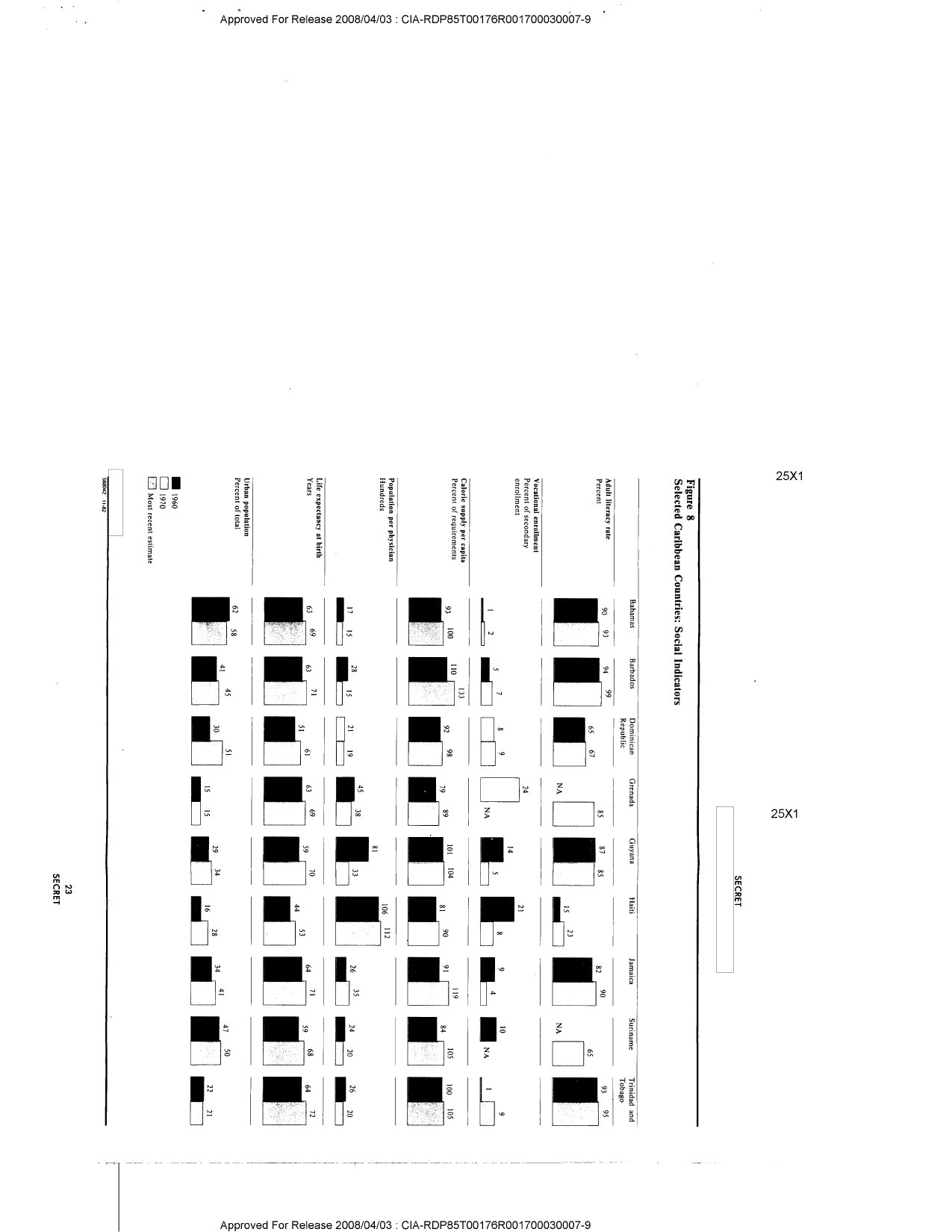
In terms of literacy, life expectancy, and available medical services, social conditions in the Caribbean are generally more favorable than in most other Third World countries where social unrest does not occur.
The relative poverty of Caribbean countries, their proximity to the United States, and their exposure to US media and consumption patterns serve more to stimulate migration to the United States than to foment unrest at home.
Although social conditions are by no means good, most Caribbean governments have been making steady progress in improving them. Living standards continue to rise, and substantial gains have been made in education and housing. The general level of medical services continues to improve, despite declines in Jamaica and Trinidad and Tobago due to mismanagement. Life expectancy in the English-speaking Caribbean of 68–71 years is among the highest in the Third World.
Ethnic-Cultural Differences
Caribbean countries are multiracial in character, and ethnic-cultural differences are significant in only four countries in the region.
- East Indians: Largest ethnic group in Guyana (51%), Suriname (37%), and Trinidad and Tobago (43%), vying with the black population for political power.
- Haiti: Mulatto economic elite outnumbered by blacks nine to one; governments traditionally support one or the other group.
Ethnic-cultural differences are not likely to create serious problems in any of the four countries over the period of this estimate.
- Guyana: Black-dominated People’s National Congress (PNC) is firmly in control. Few East Indians in government; most of the East Indian community is affiliated with the opposition. President Burnham’s policies favor Afro-Guyanese.
- Suriname: Creole-dominated military leadership strives for the appearance of ethnic neutrality.
- Trinidad: Underlying tensions between blacks and East Indians exist, but no opportunist has exploited racial differences for political ends.
- Haiti: Problems would arise only if President Duvalier’s policies appear to favor the mulatto minority.
Population Growth
Social pressures from population growth in the Caribbean would be considerably greater without the relief provided by emigration.
- Average rate of population increase: Under 2% after adjustment for emigration.
- Natural rate of population growth: About 3%, well above the Third World average.
Most Caribbean countries have official and private-sector programs for restraining natural population increase. These programs ebb and flow with foreign curbs on Caribbean emigration.
- Jamaica: Family planning programs since 1939; intensified after the 1962 UK Commonwealth Immigration Act curtailed Caribbean emigration.
- Barbados & Trinidad: Intensified population control programs in the 1960s after UK curb largely responsible for reduced rates of natural increase.
Emigration
Emigration has been a basic feature of Caribbean life for generations and has long been accepted as a safety valve for population and employment pressures.
- Population movement is intraregional and extraregional, driven more by economic than political considerations.
- Haitians: 8% of French Guiana’s population
- Immigrants: 20% of the Bahamas’ population
- Guyanese: Flow to Suriname
- Haitians: Flow to Dominican Republic
- Netherlands Antilles & Trinidad and Tobago: Attract workers from Leeward and Windward islands
The net flow of legal and illegal emigrants out of the Caribbean is currently estimated at 170,000–200,000 per year.
- Past effects: Caribbean countries benefited from remittances and were not seriously affected by the loss of surplus unskilled and semi-skilled workers.
- Recent trends: Since the mid-1970s, an exodus of professionals due to worsening economic conditions and leftward political drift (Grenada, Suriname, Jamaica) has reduced skills available to public and private sectors.
- Jamaica: Lost 40% of professional workers since 1974
- Suriname: Netherlands has more Surinamese doctors than Suriname
- Haitians in Quebec: 25,000, considerable number professionals
The impetus for emigration in the Caribbean is expected to continue, although opportunities in the US, UK, and Netherlands are likely to decline, exacerbating unemployment.
Emigrants who have established themselves stimulate further emigration by bringing in dependents or serving as contacts for future emigrants. Economic disparity between Caribbean countries and metropole centers remains too large to restrain outflows based on economic reasons.
- Example: Jamaican professionals who left during the Manley regime have not been returning in significant numbers despite the election of the more conservative Seaga government two years ago.
V. DESTABILIZING FORCES
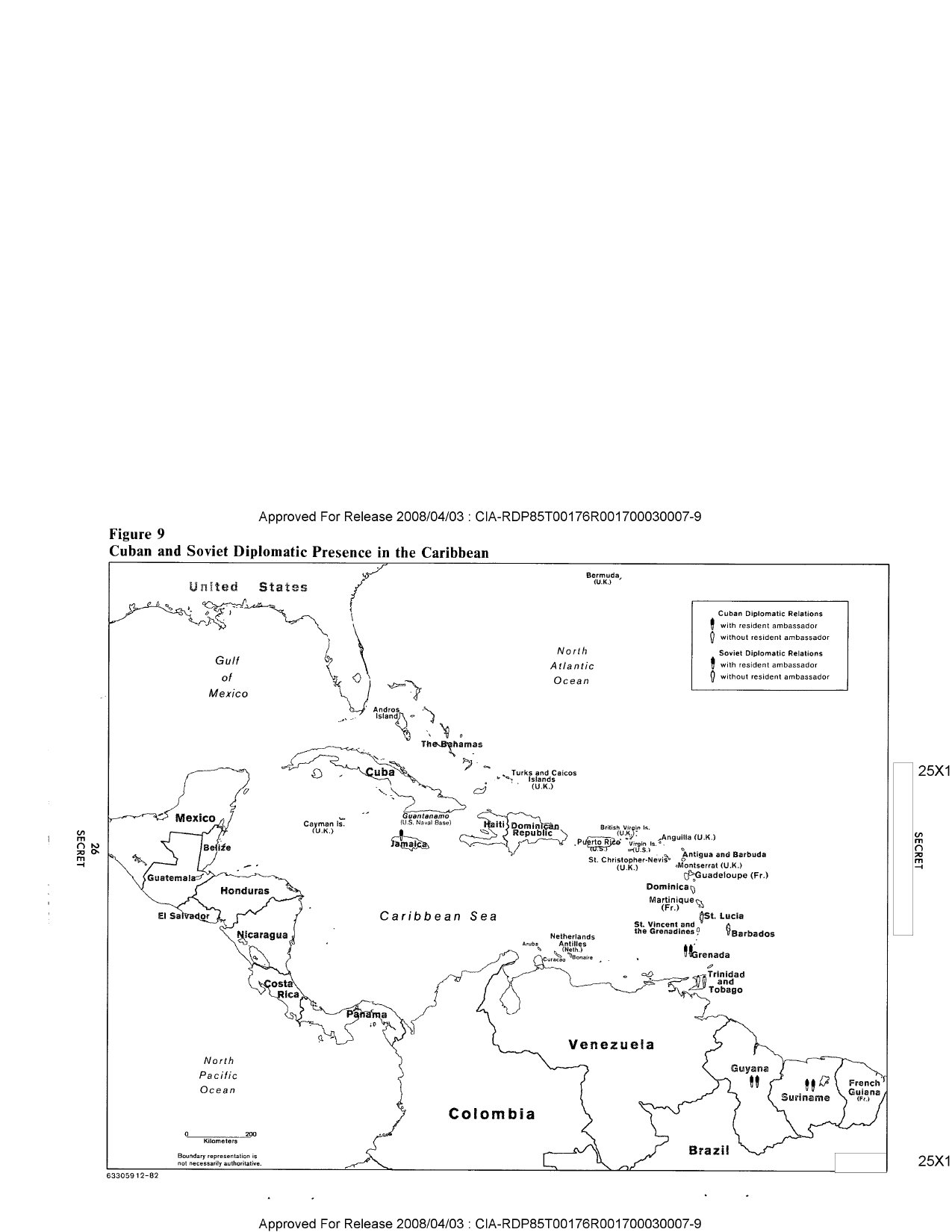
Cuba and, to a lesser degree, the Soviet Union are the main sources of external destabilizing threats to the Caribbean, but Libya and North Korea also play secondary roles. The Soviet Union has diplomatic relations with five Caribbean countries, and Cuba has diplomatic ties to seven. Libya has diplomatic relations with Grenada, Guyana, Jamaica, Suriname, and Trinidad and Tobago, and North Korea has relations with Barbados, Grenada, Guyana, St. Vincent, and Suriname.
Soviet Strategy and Tactics
The basic Soviet strategy in the Caribbean is to present a low profile in official relations with Caribbean governments while providing financial and other support for Communist and other radical groups. Moscow’s aims are to discredit US policy, undermine US influence, and promote radical change. It has adopted a cautious, gradualistic approach in its relations with the region. The Soviets suffered a setback with the 1980 defeat of the Manley government in Jamaica, followed by the election of moderate governments in Dominica (1980) and St. Lucia (1982).
Moscow’s institutional and economic ties with the Caribbean remain at a fairly low level for the region as a whole. There has, however, been a substantial expansion in Soviet linkages to Grenada and, to a lesser extent, to Suriname in recent months. The Soviets recently established an embassy in Grenada.
In financially pressed Guyana, Soviet institutional and economic ties have been constrained by longstanding ideological support for the opposition People’s Progressive Party, headed by Cheddi Jagan. More importantly, however, Moscow does not perceive the Burnham government as reliable and consequently is not willing to support it fully. Elsewhere in the Caribbean, official contacts with Moscow are relatively low-keyed. Elected governments recognize that close links with the Soviets would not receive popular support.
Moscow’s tactics in furthering its aims in the Caribbean currently center on funding local Communist organizations and front groups and cultivating pro-Soviet sentiments among academics, students, and labor organizations. Moscow sees the local orthodox Communist parties largely as instruments of Soviet policy. Most are given an annual stipend and assistance in formulating political strategy.
The Soviets offer hundreds of scholarships each year to students from the Dominican Republic, Grenada, Guyana, and Jamaica, hoping to improve Moscow’s image and to establish a local cadre for the Soviet intelligence services. By the end of 1981, an estimated 855 Caribbean students were in the Soviet Union, including 500 to 700 from the Dominican Republic.
Cuban Strategy and Tactics
Havana’s objectives in the Caribbean coincide with Moscow’s, but the Cubans are much more active and have far more contacts with Caribbean governments than the Soviets. Cuba’s main objective is to promote revolutionary change, which it seeks to accomplish primarily by penetrating democratic trade union movements and by cultivating radical personalities and groups.
Because Havana has limited access to the Caribbean trade union rank and file, its attempted trade union infiltration is directed at union leaders. Havana seeks to woo the masses through friendship societies, cultural groups, and student and women’s organizations. Havana acts primarily on its own initiative, but it also serves as a Soviet intermediary. It is well suited for the role as a go-between because Caribbean radicals, and some Caribbean governments, identify more easily with Cuba than with the Soviet Union for racial and geographical reasons.
Cuba’s official contacts with the government of Grenada are substantial. In the Eastern Caribbean, Cuba uses Grenada as an agent to spread propaganda and to maintain contact with other radicals in the region. Havana’s close relationship with Grenada’s Maurice Bishop and other members of the People’s Revolutionary Government dates back to the mid-1970s.
The Cuban Ambassador to Grenada, Julian Torres Rizo, functions as an influential adviser to Bishop on a wide range of issues. Havana has provided the Bishop government with at least $50 million in aid, principally Cuban labor and materiel for the construction of the Point Salines International Airport, which will have a 3,200-meter runway capable of accommodating the largest commercial jets and many of the large transports in the Soviet inventory. This airport could play an important role in ferrying Cuban troops and materiel to Africa. Cuba is heavily involved in the upgrading of Grenada’s security forces, providing military assistance.
Libya
Libya has increasingly sought to extend its influence into the region. The Qadhafi government has provided leftist Grenada with at least $10 million to date. Some of these funds have been earmarked for the Point Salines Airport project, but Libyan financing has also facilitated the purchase of new buses and three British-built patrol boats received by the Bishop regime in 1981.
In its support of Caribbean radicals, Libya helped to fund the unsuccessful campaigns of St. Lucia leftists George Odlum and Peter Josie during that island’s 1982 general elections. Antiguan radical Tim Hector has also received Libyan financial support.
Other Destabilizing Forces
In some Caribbean countries, law and order is threatened by international drug trafficking, with its attendant opportunities for the bribery and corruption of government officials. The Bahamas and the Turks and Caicos Islands are key transshipment and aircraft refueling points for the illegal flow of cocaine, heroin, and marijuana to the United States. In the Bahamas, the difficulty of controlling the flow of drugs through a 700-island chain is compounded by insufficient resources in manpower, patrol boats, and aircraft.
With the exception of Antigua, the Eastern Caribbean islands are not international air junctions and do not have to contend with a flow of drug couriers. Marijuana production in the area is a small but growing problem. Marijuana grown in Dominica, for example, is mainly sold in nearby Guadeloupe, where it presumably reaches the tourist trade.
The activities of exile groups bent on destabilizing Caribbean governments have not assumed significant proportions. Most of these activities are directed at the Duvalier regime in Haiti, and numerous Haitian exile groups of leftist or rightist persuasion are located in the United States, Canada, the Dominican Republic, Venezuela, and France. The lack of cohesiveness among these groups makes them largely ineffective, and they have almost no constituency within Haiti.
There is no organized external opposition to the Bishop regime in Grenada. Despite repeated threats by ousted Prime Minister Sir Eric Gairy to regain power, he has no following of his own. Guyanese and Surinamese exile groups aimed at challenging the existing government largely exist on paper only.
VI. COPING WITH THREATS
Security Forces
Caribbean countries vary widely in their ability to contain domestic unrest and cope with external threats. In the Dominican Republic, Jamaica, and Trinidad and Tobago, the security establishments are fairly large and, by Caribbean standards, relatively competent. With the exception of Barbados and Grenada, the security forces in the English-speaking Eastern Caribbean islands often are marginal establishments with minimal capability.
Caribbean security forces can reasonably cope with isolated disturbances, but most would be hard pressed to counter widespread internal violence. Barbados excepted, the English-speaking Eastern Caribbean islands are incapable of repelling armed invasions of anything greater than company size and would require outside help to deal with that contingency. In March 1979, for example, Grenada was taken by some 50 men. Security force deficiencies are particularly acute in Dominica, where the personnel are poorly trained, equipped, and led and have been ineffective in containing criminal and Rastafarian elements, let alone organized violence or coups.
The involvement of Caribbean security forces in politics varies within the region. Security forces in Grenada and Guyana are highly politicized and actively support the incumbent governments. Haiti’s security forces serve primarily to maintain the Duvalier regime. In the Dominican Republic, the armed forces have a reputation for interfering in the political process to influence or reverse election outcomes, although they did remain neutral in the general elections last May. The Jamaican security forces were subject to political pressures during the PNP administration but now are politically neutral for the most part. St. Lucia’s police force is believed subject to intimidation by the island’s radical political groups, such as that led by George Odlum.
Regional Security Cooperation
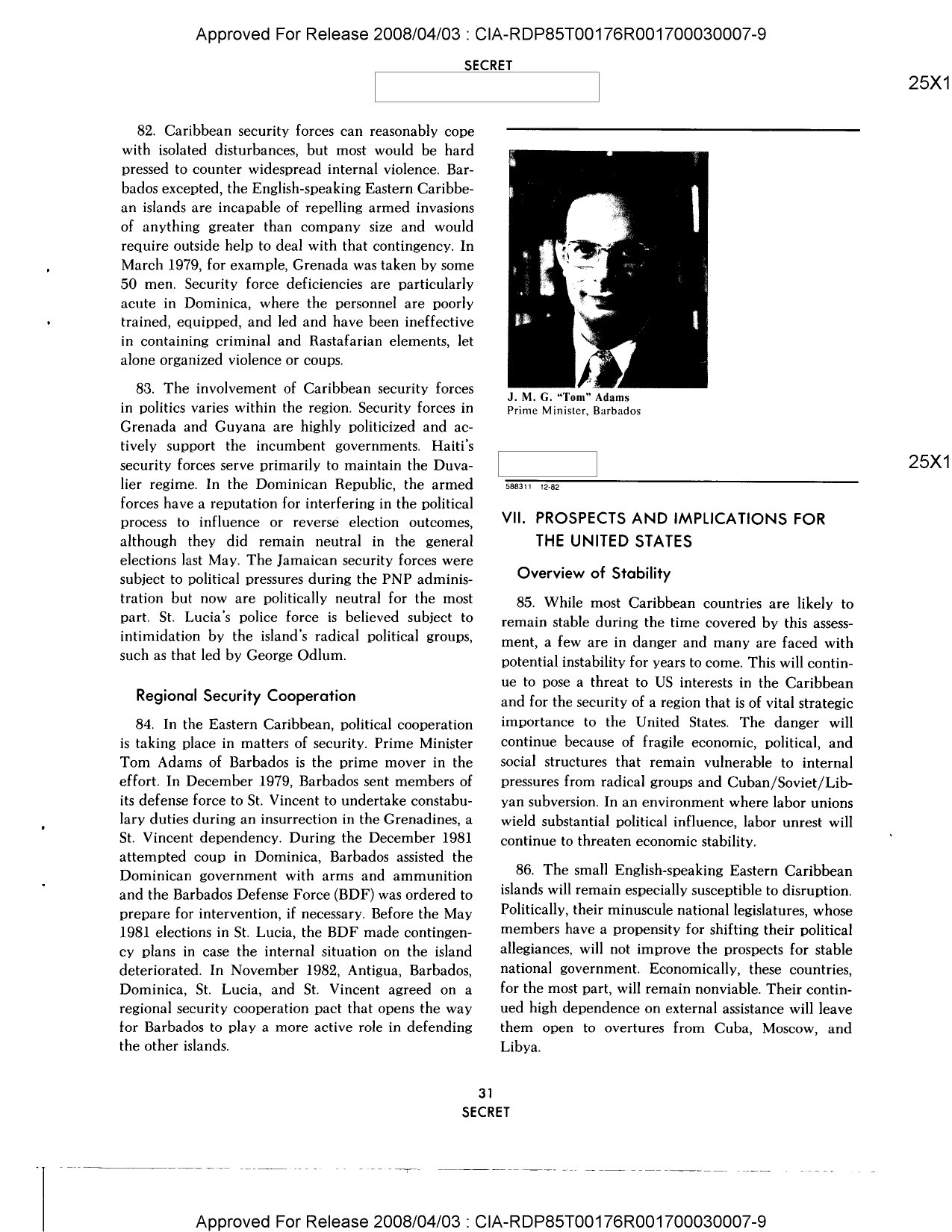
In the Eastern Caribbean, political cooperation is taking place in matters of security. Prime Minister Tom Adams of Barbados is the prime mover in the effort. In December 1979, Barbados sent members of its defense force to St. Vincent to undertake constabulary duties during an insurrection in the Grenadines, a St. Vincent dependency. During the December 1981 attempted coup in Dominica, Barbados assisted the Dominican government with arms and ammunition, and the Barbados Defense Force (BDF) was ordered to prepare for intervention, if necessary. Before the May 1981 elections in St. Lucia, the BDF made contingency plans in case the internal situation on the island deteriorated. In November 1982, Antigua, Barbados, Dominica, St. Lucia, and St. Vincent agreed on a regional security cooperation pact that opens the way for Barbados to play a more active role in defending the other islands.
VII. PROSPECTS AND IMPLICATIONS FOR THE UNITED STATES
Overview of Stability
While most Caribbean countries are likely to remain stable during the time covered by this assessment, a few are in danger and many are faced with potential instability for years to come. This will continue to pose a threat to US interests in the Caribbean and for the security of a region that is of vital strategic importance to the United States. The danger will continue because of fragile economic, political, and social structures that remain vulnerable to internal pressures from radical groups and Cuban/Soviet/Libyan subversion. In an environment where labor unions wield substantial political influence, labor unrest will continue to threaten economic stability.
The small English-speaking Eastern Caribbean islands will remain especially susceptible to disruption. Politically, their minuscule national legislatures, whose members have a propensity for shifting their political allegiances, will not improve the prospects for stable national government. Economically, these countries, for the most part, will remain nonviable. Their continued high dependence on external assistance will leave them open to overtures from Cuba, Moscow, and Libya.
The trend toward fragmentation of small island groupings with the advent of independence creates yet another factor of instability. For example, separatist pressures in St. Christopher-Nevis, Antigua and Barbuda, Trinidad and Tobago, and the Netherlands Antilles remain potentially troublesome.
We do not believe that the pressures on Caribbean stability will generate widespread disruption in the region. Periodic disturbances have tended to be country specific, and there is no shared philosophy of revolutionary change that has any foothold in the Caribbean as a whole.
The Role of the CBI
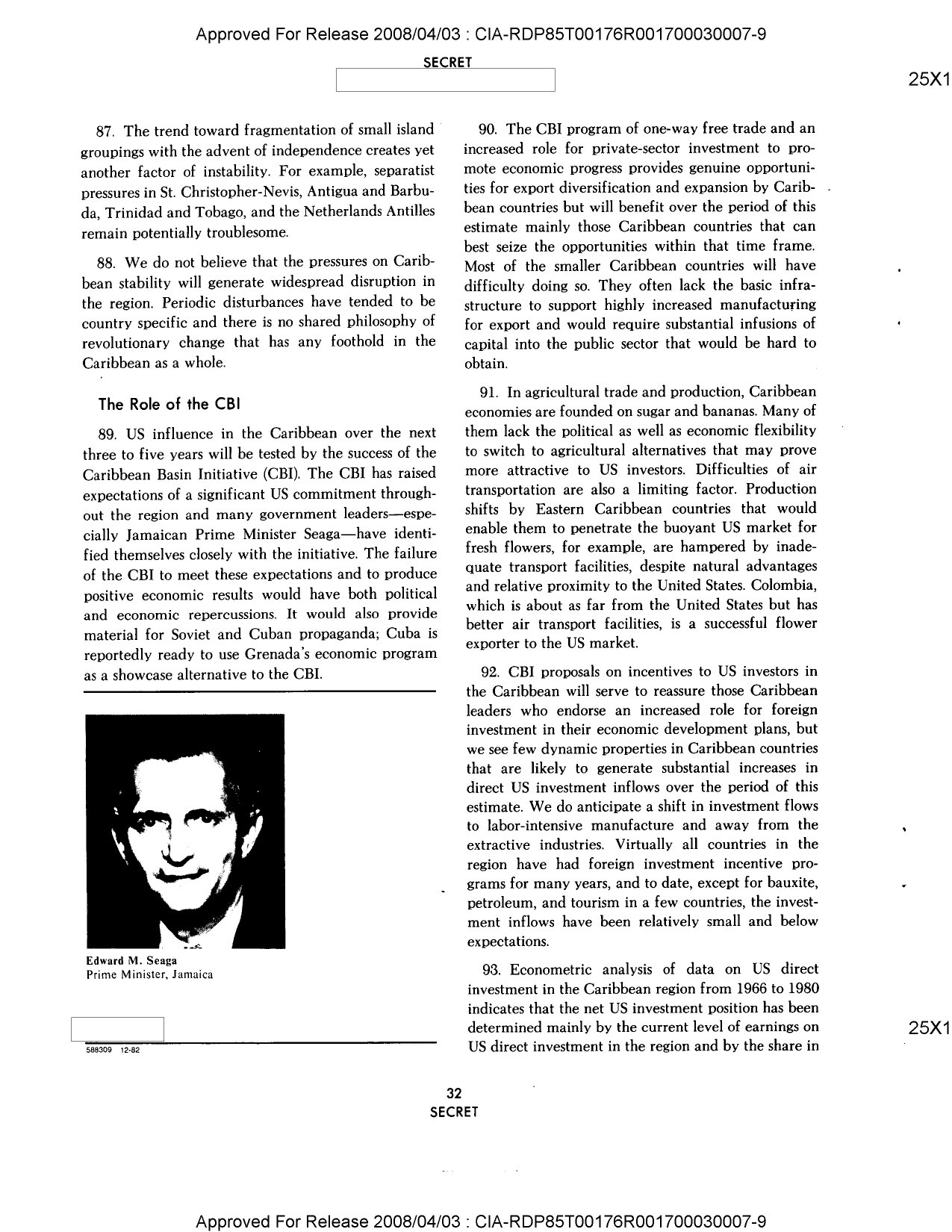
US influence in the Caribbean over the next three to five years will be tested by the success of the Caribbean Basin Initiative (CBI). The CBI has raised expectations of a significant US commitment throughout the region, and many government leaders—especially Jamaican Prime Minister Seaga—have identified themselves closely with the initiative. The failure of the CBI to meet these expectations and to produce positive economic results would have both political and economic repercussions. It would also provide material for Soviet and Cuban propaganda; Cuba is reportedly ready to use Grenada’s economic program as a showcase alternative to the CBI.
The CBI program of one-way free trade and an increased role for private-sector investment to promote economic progress provides genuine opportunities for export diversification and expansion by Caribbean countries but will benefit over the period of this estimate mainly those Caribbean countries that can best seize the opportunities within that time frame. Most of the smaller Caribbean countries will have difficulty doing so. They often lack the basic infrastructure to support highly increased manufacturing for export and would require substantial infusions of capital into the public sector that would be hard to obtain.
In agricultural trade and production, Caribbean economies are founded on sugar and bananas. Many of them lack the political as well as economic flexibility to switch to agricultural alternatives that may prove more attractive to US investors. Difficulties of air transportation are also a limiting factor. Production shifts by Eastern Caribbean countries that would enable them to penetrate the buoyant US market for fresh flowers, for example, are hampered by inadequate transport facilities, despite natural advantages and relative proximity to the United States. Colombia, which is about as far from the United States but has better air transport facilities, is a successful flower exporter to the US market.
CBI proposals on incentives to US investors in the Caribbean will serve to reassure those Caribbean leaders who endorse an increased role for foreign investment in their economic development plans, but we see few dynamic properties in Caribbean countries that are likely to generate substantial increases in direct US investment inflows over the period of this estimate. We do anticipate a shift in investment flows to labor-intensive manufacture and away from the extractive industries. Virtually all countries in the region have had foreign investment incentive programs for many years, and to date, except for bauxite, petroleum, and tourism in a few countries, the investment inflows have been relatively small and below expectations.
Econometric analysis of data on US direct investment in the Caribbean region from 1966 to 1980 indicates that the net US investment position has been determined mainly by the current level of earnings on US direct investment in the region and by the share in total exports of products, mainly bauxite and petroleum, that are of import interest to the United States. The size of Caribbean markets for locally produced output was not found to be a significant factor. If these past trends continue, the absence of natural resources that may be developed for the US market will constrain future US direct investment flows to most Caribbean countries. The unimportance of domestic market size in generating US investment inflows suggests that foreign investment programs by Caribbean governments that aim at production for domestic markets are not likely to bear much fruit. For countries without natural resources, the ability to attract new US investment will largely depend on efforts to research the US market and to identify new export products like handicrafts, furniture, and processed fruit that are amenable to light manufacture and do not have large capital requirements for individual projects. Shifting perceptions of political risks could alter the relative attractiveness of individual Caribbean countries as sites for direct investment.
Subversive Threats
Moscow is expected to maintain its efforts to reduce US influence in the Caribbean. The US position in the region is complicated by the fact that most Caribbean governments are unlikely to reverse their foreign policy of nonalignment. They will continue to seek good relations with the United States while remaining open to other foreign links. In pursuing its aims, Moscow has the advantage of being able to use its intermediaries, Cuba and Grenada, in situations where it would be less promising to act on its own.
Despite its 1980 setback in Jamaica, Cuba’s attempts to infiltrate and influence Caribbean countries are expected to intensify.
VIII. OUTLOOK
Political Stability
Caribbean political stability over the next three to five years will remain largely dependent on the ability of governments to maintain law and order and to cope with internal pressures from radical groups, labor unrest, and leftist opposition movements. While the larger countries, such as the Dominican Republic, Jamaica, Trinidad and Tobago, and Guyana, are better equipped to manage internal disturbances, the smaller Eastern Caribbean islands remain vulnerable to disruption from relatively small forces.
Political parties, especially in small islands, have a history of factionalism and shifting allegiances, which can rapidly alter parliamentary majorities. This fluidity makes stable governance difficult to maintain and increases the susceptibility of these countries to political crises. Separatist movements and regional fragmentation further exacerbate these risks, particularly in areas like St. Christopher-Nevis, Antigua and Barbuda, and the Netherlands Antilles.
Economic Vulnerabilities
Caribbean economies are fragile and heavily dependent on a limited range of export products such as sugar, bananas, and bauxite. This lack of diversification makes the region sensitive to international market fluctuations and external economic shocks. Small island nations often lack the infrastructure, capital, and skilled labor to rapidly adapt to economic changes or to seize opportunities presented by US investment initiatives such as the Caribbean Basin Initiative (CBI).
High unemployment, especially among youth, and continued dependence on foreign aid and remittances compound economic vulnerabilities. While some countries have made progress in education, healthcare, and housing, overall economic growth is insufficient to provide meaningful employment or stability in the medium term.
External Influences
External actors such as Cuba, the Soviet Union, Libya, and North Korea continue to exert varying degrees of influence in the region. Cuba and the USSR primarily support leftist parties and labor movements, while Libya has funded specific leftist campaigns and infrastructure projects. These countries exploit the region’s economic fragility and political instability to promote ideological agendas and undermine US influence.
The United States, for its part, is expected to maintain strategic involvement through economic aid, trade initiatives, and political engagement. Programs like the CBI will be key in shaping US influence, but their effectiveness depends on the ability of local governments to implement reforms, attract private investment, and generate economic growth. Failures in these areas could be exploited by external actors seeking to destabilize friendly governments.
Social Pressures
Rapid population growth, urbanization, high youth unemployment, and limited social mobility create potential sources of unrest, particularly in urban centers. Social pressures are compounded by ethnic, linguistic, and cultural differences, which in some countries have the potential to be politically exploitable. While Caribbean societies have traditionally relied on extended family networks to cushion social stress, persistent economic hardship and disillusionment with political systems can create opportunities for radical groups to gain support.
Migration has historically relieved demographic pressures, but the continued emigration of skilled professionals and younger workers reduces the human capital available for development and governance, further undermining stability.
Strategic Implications for the United States
The United States’ strategic interests in the Caribbean are tied to regional stability, prevention of hostile external influence, and secure access to trade and military routes. Maintaining political and economic engagement, particularly through initiatives like the CBI, is essential to counterbalance Soviet, Cuban, and Libyan activities.
US policy must consider:
- Support for economic development programs that build local capacity.
- Encouragement of stable governance and political inclusiveness.
- Strengthening of security cooperation among Caribbean countries.
- Monitoring and countering subversive activities by foreign powers or radical local groups.
Success in these areas will determine the US’s ability to influence outcomes in the Caribbean, prevent destabilization, and promote conditions conducive to democratic governance and economic growth.
ANNEX В
INTERNAL POLITICAL DYNAMICS OF CARIBBEAN COUNTRIES
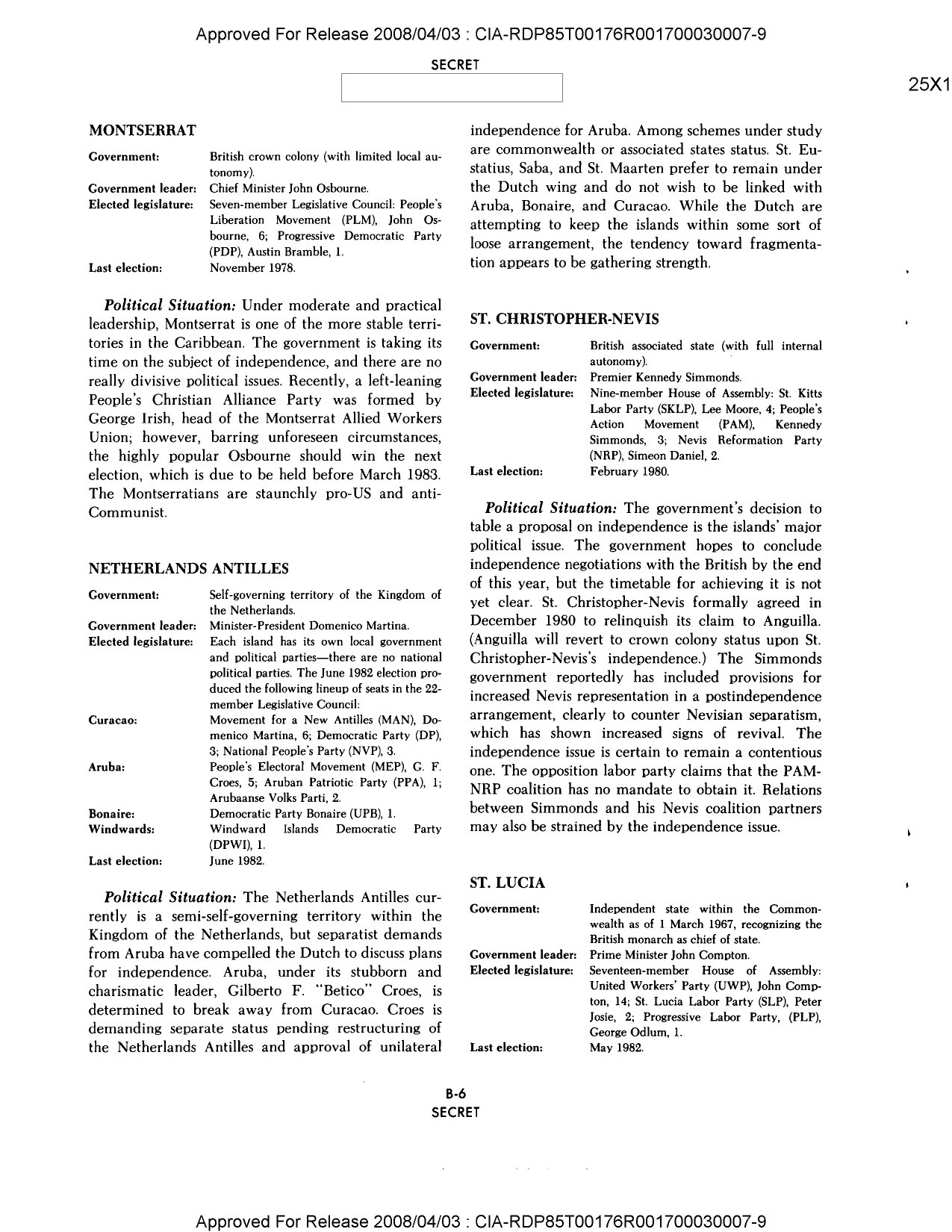
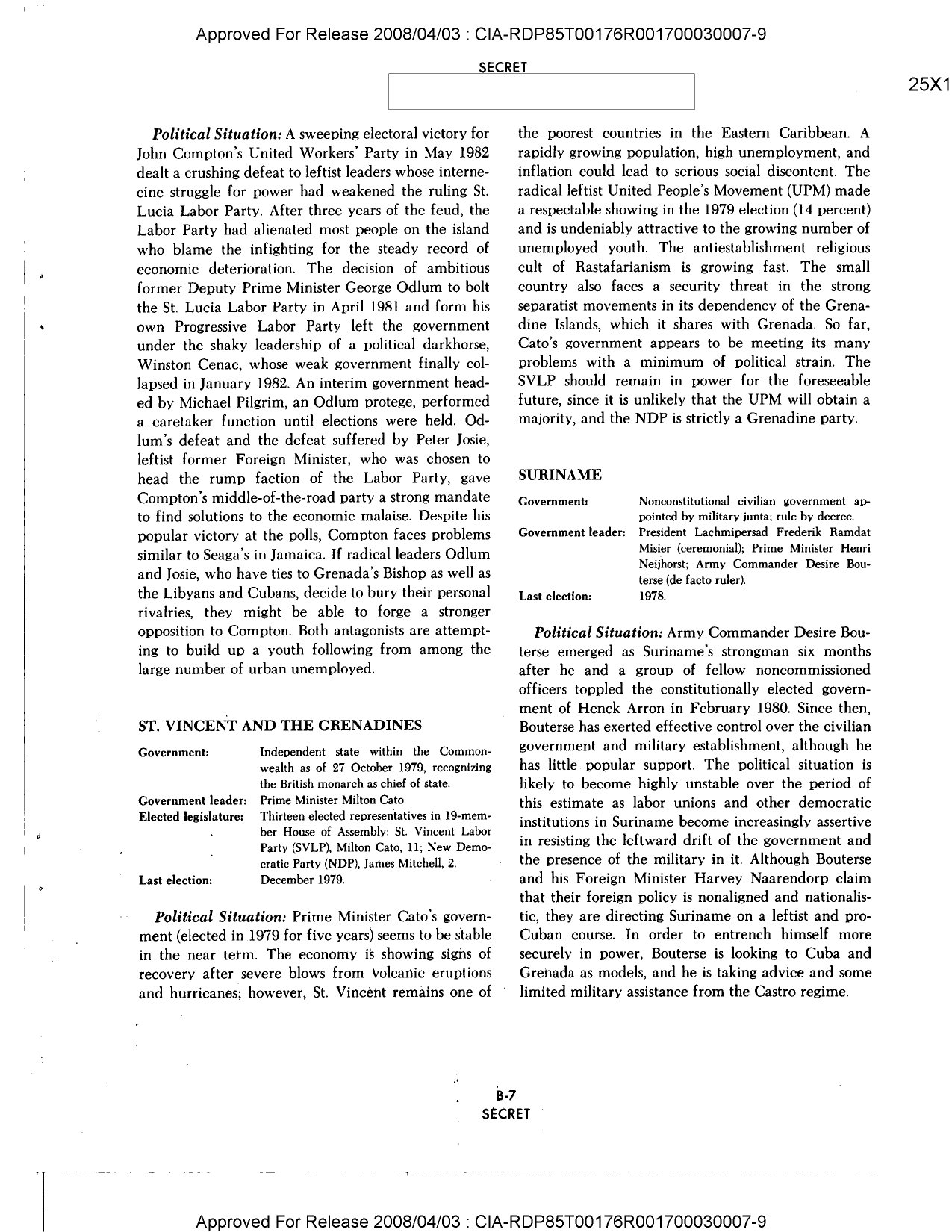
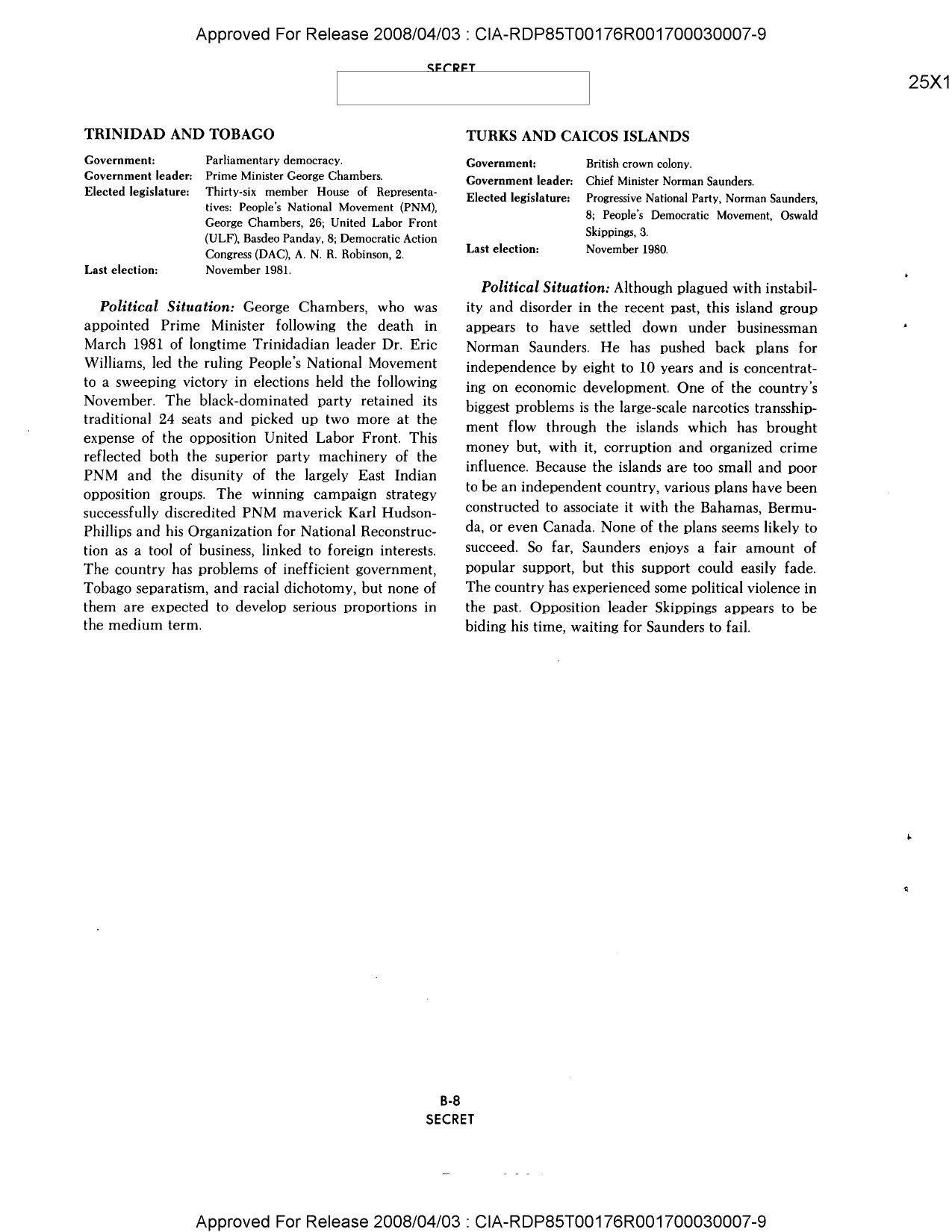
Despite a move away from leftism in Caribbean countries since 1980, the region retains a potential for instability. The combination of ministates, regional fragmentation, relative poverty, and unattainable political and economic aspirations is a volatile one. This annex summarizes the political situation in individual countries together with a medium-term political assessment.
ANGUILLA
Government: British self-governing dependency; formerly part of associated state of St. Christopher-Nevis-Anguilla until a new constitution in February 1976 provided separate administration.
Government leader: Chief Minister Ronald Webster.
Elected legislature: Seven-member House of Assembly: Anguilla People’s Party (APP), Ronald Webster, 5; Anguilla National Alliance (ANA), Emile Gumbs, 2.
Last election: June 1981.
Political Situation: Anguilla became a dependency of the United Kingdom in December 1980, formally dissolving its relationship with the associated state of St. Christopher-Nevis. Its constitution closely resembles that of the British Virgin Islands and other British dependent territories. Politics are lively and based on personality, not ideology. Anguilla should be reasonably stable in the medium term, because it has been less affected by the forces of change evident elsewhere in the Caribbean.
ANTIGUA AND BARBUDA
Government: Independent state within the Commonwealth as of 1 November 1981, recognizing the British monarch as chief of state.
Government leader: Prime Minister Vere Bird, Sr.
Elected legislature: Seventeen-member House of Representatives: Antigua Labor Party (ALP), Vere Bird, 13; Progressive Labor Movement (PLM), Robert Hall, 3; Independent, 1.
Last election: April 1980.
Political Situation: The newly independent state of Antigua and Barbuda remains firmly under the control of 73-year-old Vere Bird, Sr., who has long dominated politics on the island. The government is reasonably stable, although separatist sentiment on Barbuda is fueled by charges of neglect by the central government. Prime Minister Bird faces some factionalism within his own party, and a challenge from his son Lester Bird—the Deputy Prime Minister and Foreign Minister—who is impatient to succeed his father. Another ambitious son, Vere Jr., is Deputy Speaker of the House of Representatives. The moderate opposition party is badly fragmented and virtually paralyzed as a result of its inept performance in power during 1971-76. The demise of the party’s newspaper in 1981 and a continuing leadership split has been successfully exploited by the small leftist Antigua Caribbean Liberation Movement (ACLM), led by Tim Hector, which is seeking to fill the vacuum. Under Bird’s rule, Antigua seems certain to remain firmly on the side of the United States and to maintain a private enterprise philosophy in its efforts to develop a viable political and economic system.
THE BAHAMAS
Government: Independent state within the Commonwealth as of 10 July 1973, recognizing the British monarch as chief of state.
Government leader: Prime Minister Lynden O. Pindling.
Elected legislature: Forty-three-member House of Assembly: Progressive Liberal Party (PLP), Lynden Pindling, 32; Free National Movement (FNM), Kendal Issacs, 11.
Last election: June 1982.
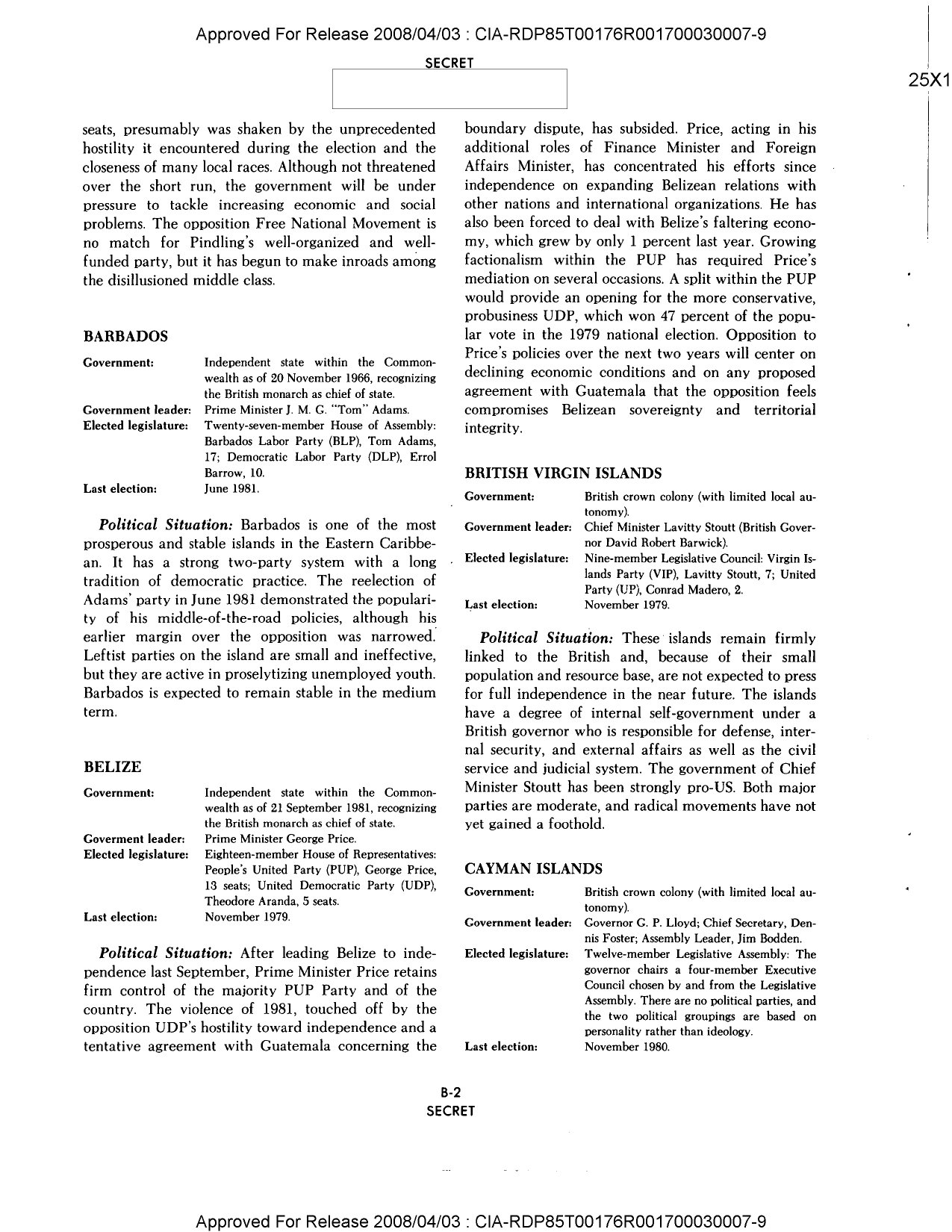
Political Situation: Bahamian Prime Minister Pindling’s Progressive Liberal Party was returned to power for its fourth five-year term in June 1982 following an acrimonious campaign by opponents who charged it with corruption and ineffectiveness. The entrenched ruling party, while winning 32 out of 43 seats, presumably was shaken by the unprecedented hostility it encountered during the election and the closeness of many local races. Although not threatened over the short run, the government will be under pressure to tackle increasing economic and social problems. The opposition Free National Movement is no match for Pindling’s well-organized and well-funded party, but it has begun to make inroads among the disillusioned middle class.
BARBADOS
Government: Independent state within the Commonwealth as of 20 November 1966, recognizing the British monarch as chief of state.
Government leader: Prime Minister J. M. G. “Tom” Adams.
Elected legislature: Twenty-seven-member House of Assembly: Barbados Labor Party (BLP), Tom Adams, 17; Democratic Labor Party (DLP), Errol Barrow, 10.
Last election: June 1981.
Political Situation: Barbados is one of the most prosperous and stable islands in the Eastern Caribbean. It has a strong two-party system with a long tradition of democratic practice. The reelection of Adams’ party in June 1981 demonstrated the popularity of his middle-of-the-road policies, although his earlier margin over the opposition was narrowed. Leftist parties on the island are small and ineffective, but they are active in proselytizing unemployed youth. Barbados is expected to remain stable in the medium term.
BELIZE
Government: Independent state within the Commonwealth as of 21 September 1981, recognizing the British monarch as chief of state.
Government leader: Prime Minister George Price.
Elected legislature: Eighteen-member House of Representatives: People’s United Party (PUP), George Price, 13 seats; United Democratic Party (UDP), Theodore Aranda, 5 seats.
Last election: November 1979.
Political Situation: After leading Belize to independence last September, Prime Minister Price retains firm control of the majority PUP Party and of the country. The violence of 1981, touched off by the opposition UDP’s hostility toward independence and a tentative agreement with Guatemala concerning the boundary dispute, has subsided. Price, acting in his additional roles of Finance Minister and Foreign Affairs Minister, has concentrated his efforts since independence on expanding Belizean relations with other nations and international organizations. He has also been forced to deal with Belize’s faltering economy, which grew by only 1 percent last year. Growing factionalism within the PUP has required Price’s mediation on several occasions. A split within the PUP would provide an opening for the more conservative, pro-business UDP, which won 47 percent of the popular vote in the 1979 national election. Opposition to Price’s policies over the next two years will center on declining economic conditions and on any proposed agreement with Guatemala that the opposition feels compromises Belizean sovereignty and territorial integrity.
BRITISH VIRGIN ISLANDS
Government: British crown colony (with limited local autonomy).
Government leader: Chief Minister Lavitty Stoutt (British Governor David Robert Barwick).
Elected legislature: Nine-member Legislative Council: Virgin Islands Party (VIP), Lavitty Stoutt, 7; United Party (UP), Conrad Madero, 2.
Last election: November 1979.
Political Situation: These islands remain firmly linked to the British and, because of their small population and resource base, are not expected to press for full independence in the near future. The islands have a degree of internal self-government under a British governor who is responsible for defense, internal security, and external affairs as well as the civil service and judicial system. The government of Chief Minister Stoutt has been strongly pro-US. Both major parties are moderate, and radical movements have not yet gained a foothold.
CAYMAN ISLANDS
Government: British crown colony (with limited local autonomy).
Government leader: Governor G. P. Lloyd; Chief Secretary, Dennis Foster; Assembly Leader, Jim Bodden.
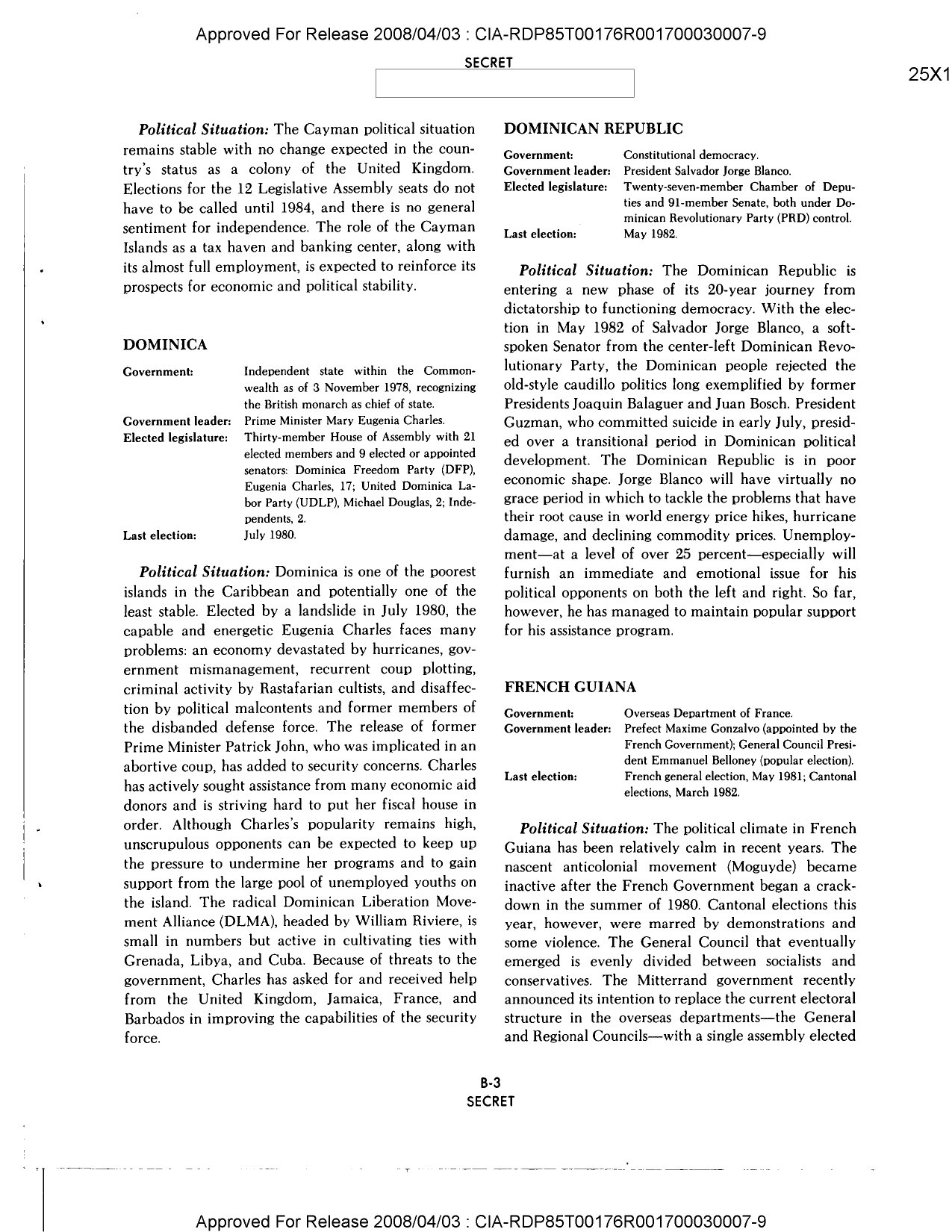
Elected legislature: Twelve-member Legislative Assembly: The governor chairs a four-member Executive Council chosen by and from the Legislative Assembly. There are no political parties, and the two political groupings are based on personality rather than ideology.
Last election: November 1980.
Political Situation: The Cayman political situation remains stable with no change expected in the country’s status as a colony of the United Kingdom. Elections for the 12 Legislative Assembly seats do not have to be called until 1984, and there is no general sentiment for independence. The role of the Cayman Islands as a tax haven and banking center, along with its almost full employment, is expected to reinforce its prospects for economic and political stability.
DOMINICA
Government: Independent state within the Commonwealth as of 3 November 1978, recognizing the British monarch as chief of state.
Government leader: Prime Minister Mary Eugenia Charles.
Elected legislature: Thirty-member House of Assembly with 21 elected members and 9 elected or appointed senators: Dominica Freedom Party (DFP), Eugenia Charles, 17; United Dominica Labor Party (UDLP), Michael Douglas, 2; Independents, 2.
Last election: July 1980.
Political Situation: Dominica is one of the poorest islands in the Caribbean and potentially one of the least stable. Elected by a landslide in July 1980, the capable and energetic Eugenia Charles faces many problems: an economy devastated by hurricanes, government mismanagement, recurrent coup plotting, criminal activity by Rastafarian cultists, and disaffection by political malcontents and former members of the disbanded defense force. The release of former Prime Minister Patrick John, who was implicated in an abortive coup, has added to security concerns. Charles has actively sought assistance from many economic aid donors and is striving hard to put her fiscal house in order. Although Charles’s popularity remains high, unscrupulous opponents can be expected to keep up the pressure to undermine her programs and to gain support from the large pool of unemployed youths on the island. The radical Dominican Liberation Movement Alliance (DLMA), headed by William Riviere, is small in numbers but active in cultivating ties with Grenada, Libya, and Cuba. Because of threats to the government, Charles has asked for and received help from the United Kingdom, Jamaica, France, and Barbados in improving the capabilities of the security force.
DOMINICAN REPUBLIC
Government: Constitutional democracy.
Government leader: President Salvador Jorge Blanco.
Elected legislature: Twenty-seven-member Chamber of Deputies and 91-member Senate, both under Dominican Revolutionary Party (PRD) control.
Last election: May 1982.
Political Situation: The Dominican Republic is entering a new phase of its 20-year journey from dictatorship to functioning democracy. With the election in May 1982 of Salvador Jorge Blanco, a soft-spoken Senator from the center-left Dominican Revolutionary Party, the Dominican people rejected the old-style caudillo politics long exemplified by former Presidents Joaquin Balaguer and Juan Bosch. President Guzman, who committed suicide in early July, presided over a transitional period in Dominican political development. The Dominican Republic is in poor economic shape. Jorge Blanco will have virtually no grace period in which to tackle the problems that have their root cause in world energy price hikes, hurricane damage, and declining commodity prices. Unemployment—at a level of over 25 percent—especially will furnish an immediate and emotional issue for his political opponents on both the left and right. So far, however, he has managed to maintain popular support for his assistance program.
FRENCH GUIANA
Government: Overseas Department of France.
Government leader: Prefect Maxime Gonzalvo (appointed by the French Government); General Council President Emmanuel Belloney (popular election).
Last election: French general election, May 1981; Cantonal elections, March 1982.
Political Situation: The political climate in French Guiana has been relatively calm in recent years. The nascent anticolonial movement (Moguyde) became inactive after the French Government began a crackdown in the summer of 1980. Cantonal elections this year, however, were marred by demonstrations and some violence. The General Council that eventually emerged is evenly divided between socialists and conservatives. The Mitterrand government recently announced its intention to replace the current electoral structure in the overseas departments—the General and Regional Councils—with a single assembly elected by proportional representation some time in 1983. The proposed single assembly and voting procedures will afford the left better representation than at present. The new system represents a threat to departmentalists, who favor remaining an integral part of the Republic, and promises to enliven local politics over the next year.
GRENADA
Government: Independent state within the Commonwealth as of 7 February 1974, recognizing the British monarch as chief of state.
Government leader: Prime Minister Maurice Bishop.
Elected legislature: None.
Last election: December 1976.
Political Situation: Since Bishop’s New Jewel Movement seized power from the corrupt Gairy dictatorship in March 1979—the first such illegal takeover in the English-speaking Caribbean—he has moved deliberately to implant a Cuban-style revolutionary Marxist state. Bishop rules by decree, without a constitution, and has spoken only in vague generalities about creating mass organizations that would constitute a “people’s democracy.” The security forces have the island under firm political control. Bishop could very well be ousted by a shift of factions within his own government, however, but his removal would not alter the government’s Communist bent.
GUADELOUPE
Government: Overseas Department of France.
Government leader: Prefect Guy Maillard; General Council President Lucette Michaux-Chevry.
Last election: French general election, May 1981; Cantonal (General Council) elections, March 1982.
Political Situation: Despite one of the highest standards of living in the Caribbean, the French Department of Guadeloupe has experienced some political turbulence in the last few years. A spate of bombings attributable to local pro-independence groups rocked the island in 1980 and early 1981. The terrorist incidents, however, subsided over the past year. In the recent Cantonal elections, the leftist parties made a significant showing, outpolling the right to win 10 out of 18 contested seats in the General Council. The conservatives—represented by the Gaullist Rally for the Republic—still retain control of the Council, but are plagued by internal splits on almost all issues except their stand against independence. Although the Socialist Party outpolled the Communist Party, the latter remains the best organized and most ideologically homogeneous party in Guadeloupe. The March 1982 elections suggest that the left will do particularly well in next year’s election for a single ruling council. The left has significant strength in the more densely populated urban centers and should profit from the vote based on proportional representation. Moreover, the burgeoning youth majority, facing an unemployment level of over 20 percent, will be increasingly lured by the left’s call for independence and an end to Antillean domination by a minority of white French “colonists.”
GUYANA
Government: Republic with Executive President.
Government leader: Executive President Linden Forbes Burnham.
Elected legislature: Fifty-three-member National Assembly: People’s National Congress, Forbes Burnham, 41; People’s Progressive Party, Cheddi Jagan, 10; United Force, Fielden Singh, 2.
Last election: December 1980.
Political Situation: Prime Minister for many years, Forbes Burnham had himself elected to the newly established position of Executive President in December 1980 in a blatantly fraudulent election. Burnham’s corrupt and brutal regime, whose endurance is based as much on the tolerance of the Guyanese as on Burnham’s own skills, faces increasing danger. Despite Guyana’s wealth of mineral, timber, land, and water resources, its economy is in precipitous decline. Although Burnham appears to be securely entrenched at present, the tide could turn swiftly. As the economy deteriorates, outbreaks of violence will probably increase and could conceivably develop into general disorder reminiscent of the race riots of the early 1960s. Also menacing Guyana is Venezuela’s claim to over five-eighths of the national territory. For the moment, Burnham is playing the dispute as an external threat and attempting to draw Guyanese concerns away from the economic situation.
HAITI
Government: Dictatorship under President-for-Life.
Government leader: President-for-Life Jean-Claude Duvalier.
Elected legislature: Fifty-eight-member Legislative Chamber/National Assembly: Pro-Duvalierist, 57; Independent (Alexandre Lerouge), 1.
Last election: February 1979 (Legislature turns all powers over to the President every year).
Political Situation: After 25 years in power, the Duvalier regime shows no sign of disappearing from the Haitian scene over the medium term. Jean-Claude Duvalier, now in his 11th year as President-for-Life, has demonstrated little of his father’s penchant for violence and has made tentative efforts to improve the quality of life in Haiti. The regime, however, still utilizes control of the security forces, favoritism, and corruption as the basic mechanisms of political survival. Although many Haitian businessmen are disgruntled with Duvalier’s mismanagement of the economy, they have virtually no power base from which to challenge him. Duvalier appears to be firmly in control of the security forces, as ill-prepared as they are. He also benefits from the passive support of the masses, who are too preoccupied with their own survival to play a role in national politics.
JAMAICA
Government: Independent state within the Commonwealth as of 6 August 1962, recognizing the British monarch as chief of state.
Government leader: Prime Minister Edward Seaga
Elected legislature: Sixty-member House of Representatives: Jamaica Labor Party (JLP), Edward Seaga, 51; People’s National Party (PNP), Michael Manley, 9.
Last election: October 1980.
Political Situation: Elected by an overwhelming political mandate, the Seaga government has taken some steps to correct serious structural weaknesses and to restore the confidence needed to attract foreign investment. Politically inspired terrorism has been brought under control, although serious crime on the island—particularly in Kingston—remains a problem. The badly battered PNP of former Prime Minister Michael Manley remains under his control. Manley shows no signs of changing the party’s orientation, although he is aware of the need to alter the party’s image if he is to regain any measure of popular support. The small but energetic Communist Worker’s Party of Jamaica, headed by Trevor Munroe, is conducting a strong campaign to gain a foothold within the island’s powerful labor movement. Both Manley and Munroe can be expected to make life difficult for Seaga as the island’s recovery moves more slowly than expected. Besieged by power outages, water shortages, labor disorders, and other troubles, Seaga will be vulnerable to growing political attack by his opponents. Cuban-trained cadres still possess weapons, and if Seaga begins to lose popular support they could renew terrorism aimed at sabotaging his recovery program.
MARTINIQUE
Government: Overseas Department of France.
Government leader: Prefect Jean Chevance; General Council President Emile Maurice.
Last election: French general election, May 1981; Cantonal (General Council) elections, March 1982.
Political Situation: Like Guadeloupe, Martinique is represented in the metropole by three Deputies and two Senators. With the election of a socialist government in France, a significant program of governmental decentralization currently is being undertaken. Decentralization already has brought some decrease in the power of the prefect and should produce a significant increase in the powers of locally elected legislatures in the near term. Although the left made a good showing in the March 1982 elections, the right still maintains a significant majority in the General Council of Martinique (24 seats to the left’s 12). Unlike their counterparts in Guadeloupe, the Communist Party of Martinique has had less success in gaining popular support, mainly because of the effective campaigning of the island’s non-Communist left. The Socialists—represented primarily by the Martinique Progressive Party—have their principal strength in the capital city and in the person of longtime Deputy, Mayor of Fort-de-France, and renowned poet, Aime Cesaire. The political outlook is a stable one.
MONTSERRAT
Government: British crown colony (with limited local autonomy).
Government leader: Chief Minister John Osbourne.
Elected legislature: Seven-member Legislative Council: People’s Liberation Movement (PLM), John Osbourne, 6; Progressive Democratic Party (PDP), Austin Bramble, 1.
Last election: November 1978.
Political Situation: Under moderate and practical leadership, Montserrat is one of the more stable territories in the Caribbean. The government is taking its time on the subject of independence, and there are no really divisive political issues. Recently, a left-leaning People’s Christian Alliance Party was formed by George Irish, head of the Montserrat Allied Workers Union; however, barring unforeseen circumstances, the highly popular Osbourne should win the next election, which is due to be held before March 1983. The Montserratians are staunchly pro-US and anti-Communist.
NETHERLANDS ANTILLES
Government: Self-governing territory of the Kingdom of the Netherlands.
Government leader: Minister-President Domenico Martina
Elected legislature:
- Curacao: Movement for a New Antilles (MAN), Domenico Martina, 6; Democratic Party (DP), 3; National People’s Party (NVP), 3.
- Aruba: People’s Electoral Movement (MEP), G. F. Croes, 5; Aruban Patriotic Party (PPA), 1; Arubaanse Volks Parti, 2.
- Bonaire: Democratic Party Bonaire (UPB), 1.
- Windwards: Windward Islands Democratic Party (DPWI), 1.
Last election: June 1982.
Political Situation: The Netherlands Antilles currently is a semi-self-governing territory within the Kingdom of the Netherlands, but separatist demands from Aruba have compelled the Dutch to discuss plans for independence. Aruba, under its stubborn and charismatic leader, Gilberto F. “Betico” Croes, is determined to break away from Curacao. Croes is demanding separate status pending restructuring of the Netherlands Antilles and approval of unilateral independence for Aruba. Among schemes under study are commonwealth or associated states status. St. Eustatius, Saba, and St. Maarten prefer to remain under the Dutch wing and do not wish to be linked with Aruba, Bonaire, and Curacao. While the Dutch are attempting to keep the islands within some sort of loose arrangement, the tendency toward fragmentation appears to be gathering strength.
ST. CHRISTOPHER-NEVIS
Government: British associated state (with full internal autonomy).
Government leader: Premier Kennedy Simmonds.
Elected legislature: Nine-member House of Assembly: St. Kitts Labor Party (SKLP), Lee Moore, 4; People’s Action Movement (PAM), Kennedy Simmonds, 3; Nevis Reformation Party (NRP), Simeon Daniel, 2.
Last election: February 1980.
Political Situation: The government’s decision to table a proposal on independence is the islands’ major political issue. The government hopes to conclude independence negotiations with the British by the end of this year, but the timetable for achieving it is not yet clear. St. Christopher-Nevis formally agreed in December 1980 to relinquish its claim to Anguilla. (Anguilla will revert to crown colony status upon St. Christopher-Nevis’s independence.) The Simmonds government reportedly has included provisions for increased Nevis representation in a post-independence arrangement, clearly to counter Nevisian separatism, which has shown increased signs of revival. The independence issue is certain to remain a contentious one. The opposition labor party claims that the PAM-NRP coalition has no mandate to obtain it. Relations between Simmonds and his Nevis coalition partners may also be strained by the independence issue.
ST. LUCIA
Government: Independent state within the Commonwealth as of 1 March 1967, recognizing the British monarch as chief of state.
Government leader: Prime Minister John Compton.
Elected legislature: Seventeen-member House of Assembly: United Workers’ Party (UWP), John Compton, 14; St. Lucia Labor Party (SLP), Peter Josie, 2; Progressive Labor Party (PLP), George Odlum, 1.
Last election: May 1982.
Political Situation: A sweeping electoral victory for John Compton’s United Workers’ Party in May 1982 dealt a crushing defeat to leftist leaders whose internecine struggle for power had weakened the ruling St. Lucia Labor Party. After three years of the feud, the Labor Party had alienated most people on the island who blame the infighting for the steady record of economic deterioration. The decision of ambitious former Deputy Prime Minister George Odlum to bolt the St. Lucia Labor Party in April 1981 and form his own Progressive Labor Party left the government under the shaky leadership of a political dark horse, Winston Cenac, whose weak government finally collapsed in January 1982. An interim government headed by Michael Pilgrim, an Odlum protégé, performed a caretaker function until elections were held. Odlum’s defeat and the defeat suffered by Peter Josie, leftist former Foreign Minister, who was chosen to head the rump faction of the Labor Party, gave Compton’s middle-of-the-road party a strong mandate to find solutions to the economic malaise. Despite his popular victory at the polls, Compton faces problems similar to Seaga’s in Jamaica. If radical leaders Odlum and Josie, who have ties to Grenada’s Bishop as well as the Libyans and Cubans, decide to bury their personal rivalries, they might be able to forge a stronger opposition to Compton. Both antagonists are attempting to build up a youth following from among the large number of urban unemployed.
ST. VINCENT AND THE GRENADINES
Government: Independent state within the Commonwealth as of 27 October 1979, recognizing the British monarch as chief of state.
Government leader: Prime Minister Milton Cato.
Elected legislature: Thirteen elected representatives in 19-member House of Assembly: St. Vincent Labor Party (SVLP), Milton Cato, 11; New Democratic Party (NDP), James Mitchell, 2.
Last election: December 1979.
Political Situation: Prime Minister Cato’s government (elected in 1979 for five years) seems to be stable in the near term. The economy is showing signs of recovery after severe blows from volcanic eruptions and hurricanes; however, St. Vincent remains one of the poorest countries in the Eastern Caribbean. A rapidly growing population, high unemployment, and inflation could lead to serious social discontent. The radical leftist United People’s Movement (UPM) made a respectable showing in the 1979 election (14 percent) and is undeniably attractive to the growing number of unemployed youth. The antiestablishment religious cult of Rastafarianism is growing fast. The small country also faces a security threat in the strong separatist movements in its dependency of the Grenadine Islands, which it shares with Grenada. So far, Cato’s government appears to be meeting its many problems with a minimum of political strain. The SVLP should remain in power for the foreseeable future, since it is unlikely that the UPM will obtain a majority, and the NDP is strictly a Grenadine party.
SURINAME
Government: Nonconstitutional civilian government appointed by military junta; rule by decree.
Government leader: President Lachmipersad Frederik Ramdat Misier (ceremonial); Prime Minister Henri Neijhorst; Army Commander Desire Bouterse (de facto ruler).
Last election: 1978.
Political Situation: Army Commander Desire Bouterse emerged as Suriname’s strongman six months after he and a group of fellow noncommissioned officers toppled the constitutionally elected government of Henck Arron in February 1980. Since then, Bouterse has exerted effective control over the civilian government and military establishment, although he has little popular support. The political situation is likely to become highly unstable over the period of this estimate as labor unions and other democratic institutions in Suriname become increasingly assertive in resisting the leftward drift of the government and the presence of the military in it. Although Bouterse and his Foreign Minister Harvey Naarendorp claim that their foreign policy is nonaligned and nationalistic, they are directing Suriname on a leftist and pro-Cuban course. In order to entrench himself more securely in power, Bouterse is looking to Cuba and Grenada as models, and he is taking advice and some limited military assistance from the Castro regime.
TRINIDAD AND TOBAGO
Government: Parliamentary democracy.
Government leader: Prime Minister George Chambers.
Elected legislature: Thirty-six-member House of Representatives: People’s National Movement (PNM), George Chambers, 26; United Labor Front (ULF), Basdeo Panday, 8; Democratic Action Congress (DAC), A. N. R. Robinson, 2.
Last election: November 1981.
Political Situation: George Chambers, who was appointed Prime Minister following the death in March 1981 of longtime Trinidadian leader Dr. Eric Williams, led the ruling People’s National Movement to a sweeping victory in elections held the following November. The black-dominated party retained its traditional 24 seats and picked up two more at the expense of the opposition United Labor Front. This reflected both the superior party machinery of the PNM and the disunity of the largely East Indian opposition groups. The winning campaign strategy successfully discredited PNM maverick Karl Hudson-Phillips and his Organization for National Reconstruction as a tool of business, linked to foreign interests. The country has problems of inefficient government, Tobago separatism, and racial dichotomy, but none of them are expected to develop serious proportions in the medium term.
TURKS AND CAICOS ISLANDS
Government: British crown colony.
Government leader: Chief Minister Norman Saunders.
Elected legislature: Progressive National Party, Norman Saunders, 8; People’s Democratic Movement, Oswald Skippings, 3.
Last election: November 1980.
Political Situation: Although plagued with instability and disorder in the recent past, this island group appears to have settled down under businessman Norman Saunders. He has pushed back plans for independence by eight to 10 years and is concentrating on economic development. One of the country’s biggest problems is the large-scale narcotics transshipment flow through the islands which has brought money but, with it, corruption and organized crime influence. Because the islands are too small and poor to be an independent country, various plans have been constructed to associate it with the Bahamas, Bermuda, or even Canada. None of the plans seems likely to succeed. So far, Saunders enjoys a fair amount of popular support, but this support could easily fade. The country has experienced some political violence in the past. Opposition leader Skippings appears to be biding his time, waiting for Saunders to fail.
Source:
Link:
Internal Link:
Date:
November 30, 1982