The Making of Brazilian Foreign Policy 1983
CIA-RDP84S00552R000200130005-0
// Lots of the text is censored.
A Research Paper
This paper was prepared by [CENSORED] Office of African and Latin American Analysis. It was coordinated with the Directorate of Operations and the National Intelligence Council [CENSORED] . Comments and queries are welcome and may be directed to the Chief, South America Division, ALA, [CENSORED]
Key Judgments
nformation available as of 16 May 1983 was used in this report.
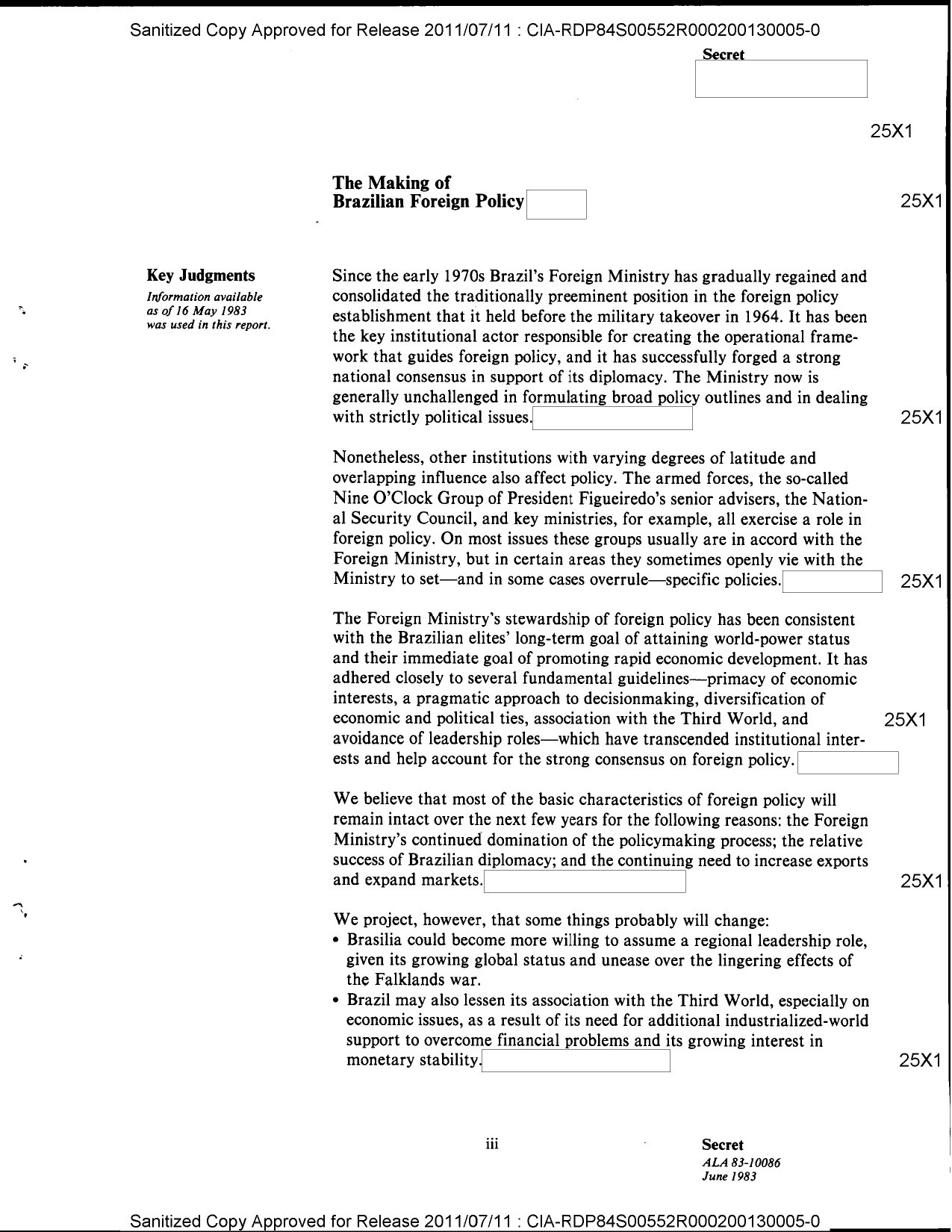
Since the early 1970s Brazil’s Foreign Ministry has gradually regained and consolidated the traditionally preeminent position in the foreign policy establishment that it held before the military takeover in 1964. It has been the key institutional actor responsible for creating the operational framework that guides foreign policy, and it has successfully forged a strong national consensus in support of its diplomacy. The Ministry now is generally unchallenged in formulating broad policy outlines and in dealing with strictly political issues.
Nonetheless, other institutions with varying degrees of latitude and overlapping influence also affect policy. The armed forces, the so-called Nine O’Clock Group of President Figueiredo’s senior advisers, the National Security Council, and key ministries, for example, all exercise a role in foreign policy. On most issues these groups usually are in accord with the Foreign Ministry, but in certain areas they sometimes openly vie with the Ministry to set—and in some cases overrule—specific policies.
The Foreign Ministry’s stewardship of foreign policy has been consistent with the Brazilian elites’ long-term goal of attaining world-power status and their immediate goal of promoting rapid economic development. It has adhered closely to several fundamental guidelines—primacy of economic interests, a pragmatic approach to decisionmaking, diversification of economic and political ties, association with the Third World, and avoidance of leadership roles—which have transcended institutional interests and help account for the strong consensus on foreign policy.
We believe that most of the basic characteristics of foreign policy will remain intact over the next few years for the following reasons: the Foreign Ministry’s continued domination of the policymaking process; the relative success of Brazilian diplomacy; and the continuing need to increase exports and expand markets.
We project, however, that some things probably will change:
- Brasilia could become more willing to assume a regional leadership role, given its growing global status and unease over the lingering effects of the Falklands war.
- Brazil may also lessen its association with the Third World, especially on economic issues, as a result of its need for additional industrialized-world support to overcome financial problems and its growing interest in monetary stability.
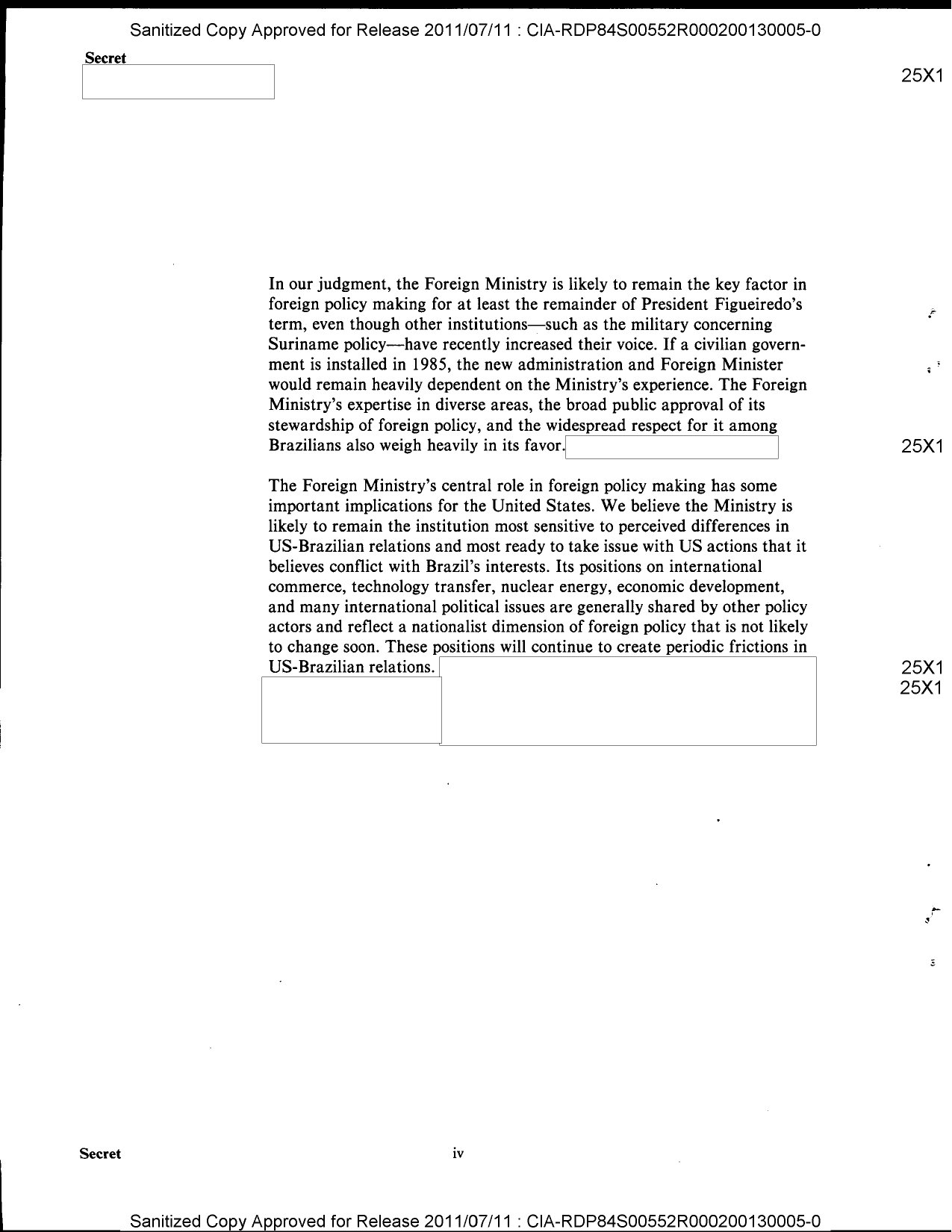
In our judgment, the Foreign Ministry is likely to remain the key factor in foreign policy making for at least the remainder of President Figueiredo’s term, even though other institutions—such as the military concerning Suriname policy—have recently increased their voice. If a civilian government is installed in 1985, the new administration and Foreign Minister would remain heavily dependent on the Ministry’s experience. The Foreign Ministry’s expertise in diverse areas, the broad public approval of its stewardship of foreign policy, and the widespread respect for it among Brazilians also weigh heavily in its favor.
The Foreign Ministry’s central role in foreign policy making has some important implications for the United States. We believe the Ministry is likely to remain the institution most sensitive to perceived differences in US-Brazilian relations and most ready to take issue with US actions that it believes conflict with Brazil’s interests. Its positions on international commerce, technology transfer, nuclear energy, economic development, and many international political issues are generally shared by other policy actors and reflect a nationalist dimension of foreign policy that is not likely to change soon. These positions will continue to create periodic frictions in US-Brazilian relations.
Contents
| Section | Page |
|---|---|
| Key Judgments | iii |
| Introduction | 1 |
| The Foreign Policy Establishment | 1 |
| Itamaraty | 1 |
| Other Institutional Actors | 2 |
| Dimensions of Foreign Policy | 6 |
| Operational Guidelines | 6 |
| Constancy Versus Change | 9 |
| Outlook | 10 |
Introduction
Since the early 1970s, Brazil’s Foreign Ministry has gradually regained and consolidated its traditionally preeminent position in foreign policy making. It has successfully forged a strong national consensus in support of its diplomacy and is now generally unchallenged in initiating broad policy outlines and dealing with clearly political issues. Its broad expertise, institutional aggressiveness, and the general liberalization of the Brazilian political process are the primary factors accounting for its reemergence.
We believe the Foreign Ministry’s reemergence has important implications for the formulation and content of Brazilian foreign policy. This paper examines the institutional dimension of Brazilian foreign policy, the dynamics of foreign policy making, and the key personalities that influence its formulation. It also examines the tenets that have guided recent foreign policy and have provided a constancy that transcends institutional interests. Finally, the paper assesses the pressures for change in Brazilian diplomacy and the prospects for Brazilian foreign policy in view of the Foreign Ministry’s reemergence.
The Foreign Policy Establishment
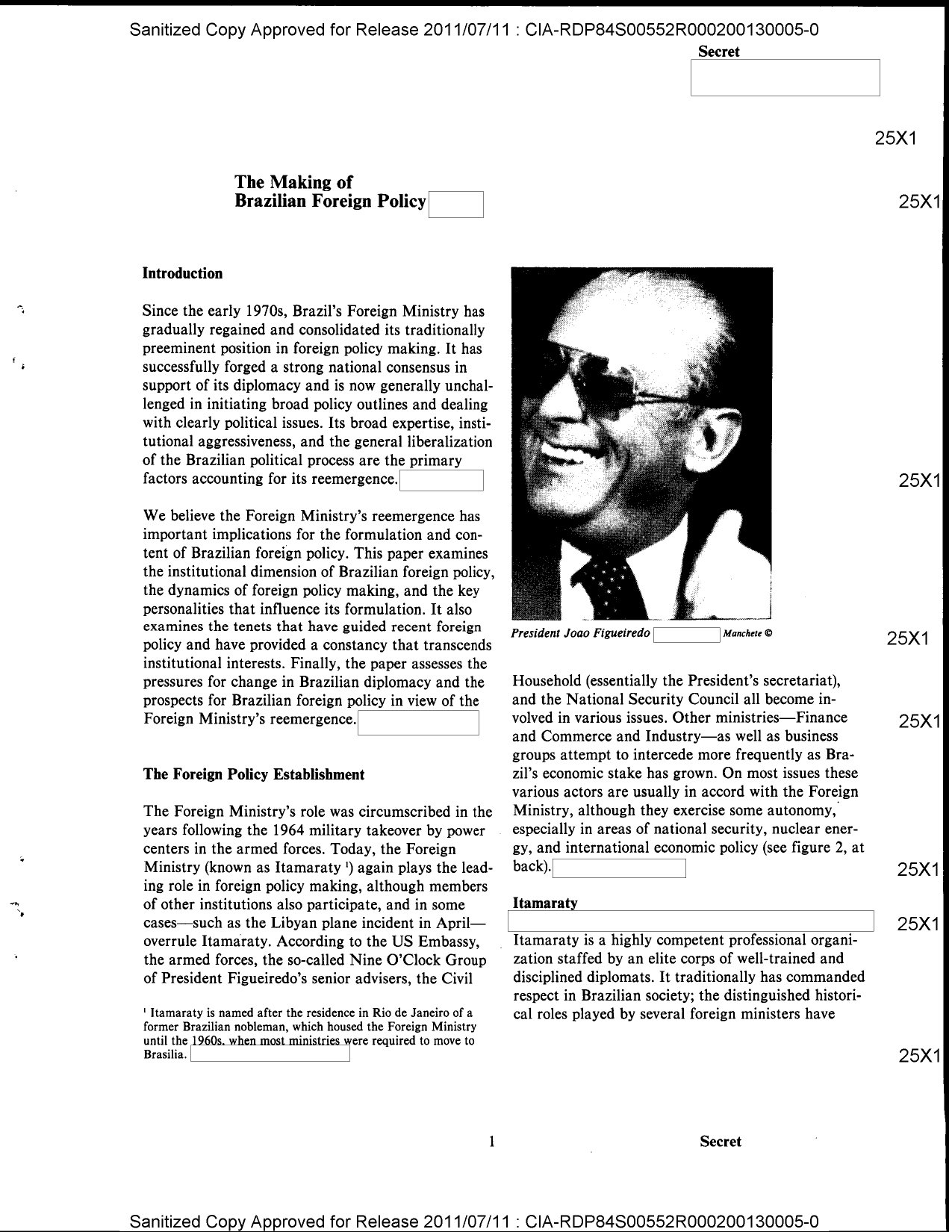
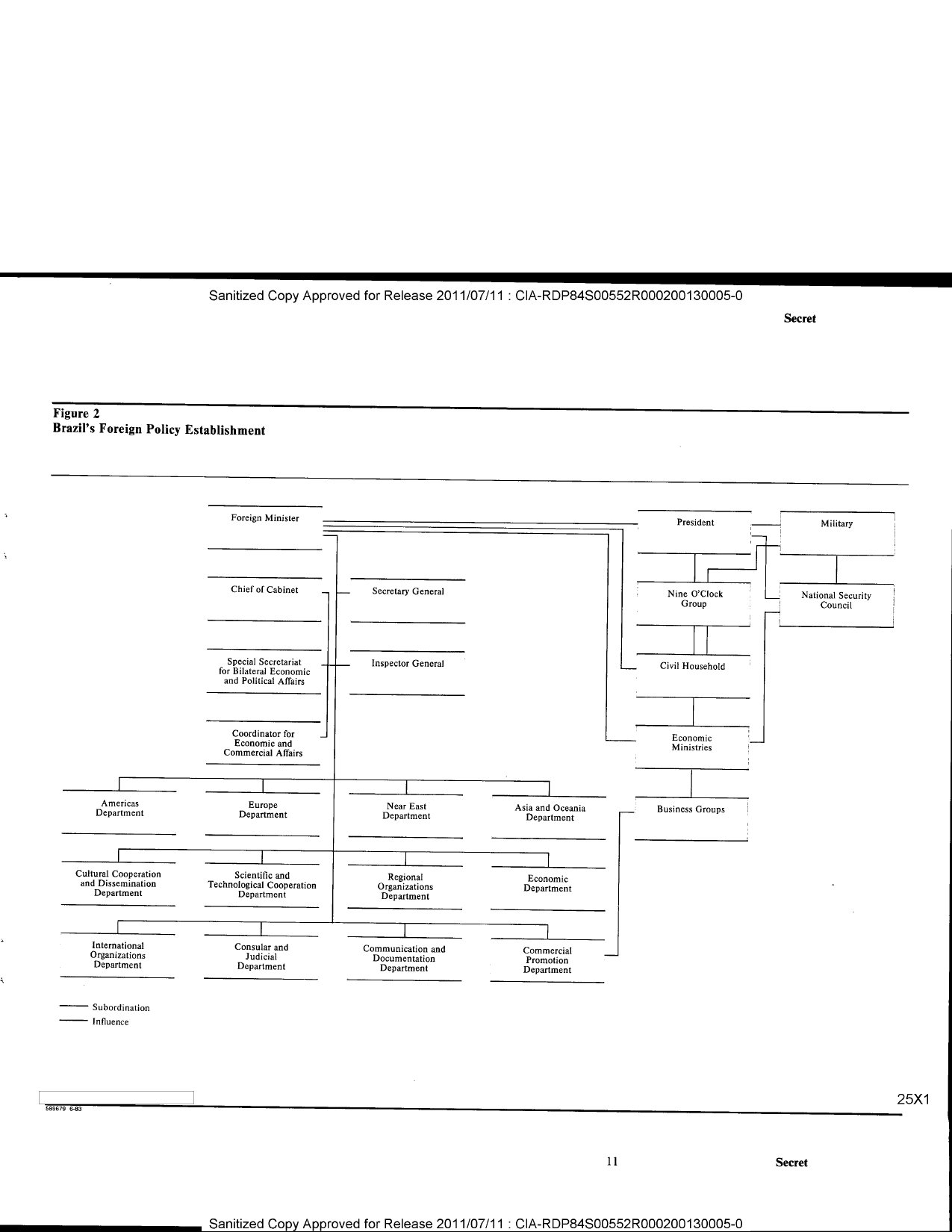
The Foreign Ministry’s role was circumscribed in the years following the 1964 military takeover by power centers in the armed forces. Today, the Foreign Ministry (known as Itamaraty¹) again plays the leading role in foreign policy making, although members of other institutions also participate, and in some cases—such as the Libyan plane incident in April—overrule Itamaraty. According to the US Embassy, the armed forces, the so-called Nine O’Clock Group of President Figueiredo’s senior advisers, the Civil Household (essentially the President’s secretariat), and the National Security Council all become involved in various issues. Other ministries—Finance and Commerce and Industry—as well as business groups attempt to intercede more frequently as Brazil’s economic stake has grown. On most issues these various actors are usually in accord with the Foreign Ministry, although they exercise some autonomy, especially in areas of national security, nuclear energy, and international economic policy (see figure 2, at back).
Itamaraty
Itamaraty is a highly competent professional organization staffed by an elite corps of well-trained and disciplined diplomats. It traditionally has commanded respect in Brazilian society; the distinguished historical roles played by several foreign ministers have enhanced its public esteem.
[CENSORED] the excellent quality of political and economic analysis produced by Brazilian diplomats worldwide.
Itamaraty is divided into various geographic and functional departments, but decisionmaking is highly centralized. [CENSORED]
this system often produces internal frictions. Brazilian diplomats, nonetheless, are discreet.
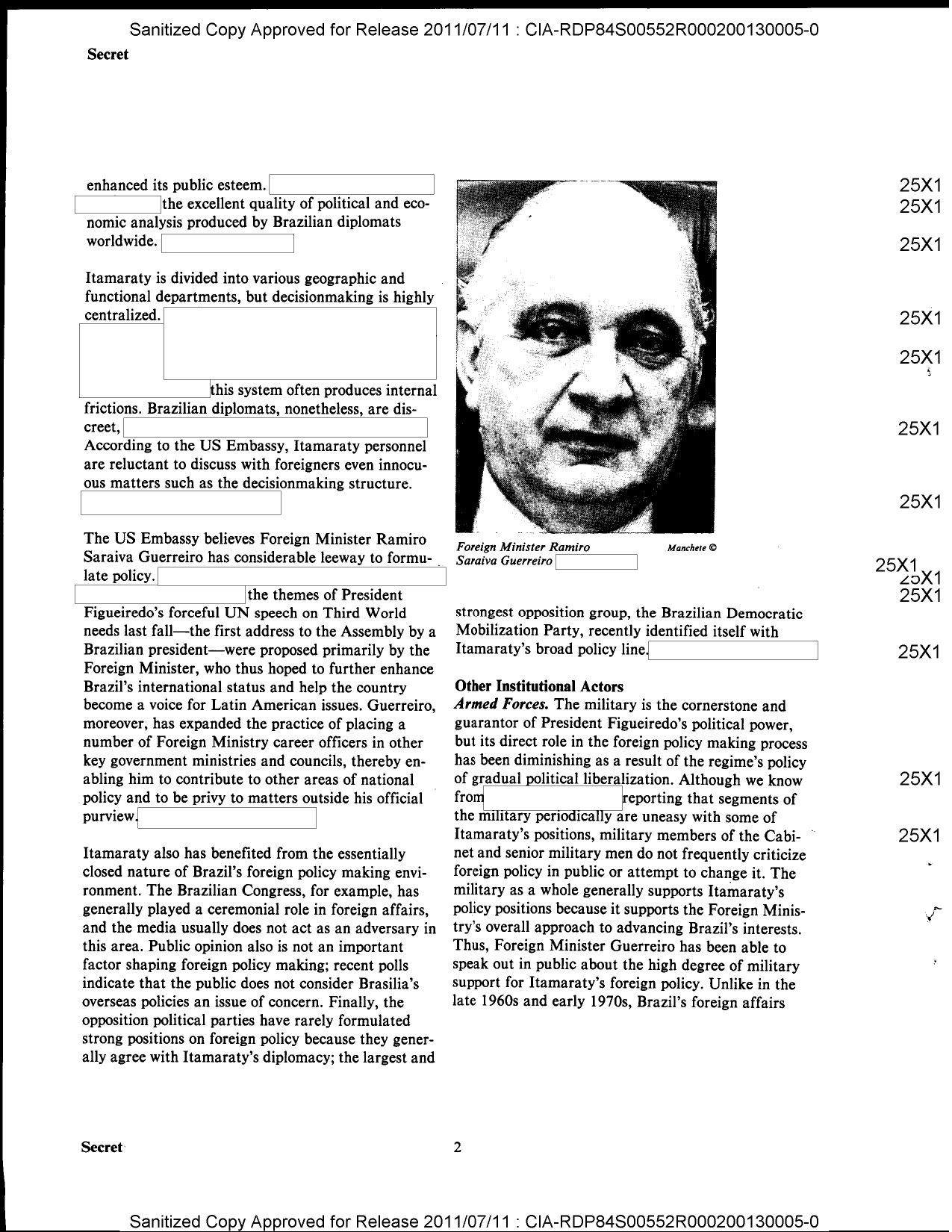
According to the US Embassy, Itamaraty personnel are reluctant to discuss with foreigners even innocuous matters such as the decisionmaking structure. The US Embassy believes Foreign Minister Ramiro Saraiva Guerreiro has considerable leeway to formulate policy. [CENSORED]
the themes of President Figueiredo’s forceful UN speech on Third World needs last fall—the first address to the Assembly by a Brazilian president—were proposed primarily by the Foreign Minister, who thus hoped to further enhance Brazil’s international status and help the country become a voice for Latin American issues. Guerreiro, moreover, has expanded the practice of placing a number of Foreign Ministry career officers in other key government ministries and councils, thereby enabling him to contribute to other areas of national policy and to be privy to matters outside his official purview.
Itamaraty also has benefited from the essentially closed nature of Brazil’s foreign policy making environment. The Brazilian Congress, for example, has generally played a ceremonial role in foreign affairs, and the media usually does not act as an adversary in this area. Public opinion also is not an important factor shaping foreign policy making; recent polls indicate that the public does not consider Brasilia’s overseas policies an issue of concern. Finally, the opposition political parties have rarely formulated strong positions on foreign policy because they generally agree with Itamaraty’s diplomacy; the largest and strongest opposition group, the Brazilian Democratic Mobilization Party, recently identified itself with Itamaraty’s broad policy line.
Other Institutional Actors
Armed Forces.
The military is the cornerstone and guarantor of President Figueiredo’s political power, but its direct role in the foreign policy making process has been diminishing as a result of the regime’s policy of gradual political liberalization. Although we know from reporting that segments of the military periodically are uneasy with some of Itamaraty’s positions, military members of the Cabinet and senior military men do not frequently criticize foreign policy in public or attempt to change it. The military as a whole generally supports Itamaraty’s policy positions because it supports the Foreign Ministry’s overall approach to advancing Brazil’s interests.
Thus, Foreign Minister Guerreiro has been able to speak out in public about the high degree of military support for Itamaraty’s foreign policy. Unlike in the late 1960s and early 1970s, Brazil’s foreign affairs commentators no longer routinely refer to the country’s “military” or “dual” diplomacy when describing the influence of the armed forces on foreign policy.
Nonetheless, the Brazilian propensity to resolve problems by personal contact permits significant informal contributions into policymaking. Both the Army Minister and the Chief of the Military Household (the President’s key man on military matters), as well as many senior retired and active-duty officers, are close friends of President Figueiredo and privately make their views known to him. Within a small range of issues—such as questions pertaining to Cuba—the military probably still maintains a veto power over foreign policy. The US Embassy reports, for example, that the Chief of the National Intelligence Service (SNI), an active-duty general close to the President, was instrumental in blocking the opening of a PLO office in Brazil. The US Embassy reported that Itamaraty proposed this PLO presence.
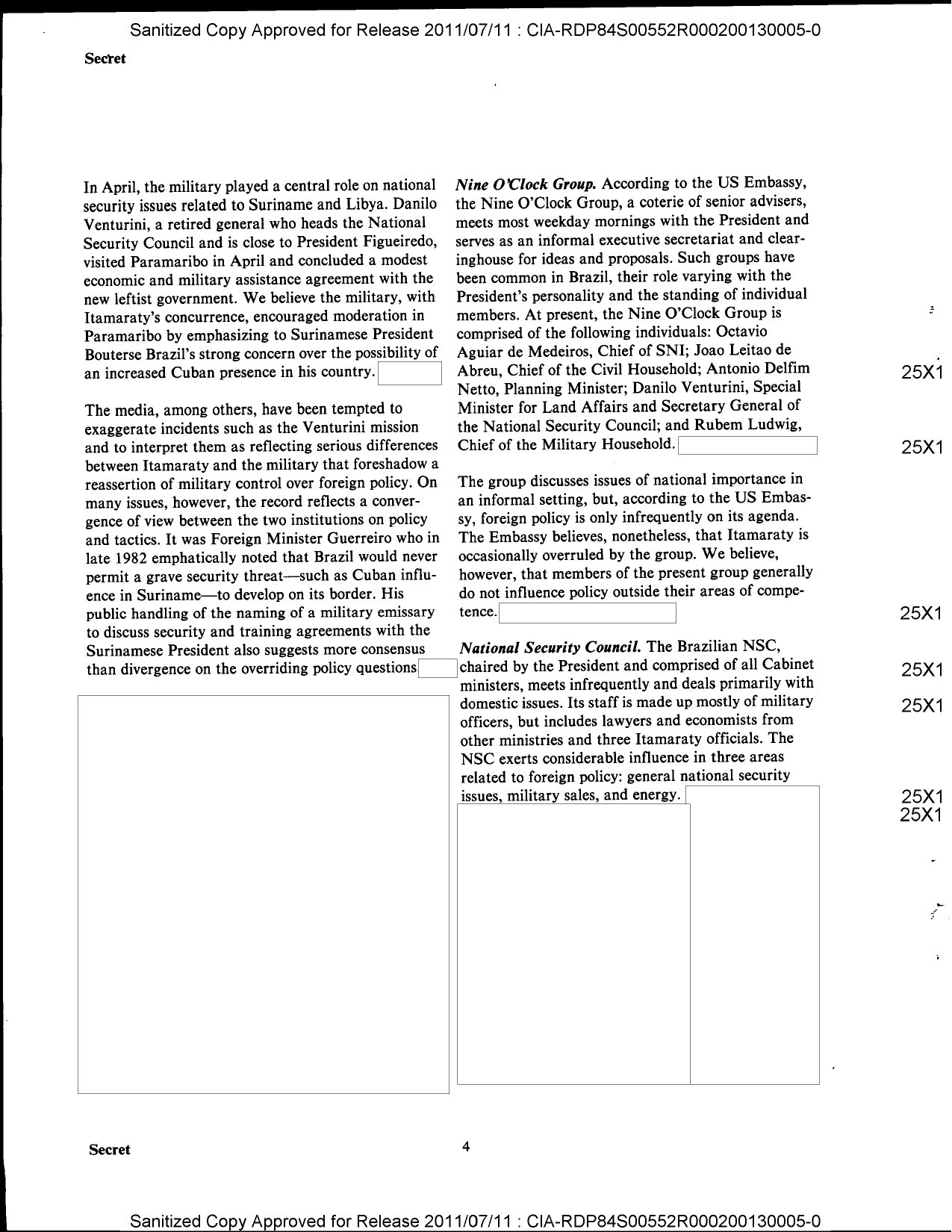
In April, the military played a central role on national security issues related to Suriname and Libya. Danilo Venturini, a retired general who heads the National Security Council and is close to President Figueiredo, visited Paramaribo in April and concluded a modest economic and military assistance agreement with the new leftist government. We believe the military, with Itamaraty’s concurrence, encouraged moderation in Paramaribo by emphasizing to Surinamese President Bouterse Brazil’s strong concern over the possibility of an increased Cuban presence in his country.
The media, among others, have been tempted to exaggerate incidents such as the Venturini mission and to interpret them as reflecting serious differences between Itamaraty and the military that foreshadow a reassertion of military control over foreign policy. On many issues, however, the record reflects a convergence of view between the two institutions on policy and tactics. It was Foreign Minister Guerreiro who in late 1982 emphatically noted that Brazil would never permit a grave security threat—such as Cuban influence in Suriname—to develop on its border. His public handling of the naming of a military emissary to discuss security and training agreements with the Surinamese President also suggests more consensus than divergence on the overriding policy questions.
Nine O’Clock Group.
According to the US Embassy, the Nine O’Clock Group, a coterie of senior advisers, meets most weekday mornings with the President and serves as an informal executive secretariat and clearinghouse for ideas and proposals. Such groups have been common in Brazil, their role varying with the President’s personality and the standing of individual members. At present, the Nine O’Clock Group is comprised of the following individuals: Octavio Aguiar de Medeiros, Chief of SNI; Joao Leitao de Abreu, Chief of the Civil Household; Antonio Delfim Netto, Planning Minister; Danilo Venturini, Special Minister for Land Affairs and Secretary General of the National Security Council; and Rubem Ludwig, Chief of the Military Household.
The group discusses issues of national importance in an informal setting, but, according to the US Embassy, foreign policy is only infrequently on its agenda. The Embassy believes, nonetheless, that Itamaraty is occasionally overruled by the group. We believe, however, that members of the present group generally do not influence policy outside their areas of competence.
National Security Council.
The Brazilian NSC, chaired by the President and comprised of all Cabinet ministers, meets infrequently and deals primarily with domestic issues. Its staff is made up mostly of military officers, but includes lawyers and economists from other ministries and three Itamaraty officials. The NSC exerts considerable influence in three areas related to foreign policy: general national security issues, military sales, and energy.
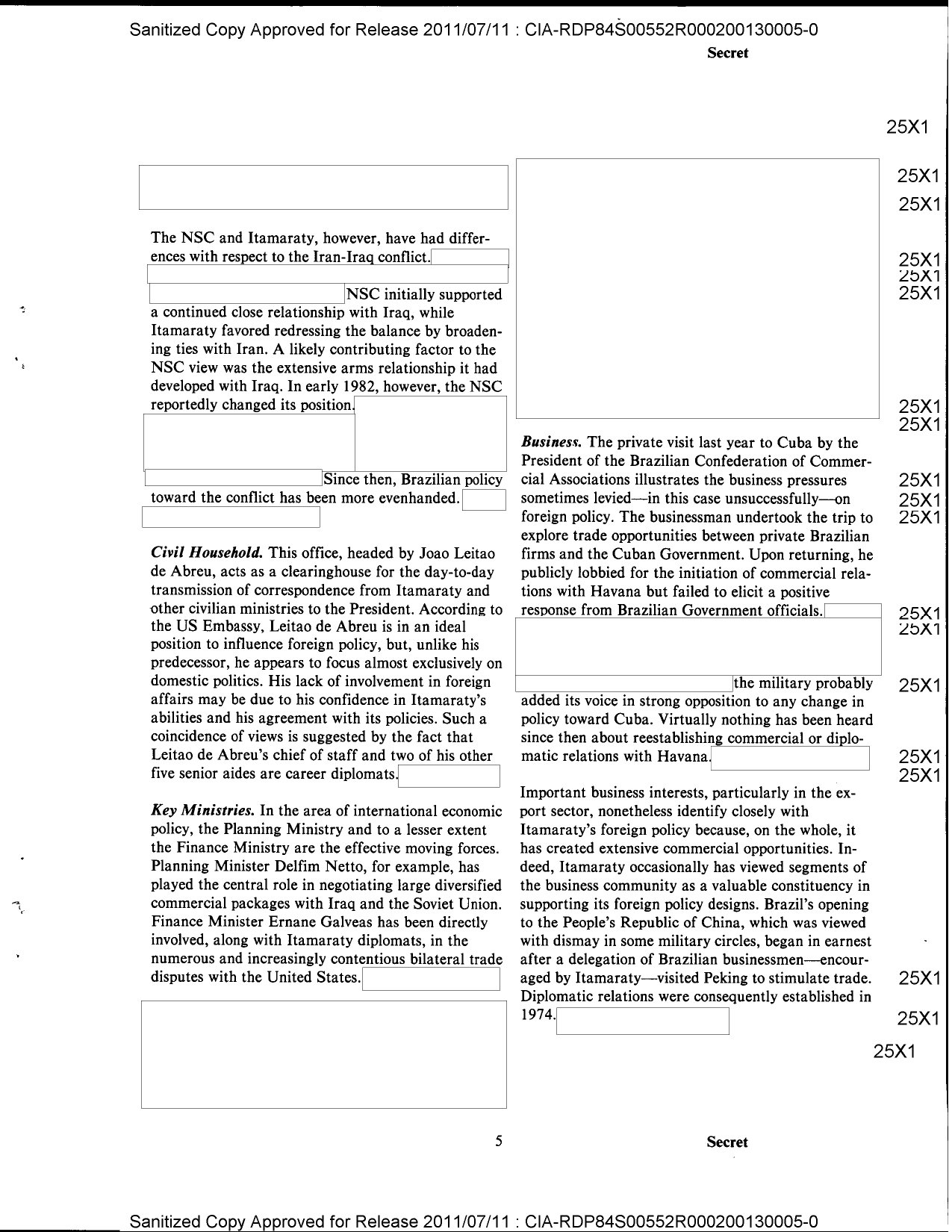
The NSC and Itamaraty, however, have had differences with respect to the Iran-Iraq conflict. NSC initially supported a continued close relationship with Iraq, while Itamaraty favored redressing the balance by broadening ties with Iran. A likely contributing factor to the NSC view was the extensive arms relationship it had developed with Iraq. In early 1982, however, the NSC reportedly changed its position. Since then, Brazilian policy toward the conflict has been more evenhanded.
Civil Household.
This office, headed by Joao Leitao de Abreu, acts as a clearinghouse for the day-to-day transmission of correspondence from Itamaraty and other civilian ministries to the President. According to the US Embassy, Leitao de Abreu is in an ideal position to influence foreign policy, but, unlike his predecessor, he appears to focus almost exclusively on domestic politics. His lack of involvement in foreign affairs may be due to his confidence in Itamaraty’s abilities and his agreement with its policies. Such a coincidence of views is suggested by the fact that Leitao de Abreu’s chief of staff and two of his other five senior aides are career diplomats.
Key Ministries.
In the area of international economic policy, the Planning Ministry and to a lesser extent the Finance Ministry are the effective moving forces. Planning Minister Delfim Netto, for example, has played the central role in negotiating large diversified commercial packages with Iraq and the Soviet Union. Finance Minister Ernane Galveas has been directly involved, along with Itamaraty diplomats, in the numerous and increasingly contentious bilateral trade disputes with the United States.
Business.
The private visit last year to Cuba by the President of the Brazilian Confederation of Commercial Associations illustrates the business pressures sometimes levied—in this case unsuccessfully—on foreign policy. The businessman undertook the trip to explore trade opportunities between private Brazilian firms and the Cuban Government. Upon returning, he publicly lobbied for the initiation of commercial relations with Havana but failed to elicit a positive response from Brazilian Government officials. the military probably added its voice in strong opposition to any change in policy toward Cuba. Virtually nothing has been heard since then about reestablishing commercial or diplomatic relations with Havana.
Important business interests, particularly in the export sector, nonetheless identify closely with Itamaraty’s foreign policy because, on the whole, it has created extensive commercial opportunities. Indeed, Itamaraty occasionally has viewed segments of the business community as a valuable constituency in supporting its foreign policy designs. Brazil’s opening to the People’s Republic of China, which was viewed with dismay in some military circles, began in earnest after a delegation of Brazilian businessmen—encouraged by Itamaraty—visited Peking to stimulate trade. Diplomatic relations were consequently established in 1974.
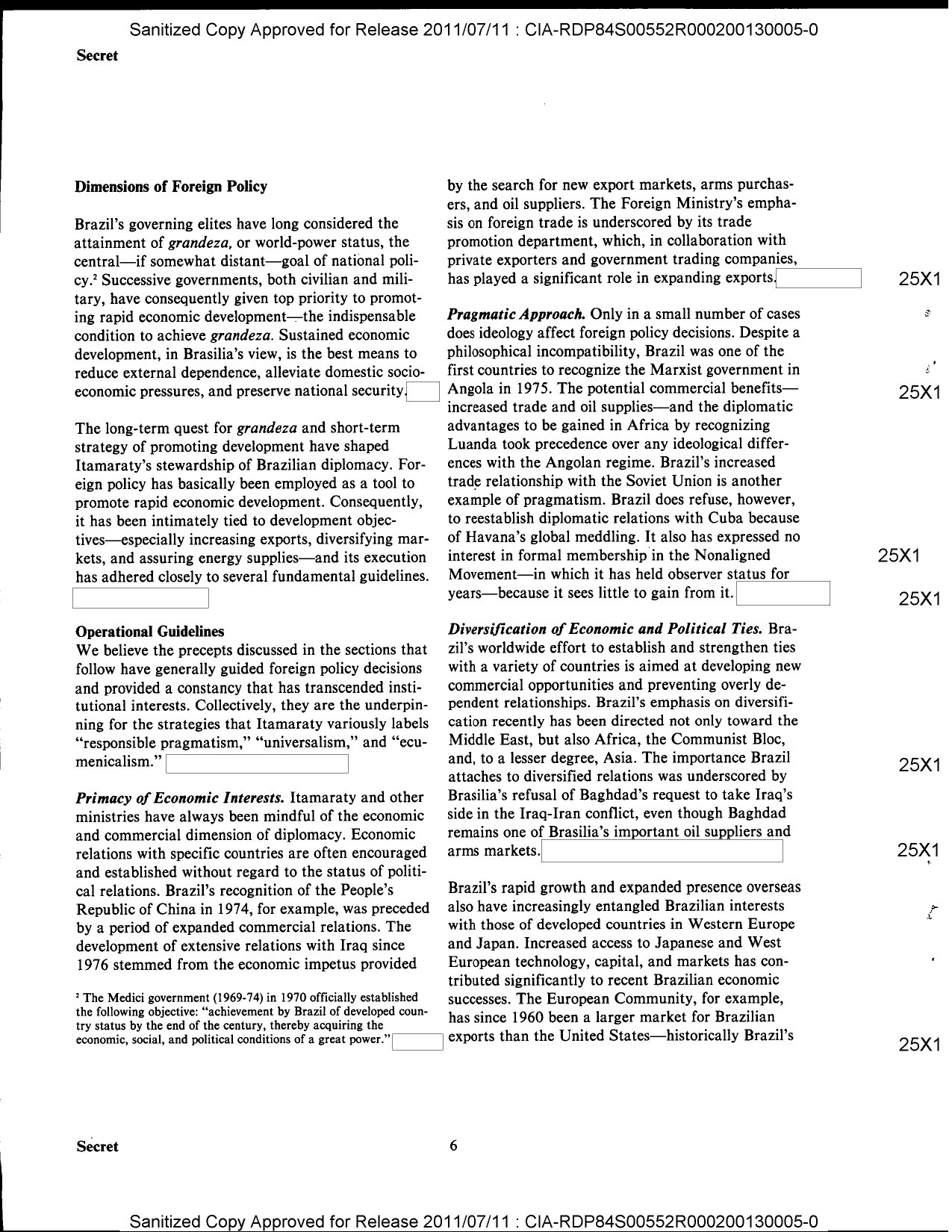
Dimensions of Foreign Policy
Brazil’s governing elites have long considered the attainment of grandeza, or world-power status, the central-if somewhat distant-goal of national policy. Successive governments, both civilian and military, have consequently given top priority to promoting rapid economic development-the indispensable condition to achieve grandeza. Sustained economic development, in Brasilia’s view, is the best means to reduce external dependence, alleviate domestic socioeconomic pressures, and preserve national security.
The long-term quest for grandeza and short-term strategy of promoting development have shaped Itamaraty’s stewardship of Brazilian diplomacy. Foreign policy has basically been employed as a tool to promote rapid economic development. Consequently, it has been intimately tied to development objectives-especially increasing exports, diversifying markets, and assuring energy supplies-and its execution has adhered closely to several fundamental guidelines.
Operational Guidelines
We believe the precepts discussed in the sections that follow have generally guided foreign policy decisions and provided a constancy that has transcended institutional interests. Collectively, they are the underpinning for the strategies that Itamaraty variously labels “responsible pragmatism,” “universalism,” and “ecumenicalism.”
Primacy of Economic Interests.
Itamaraty and other ministries have always been mindful of the economic and commercial dimension of diplomacy. Economic relations with specific countries are often encouraged and established without regard to the status of political relations. Brazil’s recognition of the People’s Republic of China in 1974, for example, was preceded by a period of expanded commercial relations. The development of extensive relations with Iraq since 1976 stemmed from the economic impetus provided by the search for new export markets, arms purchasers, and oil suppliers. The Foreign Ministry’s emphasis on foreign trade is underscored by its trade promotion department, which, in collaboration with private exporters and government trading companies, has played a significant role in expanding exports.
Pragmatic Approach.
Only in a small number of cases does ideology affect foreign policy decisions. Despite a philosophical incompatibility, Brazil was one of the first countries to recognize the Marxist government in Angola in 1975. The potential commercial benefits-increased trade and oil supplies-and the diplomatic advantages to be gained in Africa by recognizing Luanda took precedence over any ideological differences with the Angolan regime. Brazil’s increased trade relationship with the Soviet Union is another example of pragmatism. Brazil does refuse, however, to reestablish diplomatic relations with Cuba because of Havana’s global meddling. It also has expressed no interest in formal membership in the Nonaligned Movement-in which it has held observer status for years-because it sees little to gain from it.
Diversification of Economic and Political Ties.
Brazil’s worldwide effort to establish and strengthen ties with a variety of countries is aimed at developing new commercial opportunities and preventing overly dependent relationships. Brazil’s emphasis on diversification recently has been directed not only toward the Middle East, but also Africa, the Communist Bloc, and, to a lesser degree, Asia. The importance Brazil attaches to diversified relations was underscored by Brasilia’s refusal of Baghdad’s request to take Iraq’s side in the Iraq-Iran conflict, even though Baghdad remains one of Brasilia’s important oil suppliers and arms markets.
Brazil’s rapid growth and expanded presence overseas also have increasingly entangled Brazilian interests with those of developed countries in Western Europe and Japan. Increased access to Japanese and West European technology, capital, and markets has contributed significantly to recent Brazilian economic successes. The European Community, for example, has since 1960 been a larger market for Brazilian exports than the United States-historically Brazil’s leading market-and EC exports to Brazil now rival those of the United States. In addition, the amount of Japanese direct investment in Brazil has increased significantly since 1969. Japan also is playing an important role in the development of Brazilian capital industries; among the more than 400 joint Japanese-Brazilian enterprises in Brazil are a large steelworks complex, a major shipyard, and an 800,000-ton alumina plant. The fact that Brazil’s Japanese community is the largest outside Japan-400,000 Japanese in Sao Paulo alone-serves to reinforce Brazilian-Japanese ties.
*2 The Medici government (1969-74) in 1970 officially established the following objective: “achievement by Brazil of developed country status by the end of the century, thereby acquiring the economic, social, and political conditions of a great power.”
Association With the Third World
At the UN and other international forums, Brazil consistently identifies itself as a developing country. It usually adopts positions consistent with the Group of 77, the developing countries’ UN caucus, and has vigorously opposed what it believes are attempts by the superpowers to freeze political-economic relationships. It therefore has refused to sign the Non-Proliferation Treaty, based on the publicly stated belief that the treaty formally establishes the technological advantages of a few select developed countries while perpetuating dependency relationships for developing nations. Brasilia’s stances on Law of the Sea issues and North-South negotiations also underscore its Third World affinities.
Brazil is less committed to the Third World, however, than its rhetoric would indicate. Brazil’s ties with Africa, for example, reflect some of Brasilia’s continuing ambivalence toward the Third World. Although Brazil expresses a special affinity for former Portuguese colonies, it nevertheless refuses to sever relations with South Africa and maintains extensive commercial ties with Pretoria. Brazil’s rapid industrialization has caused it to disassociate itself from Third World positions that run counter to its economic interests. Notwithstanding its public support, Brasilia is not pressing for the formation of a common fund and has privately agreed with the industrial countries on this issue. Brazil has opposed all debt-relief proposals-joint renegotiation, collective moratoriums-that would impede its access to private international capital markets. Brazil has shown little willingness to prod industrial nations to increase aid to the LDCs and is opposed to an international code that would restrict foreign private investment. Although the government supports the international coffee agreement, it has shown little interest in pushing for agreements on other commodities, many of which it imports.
Avoidance of a Leadership Role
Although Brazil seeks world-power status, until recently its diplomatic involvement in international affairs has-by design-lagged behind its current and potential economic, demographic, and territorial stature. Brasilia’s policy of shunning a leadership position in Latin America to allay concerns of “hegemonism” among its neighbors is the best example. Brasilia long believed that the costs of a regional leadership role have outweighed the potential advantages. Recently, however, Brazil’s reluctance to assume a higher profile has begun to ebb in recognition of its growing global status. Thus, Brazil has begun to speak out more strongly on regional issues. It may be considering seeking the OAS presidency next year, according to the US Embassy, and is willing in general to accept more of a leadership role among developing nations.
Constancy Versus Change
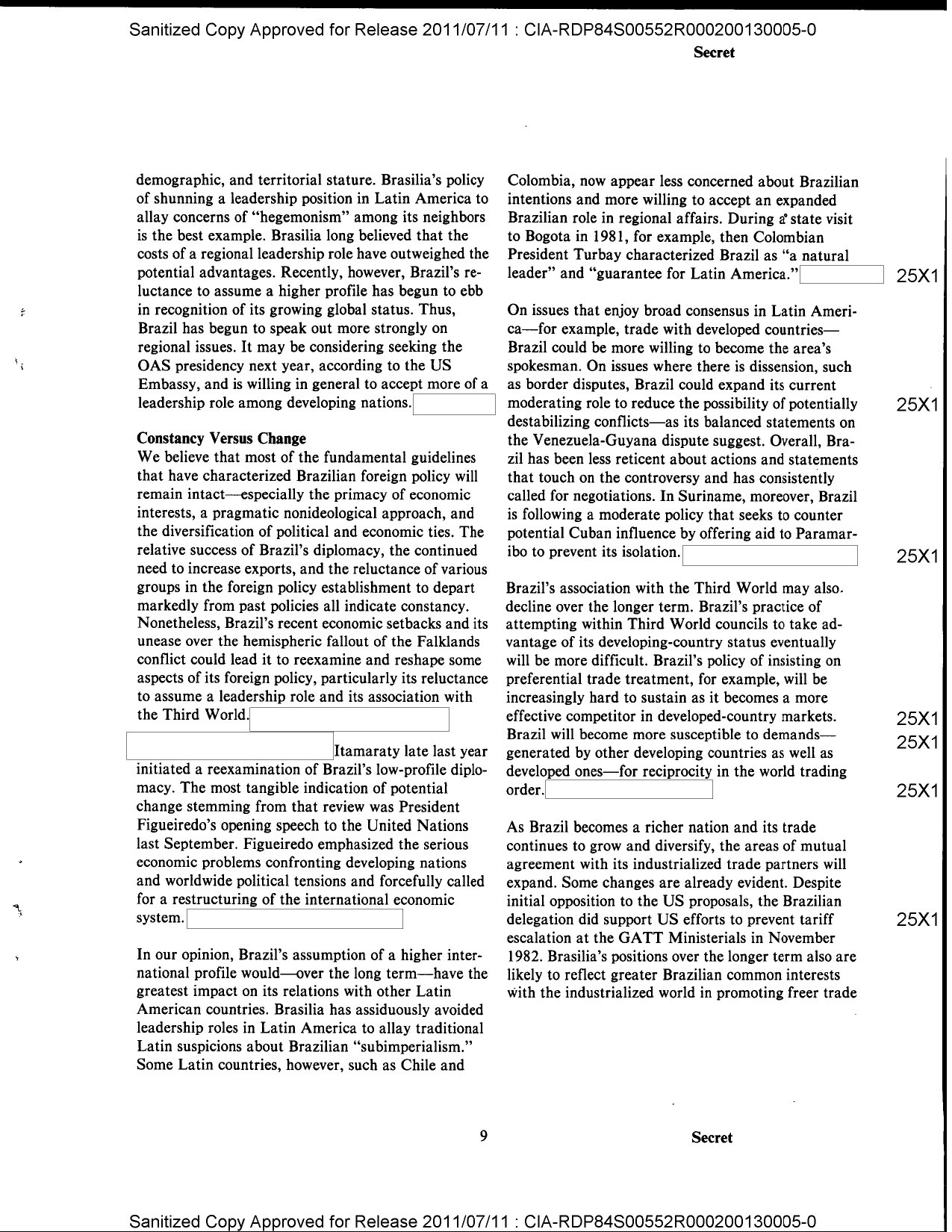
We believe that most of the fundamental guidelines that have characterized Brazilian foreign policy will remain intact especially the primacy of economic interests, a pragmatic nonideological approach, and the diversification of political and economic ties. The relative success of Brazil’s diplomacy, the continued need to increase exports, and the reluctance of various groups in the foreign policy establishment to depart markedly from past policies all indicate constancy. Nonetheless, Brazil’s recent economic setbacks and its unease over the hemispheric fallout of the Falklands conflict could lead it to reexamine and reshape some aspects of its foreign policy, particularly its reluctance to assume a leadership role and its association with the Third World.
Itamaraty late last year initiated a reexamination of Brazil’s low-profile diplomacy. The most tangible indication of potential change stemming from that review was President Figueiredo’s opening speech to the United Nations last September. Figueiredo emphasized the serious economic problems confronting developing nations and worldwide political tensions and forcefully called for a restructuring of the international economic system.
In our opinion, Brazil’s assumption of a higher international profile would-over the long term-have the greatest impact on its relations with other Latin American countries. Brasilia has assiduously avoided leadership roles in Latin America to allay traditional Latin suspicions about Brazilian “subimperialism.” Some Latin countries, however, such as Chile and Colombia, now appear less concerned about Brazilian intentions and more willing to accept an expanded Brazilian role in regional affairs. During a state visit to Bogota in 1981, for example, then Colombian President Turbay characterized Brazil as “a natural leader” and “guarantee for Latin America.”
On issues that enjoy broad consensus in Latin America-for example, trade with developed countries-Brazil could be more willing to become the area’s spokesman. On issues where there is dissension, such as border disputes, Brazil could expand its current moderating role to reduce the possibility of potentially destabilizing conflicts-as its balanced statements on the Venezuela-Guyana dispute suggest. Overall, Brazil has been less reticent about actions and statements that touch on the controversy and has consistently called for negotiations. In Suriname, moreover, Brazil is following a moderate policy that seeks to counter potential Cuban influence by offering aid to Paramaribo to prevent its isolation.
Brazil’s association with the Third World may also decline over the longer term. Brazil’s practice of attempting within Third World councils to take advantage of its developing-country status eventually will be more difficult. Brazil’s policy of insisting on preferential trade treatment, for example, will be increasingly hard to sustain as it becomes a more effective competitor in developed-country markets. Brazil will become more susceptible to demands-generated by other developing countries as well as developed ones-for reciprocity in the world trading order.
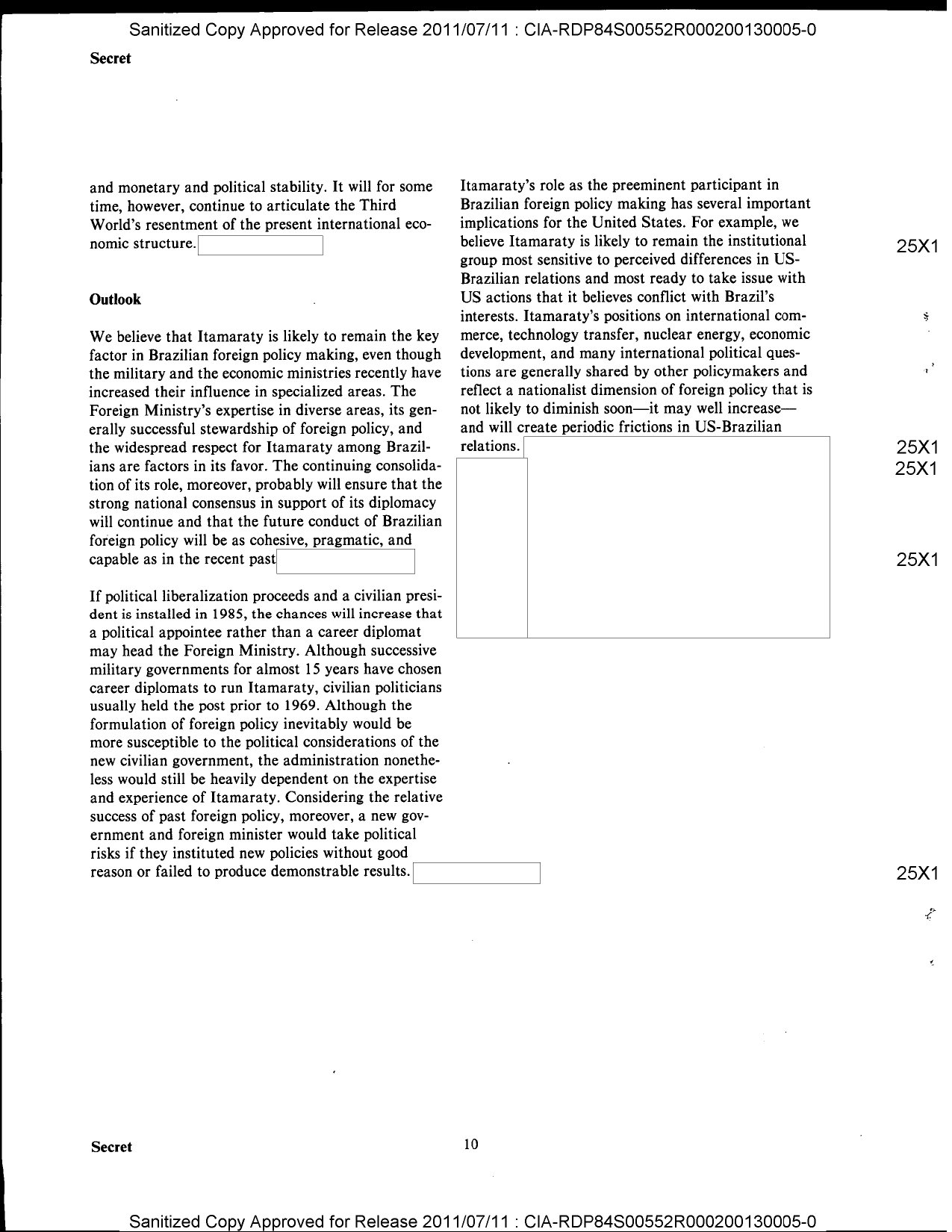
As Brazil becomes a richer nation and its trade continues to grow and diversify, the areas of mutual agreement with its industrialized trade partners will expand. Some changes are already evident. Despite initial opposition to the US proposals, the Brazilian delegation did support US efforts to prevent tariff escalation at the GATT Ministerials in November 1982. Brasilia’s positions over the longer term also are likely to reflect greater Brazilian common interests with the industrialized world in promoting freer trade and monetary and political stability. It will for some time, however, continue to articulate the Third World’s resentment of the present international economic structure.
Outlook
We believe that Itamaraty is likely to remain the key factor in Brazilian foreign policy making, even though the military and the economic ministries recently have increased their influence in specialized areas. The Foreign Ministry’s expertise in diverse areas, its generally successful stewardship of foreign policy, and the widespread respect for Itamaraty among Brazilians are factors in its favor. The continuing consolidation of its role, moreover, probably will ensure that the strong national consensus in support of its diplomacy will continue and that the future conduct of Brazilian foreign policy will be as cohesive, pragmatic, and capable as in the recent past.
If political liberalization proceeds and a civilian president is installed in 1985, the chances will increase that a political appointee rather than a career diplomat may head the Foreign Ministry. Although successive military governments for almost 15 years have chosen career diplomats to run Itamaraty, civilian politicians usually held the post prior to 1969. Although the formulation of foreign policy inevitably would be more susceptible to the political considerations of the new civilian government, the administration nonetheless would still be heavily dependent on the expertise and experience of Itamaraty. Considering the relative success of past foreign policy, moreover, a new government and foreign minister would take political risks if they instituted new policies without good reason or failed to produce demonstrable results.
Itamaraty’s role as the preeminent participant in Brazilian foreign policy making has several important implications for the United States. For example, we believe Itamaraty is likely to remain the institutional group most sensitive to perceived differences in US-Brazilian relations and most ready to take issue with US actions that it believes conflict with Brazil’s interests. Itamaraty’s positions on international commerce, technology transfer, nuclear energy, economic development, and many international political questions are generally shared by other policymakers and reflect a nationalist dimension of foreign policy that is not likely to diminish soon-it may well increase-and will create periodic frictions in US-Brazilian relations.
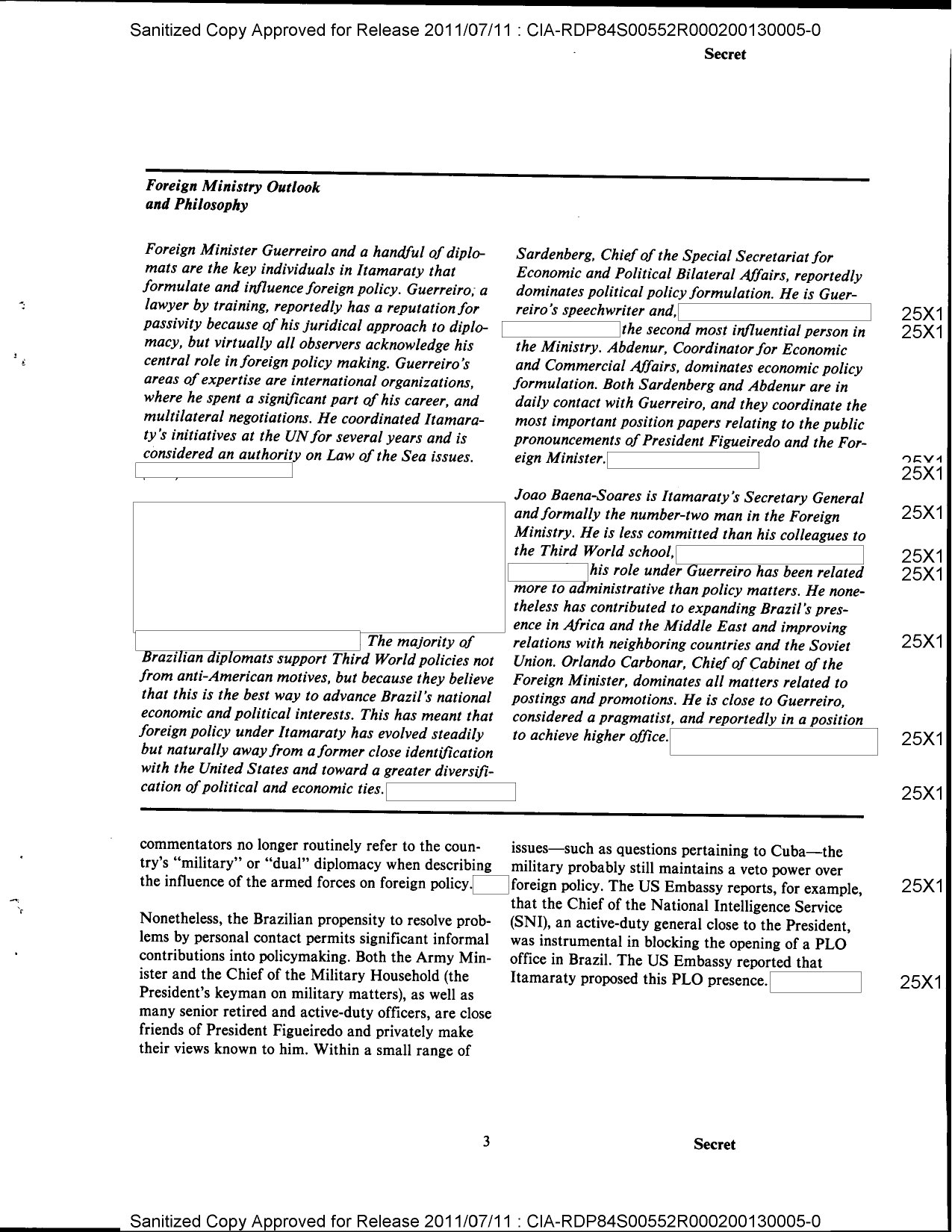
Foreign Ministry Outlook and Philosophy
Foreign Minister Guerreiro and a handful of diplomats are the key individuals in Itamaraty that formulate and influence foreign policy. Guerreiro, a lawyer by training, reportedly has a reputation for passivity because of his juridical approach to diplomacy, but virtually all observers acknowledge his central role in foreign policy making. Guerreiro’s areas of expertise are international organizations, where he spent a significant part of his career, and multilateral negotiations. He coordinated Itamaraty’s initiatives at the UN for several years and is considered an authority on Law of the Sea issues.
[CENSORED]
he majority of Brazilian diplomats support Third World policies not from anti-American motives, but because they believe that this is the best way to advance Brazil’s national economic and political interests. This has meant that foreign policy under Itamaraty has evolved steadily but naturally away from a former close identification with the United States and toward a greater diversification of political and economic ties.
Sardenberg, Chief of the Special Secretariat for Economic and Political Bilateral Affairs, reportedly dominates political policy formulation. He is Guerreiro’s speechwriter and, [CENSORED] the second most influential person in the Ministry. Abdenur, Coordinator for Economic and Commercial Affairs, dominates economic policy formulation. Both Sardenberg and Abdenur are in daily contact with Guerreiro, and they coordinate the most important position papers relating to the public pronouncements of President Figueiredo and the Foreign Minister.
Joao Baena-Soares is Itamaraty’s Secretary General and formally the number-two man in the Foreign Ministry. He is less committed than his colleagues to the Third World school, [CENSORED] his role under Guerreiro has been related more to administrative than policy matters. He nonetheless has contributed to expanding Brazil’s presence in Africa and the Middle East and improving relations with neighboring countries and the Soviet Union.
Orlando Carbonar, Chief of Cabinet of the Foreign Minister, dominates all matters related to postings and promotions. He is close to Guerreiro, considered a pragmatist, and reportedly in a position to achieve higher office.
Brazil’s Growing Economic and Political Status
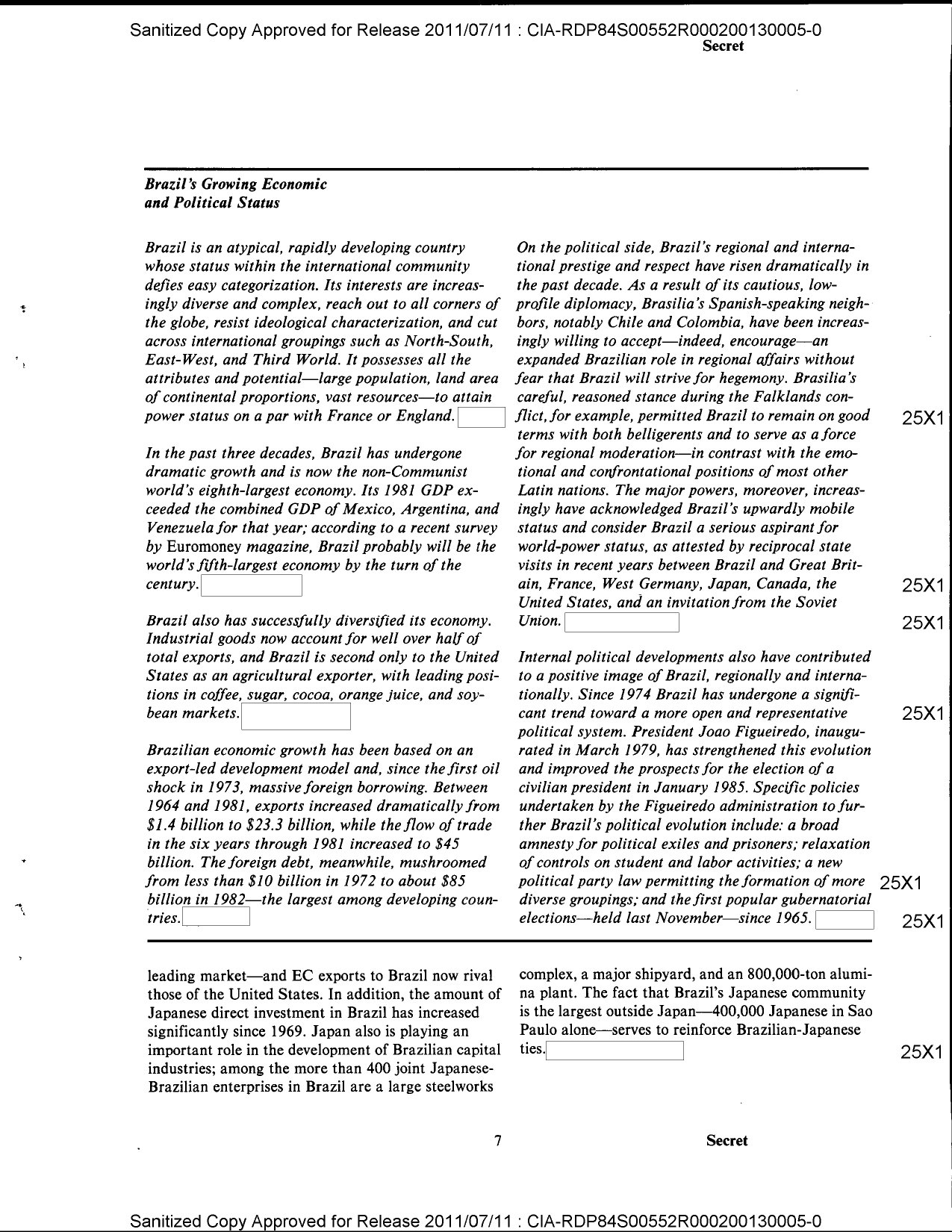
Brazil is an atypical, rapidly developing country whose status within the international community defies easy categorization. Its interests are increasingly diverse and complex, reach out to all corners of the globe, resist ideological characterization, and cut across international groupings such as North-South, East-West, and Third World. It possesses all the attributes and potential-large population, land area of continental proportions, vast resources-to attain power status on a par with France or England.
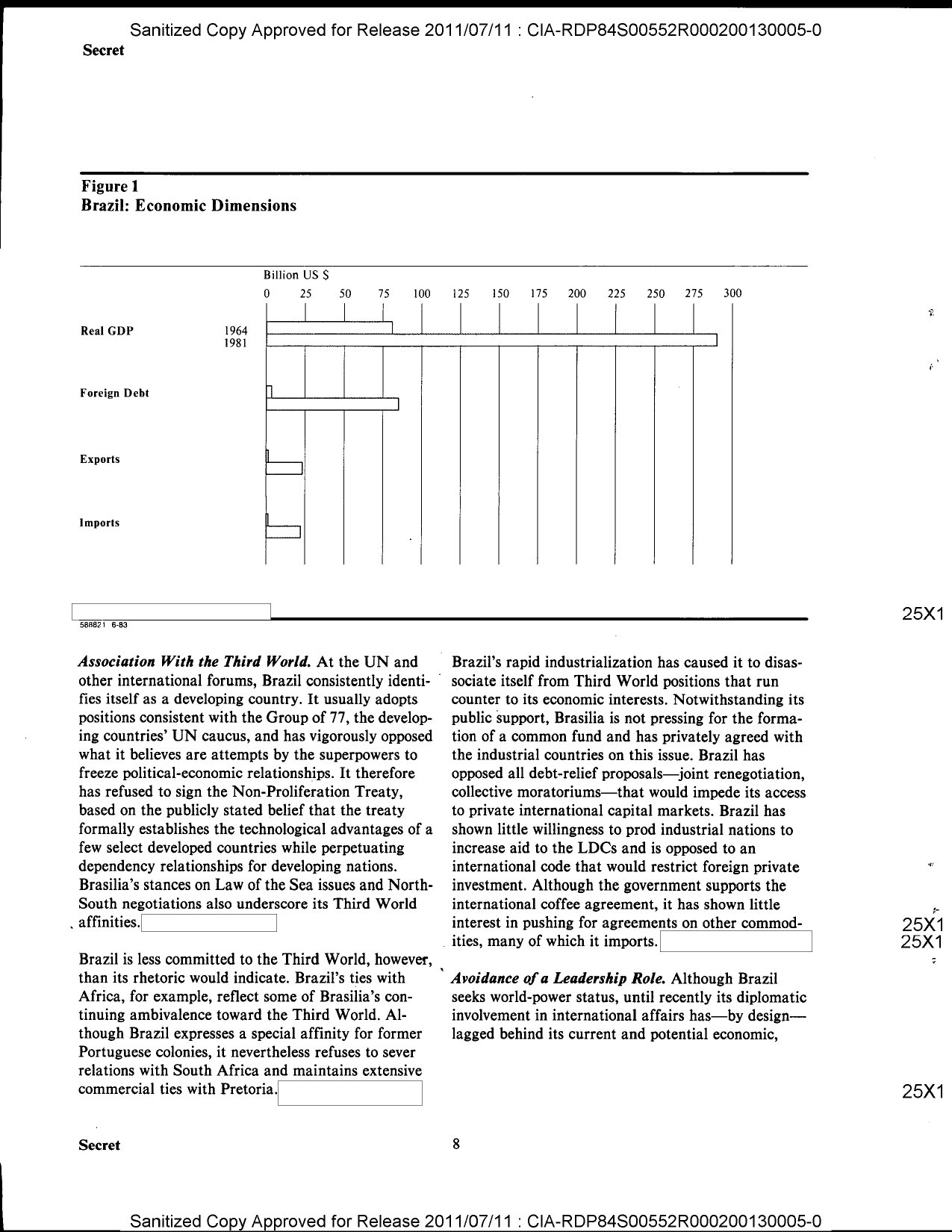
In the past three decades, Brazil has undergone dramatic growth and is now the non-Communist world’s eighth-largest economy. Its 1981 GDP exceeded the combined GDP of Mexico, Argentina, and Venezuela for that year; according to a recent survey by Euromoney magazine, Brazil probably will be the world’s fifth-largest economy by the turn of the century.
Brazil also has successfully diversified its economy. Industrial goods now account for well over half of total exports, and Brazil is second only to the United States as an agricultural exporter, with leading positions in coffee, sugar, cocoa, orange juice, and soybean markets.
Brazilian economic growth has been based on an export-led development model and, since the first oil shock in 1973, massive foreign borrowing. Between 1964 and 1981, exports increased dramatically from $1.4 billion to $23.3 billion, while the flow of trade in the six years through 1981 increased to $45 billion. The foreign debt, meanwhile, mushroomed from less than $10 billion in 1972 to about $85 billion in 1982—the largest among developing countries.
On the political side, Brazil’s regional and international prestige and respect have risen dramatically in the past decade. As a result of its cautious, low-profile diplomacy, Brasilia’s Spanish-speaking neighbors, notably Chile and Colombia, have been increasingly willing to accept-indeed, encourage-an expanded Brazilian role in regional affairs without fear that Brazil will strive for hegemony. Brasilia’s careful, reasoned stance during the Falklands conflict, for example, permitted Brazil to remain on good terms with both belligerents and to serve as a force for regional moderation-in contrast with the emotional and confrontational positions of most other Latin nations. The major powers, moreover, increasingly have acknowledged Brazil’s upwardly mobile status and consider Brazil a serious aspirant for world-power status, as attested by reciprocal state visits in recent years between Brazil and Great Britain, France, West Germany, Japan, Canada, the United States, and an invitation from the Soviet Union.
Internal political developments also have contributed to a positive image of Brazil, regionally and internationally. Since 1974 Brazil has undergone a significant trend toward a more open and representative political system. President Joao Figueiredo, inaugurated in March 1979, has strengthened this evolution and improved the prospects for the election of a civilian president in January 1985. Specific policies undertaken by the Figueiredo administration to further Brazil’s political evolution include: a broad amnesty for political exiles and prisoners; relaxation of controls on student and labor activities; a new political party law permitting the formation of more diverse groupings; and the first popular gubernatorial elections-held last November-since 1965.
Source:
Link:
Internal Link:
Date:
June 1, 1983