The Shadowy World of America’s Mercenaries
CIA-RDP88B00443R002004490006-0
The Secret World of New America’s Mercenaries – 3 November 1986
From the old-boy network to the born losers
He calls himself Paul Fanshaw, his nom de guerre in the French Foreign [CENSORED]. He is a truly scary man. Hard of eye and roу of muscle, he is a merciless warrior who has an athlete’s build at 48; and now, alone in a hotel room in Dayton, Ohio, with NEWSWEEK’s Vincent Coppola, he is dangerously drunk and wavering between belligerence and a kind of remorse.
He has been rambling angrily about his grievances against the CIA, Ronald Reagan, Muammar Kaddafi; the FBI is after him, he says, for his role in an attempted coup in Ghana. He drinks Dom Perignon champagne and chews Skoal Long Cut, spitting the tobacco juice into a tumbler.
“I’m a mercenary who thinks too much,” he says. “I’ve killed poor people. It bothers me about the poor, to have to make a living like that… I’ve lost my honor, they’ve taken my honor…” Suddenly he is weeping silently. “I’m a soldier, you understand. You trouble me. You are a danger to me. I’d as soon shoot you as…”
Fanshaw is a far cry from Eugene Hasenfus, sitting stunned and morose in a cell in Managua, and even further from the anticommunist zealots and gun-crazy amateurs who have been beating paths to Tegucigalpa and San Salvador in recent years to get a taste of a real war. But all three are variants of the rank-and-file mercenary: losers and misfits.
Rambo beware: They call themselves mercs, and each of them thinks his kind is the only real soldier of fortune. Hasenfus “is a disgrace to his country,” says a Missouri-based mercenary who has raided with the contras; for that matter, he brags, Sylvester Stallone’s Rambo “wouldn’t last two minutes in my jungle.”
Theirs is a shadowy, conspiratorial world, where lies are common currency and yet faith is implicit: plots are everywhere, the CIA has a hand in almost everything, all is deniable and nothing is provable. Its characters range from hired guns who will take anyone’s money to fantasy killers who dream over Soldier of Fortune magazine and play paramilitary games in the woods. But for all of them, war has a primal pull.
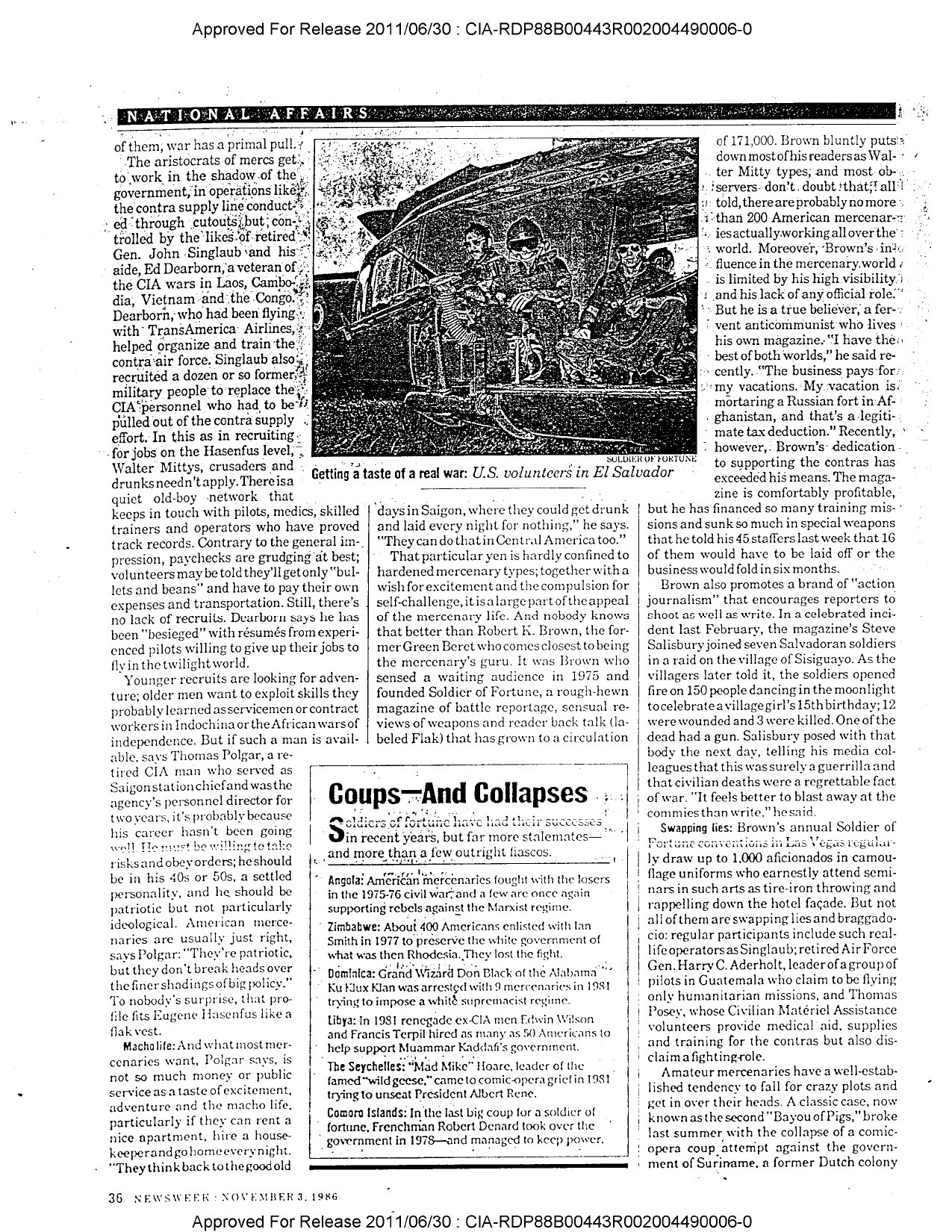
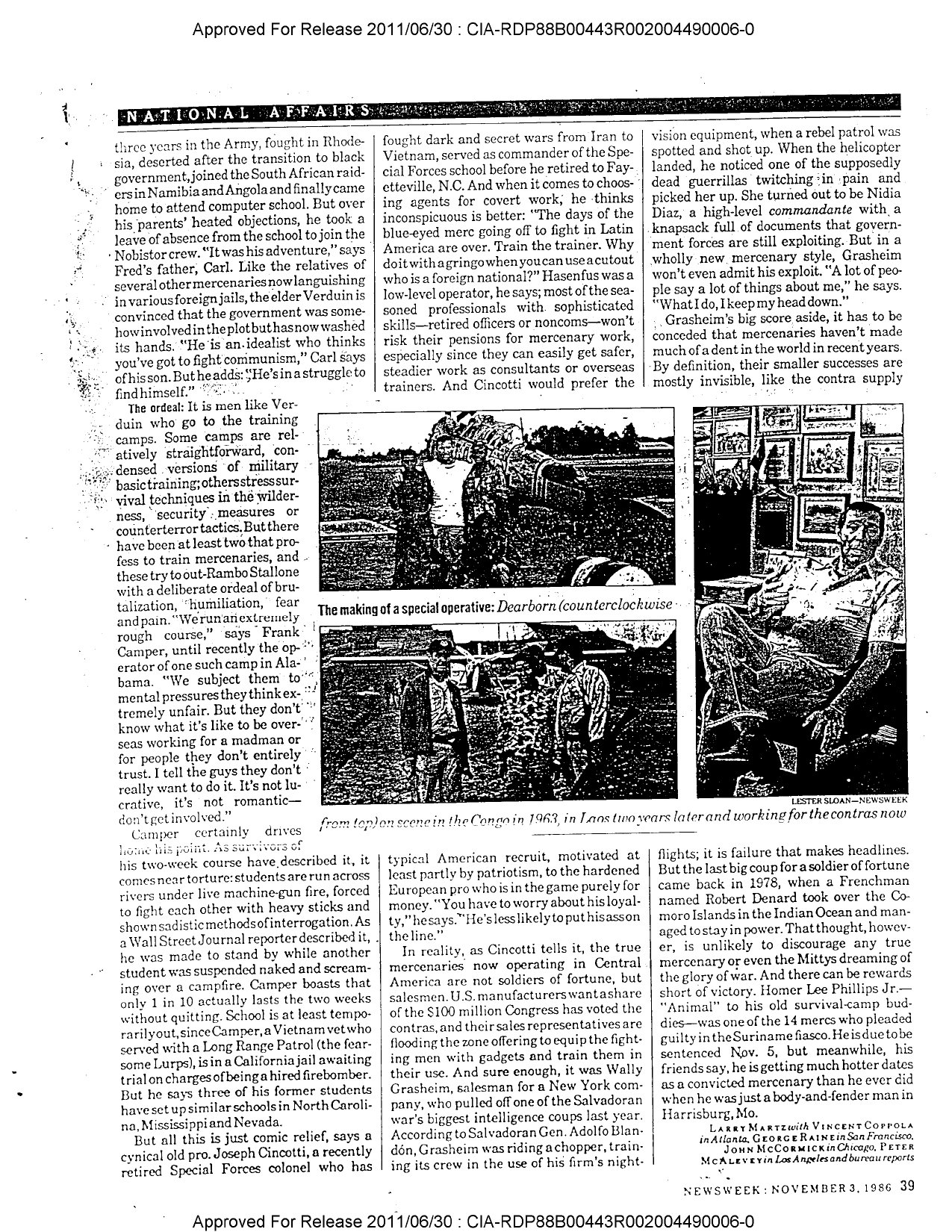
The aristocrats of mercs get to work in the shadow of the government, in operations like the contra supply line conducted through cutouts but controlled by the likes of retired Gen. John Singlaub and his aide, Ed Dearborn, a veteran of the CIA wars in Laos, Cambodia, Vietnam, and the Congo.
Dearborn, who had been flying with TransAmerica Airlines, helped organize and train the contra air force. Singlaub also recruited a dozen or so former military people to replace the CIA personnel who had to be pulled out of the contra supply effort. In this, as in recruiting for jobs on the Hasenfus level, Walter Mittys, crusaders, and drunks needn’t apply.
There is a quiet old-boy network that keeps in touch with pilots, medics, skilled trainers, and operators who have proved track records. Contrary to the general impression, paychecks are grudging at best; volunteers may be told they’ll get only “bullets and beans” and have to pay their own expenses and transportation. Still, there’s no lack of recruits. Dearborn says he has been “besieged” with résumés from experienced pilots willing to give up their jobs to fly in the twilight world.
Younger recruits are looking for adventure; older men want to exploit skills they probably learned as servicemen or contract workers in Indochina or the African wars of independence. But if such a man is available, says Thomas Polgar, a retired CIA man who served as Saigon station chief and was the agency’s personnel director for two years, it’s probably because his career hasn’t been going well. He must be willing to take risks and obey orders; he should be in his 40s or 50s, a settled personality, and he should be patriotic but not particularly ideological.
American mercenaries are usually just right, says Polgar: “They’re patriotic, but they don’t break heads over the finer shadings of big policy.” To nobody’s surprise, that profile fits Eugene Hasenfus like a flak vest.
Macho life: And what most mercenaries want, Polgar says, is not so much money or public service as a taste of excitement, adventure, and the macho life—particularly if they can rent a nice apartment, hire a housekeeper, and go home every night.
“They think back to the good old days in Saigon, where they could get drunk and laid every night for nothing,” he says. “They can do that in Central America too.” That particular yen is hardly confined to hardened mercenary types; together with a wish for excitement and the compulsion for self-challenge, it is a large part of the appeal of the mercenary life.
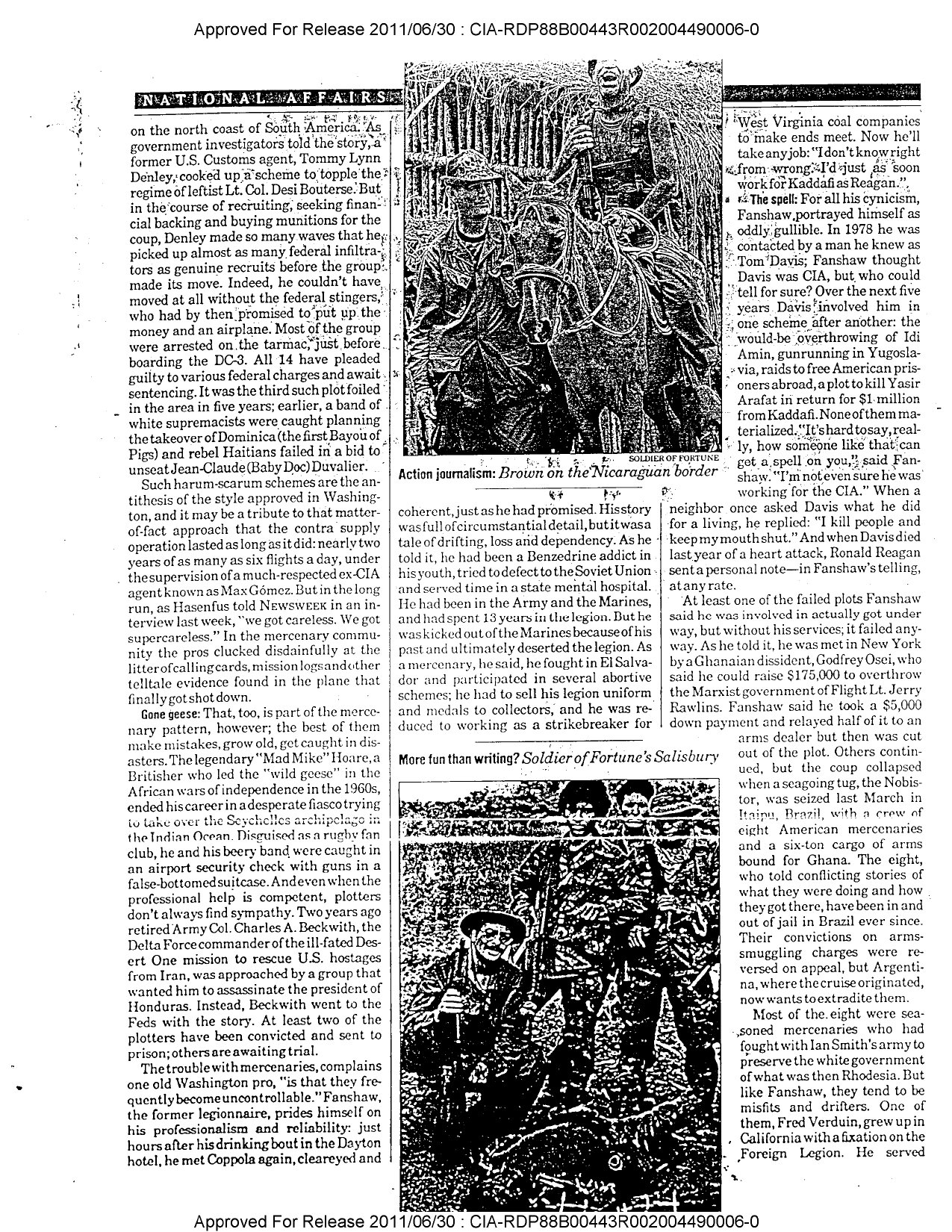
And nobody knows that better than Robert K. Brown, the former Green Beret who comes closest to being the mercenary’s guru. It was Brown who sensed a waiting audience in 1975 and founded Soldier of Fortune, a rough-hewn magazine of battle reportage, sensual reviews of weapons, and reader back talk (labeled Flak) that has grown to a circulation of 171,000. Brown bluntly puts down most of his readers as Walter Mitty types; and most observers don’t doubt it: all told, there are probably no more than 200 American mercenaries actually working all over the world.
Moreover, Brown’s influence in the mercenary world is limited by his high visibility and his lack of any official role. But he is a true believer, a fervent anticommunist who lives his own magazine. “I have the best of both worlds,” he said recently. “The business pays for my vacations. My vacation is mortaring a Russian fort in Afghanistan, and that’s a legitimate tax deduction.”
Recently, however, Brown’s dedication to supporting the contras has exceeded his means. The magazine is comfortably profitable, but he has financed so many training missions and sunk so much in special weapons that he told his 45 staffers last week that 16 of them would have to be laid off or the business would fold in six months.
Brown also promotes a brand of “action journalism” that encourages reporters to shoot as well as write. In a celebrated incident last February, the magazine’s Steve Salisbury joined seven Salvadoran soldiers in a raid on the village of Sisiguayo. As the villagers later told it, the soldiers opened fire on 150 people dancing in the moonlight to celebrate a village girl’s 15th birthday; 12 were wounded and 3 were killed. One of the dead had a gun. Salisbury posed with that body the next day, telling his media colleagues that this was surely a guerrilla and that civilian deaths were a regrettable fact of war. “It feels better to blast away at the commies than write,” he said.
Swapping lies: Brown’s annual Soldier of Fortune conventions in Las Vegas regularly draw up to 1,000 aficionados in camouflage uniforms who earnestly attend seminars in such arts as tire-iron throwing and rappelling down the hotel façade. But not all of them are swapping lies and braggadocio: regular participants include such real-life operators as Singlaub; retired Air Force Gen. Harry C. Aderholt, leader of a group of pilots in Guatemala who claim to be flying only humanitarian missions; and Thomas Posey, whose Civilian Matériel Assistance volunteers provide medical aid, supplies, and training for the contras but also disclaim a fighting role.
Amateur mercenaries have a well-established tendency to fall for crazy plots and get in over their heads. A classic case, now known as the second “Bayou of Pigs,” broke last summer with the collapse of a comic-opera coup attempt against the government of Suriname, a former Dutch colony on the north coast of South America.
As government investigators told the story, a former U.S. Customs agent, Tommy Lynn Denley, cooked up a scheme to topple the regime of leftist Lt. Col. Desi Bouterse. But in the course of recruiting, seeking financial backing, and buying munitions for the coup, Denley made so many waves that he picked up almost as many federal infiltrators as genuine recruits before the group made its move. Indeed, he couldn’t have moved at all without the federal stingers, who had by then promised to put up the money and an airplane. Most of the group were arrested on the tarmac, just before boarding the DC-3. All 14 have pleaded guilty to various federal charges and await sentencing.
It was the third such plot foiled in the area in five years; earlier, a band of white supremacists were caught planning the takeover of Dominica (the first Bayou of Pigs) and rebel Haitians failed in a bid to unseat Jean-Claude (Baby Doc) Duvalier.
Such harum-scarum schemes are the antithesis of the style approved in Washington, and it may be a tribute to that matter-of-fact approach that the contra supply operation lasted as long as it did: nearly two years of as many as six flights a day, under the supervision of a much-respected ex-CIA agent known as Max Gómez. But in the long run, as Hasenfus told NEWSWEEK in an interview last week, “we got careless. We got supercareless.”
In the mercenary community, the pros clucked disdainfully at the litter of calling cards, mission logs, and other telltale evidence found in the plane that finally got shot down.
Gone geese: That, too, is part of the mercenary pattern, however; the best of them make mistakes, grow old, get caught in disasters. The legendary “Mad Mike” Hoare, a Britisher who led the “wild geese” in the African wars of independence in the 1960s, ended his career in a desperate fiasco trying to take over the Seychelles archipelago in the Indian Ocean. Disguised as a rugby fan club, he and his beery band were caught in an airport security check with guns in a false-bottomed suitcase.
And even when the professional help is competent, plotters don’t always find sympathy. Two years ago retired Army Col. Charles A. Beckwith, the Delta Force commander of the ill-fated Desert One mission to rescue U.S. hostages from Iran, was approached by a group that wanted him to assassinate the president of Honduras. Instead, Beckwith went to the Feds with the story. At least two of the plotters have been convicted and sent to prison; others are awaiting trial.
The trouble with mercenaries, complains one old Washington pro, “is that they frequently become uncontrollable.”
Fanshaw, the former legionnaire, prides himself on his professionalism and reliability: just hours after his drinking bout in the Dayton hotel, he met Coppola again, clear-eyed and coherent, just as he had promised. His story was full of circumstantial detail, but it was a tale of drifting, loss, and dependency.
As he told it, he had been a Benzedrine addict in his youth, tried to defect to the Soviet Union, and served time in a state mental hospital. He had been in the Army and the Marines, and had spent 13 years in the legion. But he was kicked out of the Marines because of his past and ultimately deserted the legion. As a mercenary, he said, he fought in El Salvador and participated in several abortive schemes; he had to sell his legion uniform and medals to collectors, and he was reduced to working as a strikebreaker for West Virginia coal companies to make ends meet. Now he’ll take any job: “I don’t know right from wrong. I’d just as soon work for Kaddafi as Reagan.”
The spell: For all his cynicism, Fanshaw portrayed himself as oddly gullible. In 1978 he was contacted by a man he knew as Tom Davis; Fanshaw thought Davis was CIA, but who could tell for sure? Over the next five years, Davis involved him in one scheme after another: the would-be overthrowing of Idi Amin, gunrunning in Yugoslavia, raids to free American prisoners abroad, a plot to kill Yasir Arafat in return for $1 million from Kaddafi. None of them materialized.
“It’s hard to say, really, how someone like that can get a spell on you,” said Fanshaw. “I’m not even sure he was working for the CIA.” When a neighbor once asked Davis what he did for a living, he replied: “I kill people and keep my mouth shut.” And when Davis died last year of a heart attack, Ronald Reagan sent a personal note—in Fanshaw’s telling, at any rate.
At least one of the failed plots Fanshaw said he was involved in actually got under way, but without his services; it failed anyway. As he told it, he was met in New York by a Ghanaian dissident, Godfrey Osei, who said he could raise $175,000 to overthrow the Marxist government of Flight Lt. Jerry Rawlins. Fanshaw said he took a $5,000 down payment and relayed half of it to an arms dealer but then was cut out of the plot. Others continued, but the coup collapsed when a seagoing tug, the Nobistor, was seized last March in Itaipu, Brazil, with a crew of eight American mercenaries and a six-ton cargo of arms bound for Ghana.
The eight, who told conflicting stories of what they were doing and how they got there, have been in and out of jail in Brazil ever since. Their convictions on arms-smuggling charges were reversed on appeal, but Argentina, where the cruise originated, now wants to extradite them.
Most of the eight were seasoned mercenaries who had fought with Ian Smith’s army to preserve the white government of what was then Rhodesia. But like Fanshaw, they tend to be misfits and drifters. One of them, Fred Verduin, grew up in California with a fixation on the Foreign Legion. He served three years in the Army, fought in Rhodesia, deserted after the transition to black government, joined the South African raiders in Namibia and Angola, and finally came home to attend computer school.
But over his parents’ heated objections, he took a leave of absence from the school to join the Nobistor crew. “It was his adventure,” says Fred’s father, Carl.
Like the relatives of several other mercenaries now languishing in various foreign jails, the elder Verduin is convinced that the government was somehow involved in the plot but has now washed its hands. “He is an idealist who thinks you’ve got to fight communism,” Carl says of his son. But he adds: “He’s in a struggle to find himself.”
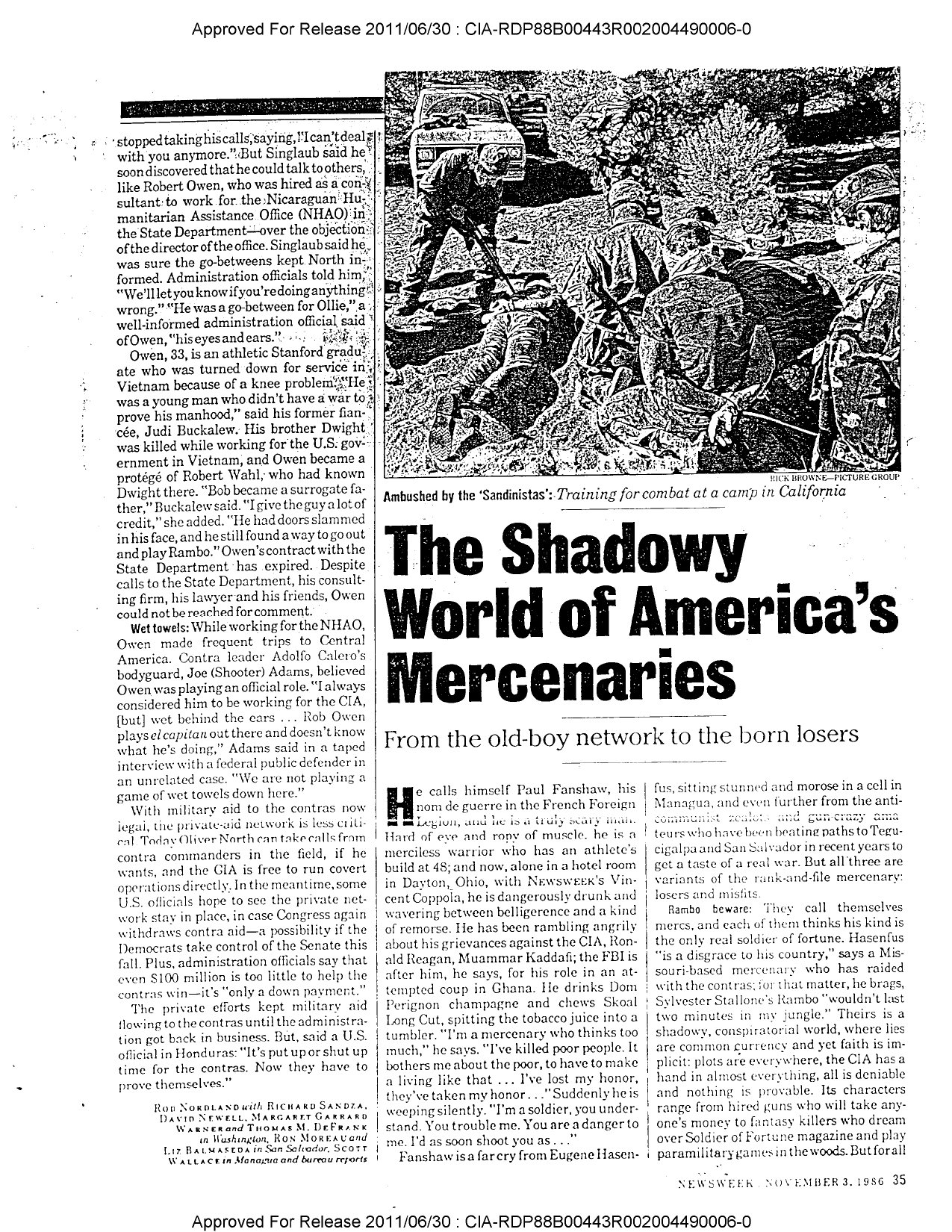
The ordeal: It is men like Verduin who go to the training camps. Some camps are relatively straightforward, condensed versions of military basic training; others stress survival techniques in the wilderness, security measures, or counterterror tactics.
But there have been at least two that profess to train mercenaries, and these try to out-Rambo Stallone with a deliberate ordeal of brutalization, humiliation, fear, and pain.
“We run an extremely rough course,” says Frank Camper, until recently the operator of one such camp in Alabama. “We subject them to mental pressures they think extremely unfair. But they don’t know what it’s like to be overseas working for a madman or for people they don’t entirely trust. I tell the guys they don’t really want to do it. It’s not lucrative, it’s not romantic—don’t get involved.”
Camper certainly drives home his point. As survivors of his two-week course have described it, it comes near torture: students are run across rivers under live machine-gun fire, forced to fight each other with heavy sticks, and shown sadistic methods of interrogation.
As a Wall Street Journal reporter described it, he was made to stand by while another student was suspended naked and screaming over a campfire. Camper boasts that only 1 in 10 actually lasts the two weeks without quitting.
School is at least temporarily out, since Camper, a Vietnam vet who served with a Long Range Patrol (the fearsome Lurps), is in a California jail awaiting trial on charges of being a hired firebomber. But he says three of his former students have set up similar schools in North Carolina, Mississippi, and Nevada.
But all this is just comic relief, says a cynical old pro, Joseph Cincotti, a recently retired Special Forces colonel, who has seen the spectrum from the typical American recruit, motivated at least partly by patriotism, to the hardened European pro who is in the game purely for money.
“You have to worry about his loyalty,” he says. “He’s less likely to put his ass on the line.”
In reality, as Cincotti tells it, the true mercenaries now operating in Central America are not soldiers of fortune, but salesmen. U.S. manufacturers want a share of the $100 million Congress has voted the contras, and their sales representatives are flooding the zone offering to equip the fighting men with gadgets and train them in their use.
And sure enough, it was Wally Grasheim, salesman for a New York company, who pulled off one of the Salvadoran war’s biggest intelligence coups last year. According to Salvadoran Gen. Adolfo Blandón, Grasheim was riding a chopper, training its crew in the use of his firm’s night flights; it is failure that makes headlines.
But the last big coup for a soldier of fortune came back in 1978, when a Frenchman named Robert Denard took over the Comoro Islands in the Indian Ocean and managed to stay in power.
That thought, however, is unlikely to discourage any true mercenary or even the Mittys dreaming of the glory of war. And there can be rewards short of victory.
Homer Lee Phillips Jr.—”Animal” to his old survival-camp buddies—was one of the 14 mercs who pleaded guilty in the Suriname fiasco. He is due to be sentenced Nov. 5, but meanwhile, his friends say, he is getting much hotter dates as a convicted mercenary than he ever did when he was just a body-and-fender man in Harrisburg, Mo.
LARRY MARTZ with VINCENT COPPOLA in Atlanta, GEORGE RAINE in San Francisco, JOHN MCCORMICK in Chicago, PETER MCALEVEY in Los Angeles, and bureau reports
Source:
Link:
Internal Link:
Date:
November 3, 1986