The Success of the Brazilian Initiative 1983
CIA-RDP85T00287R000500070001-1
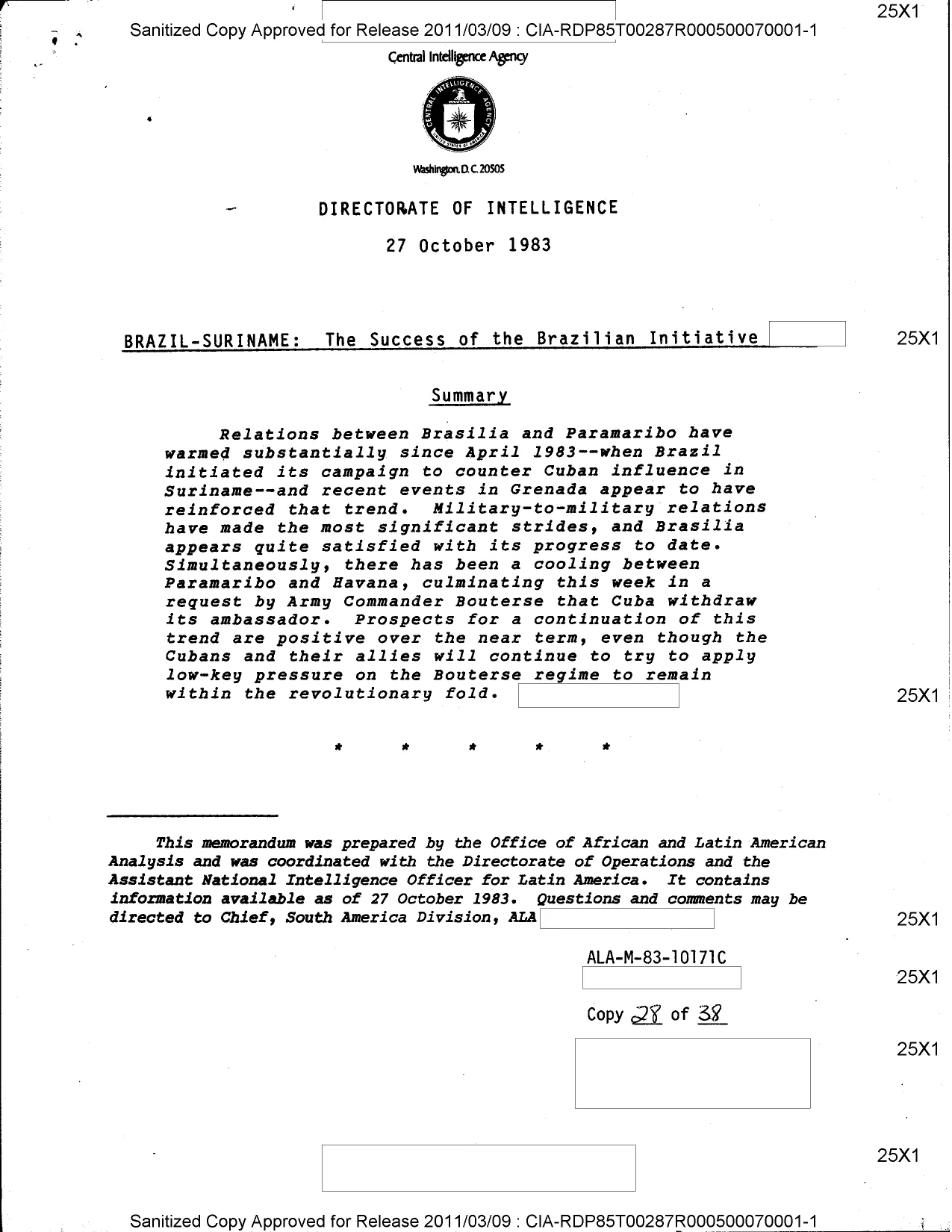
Summary
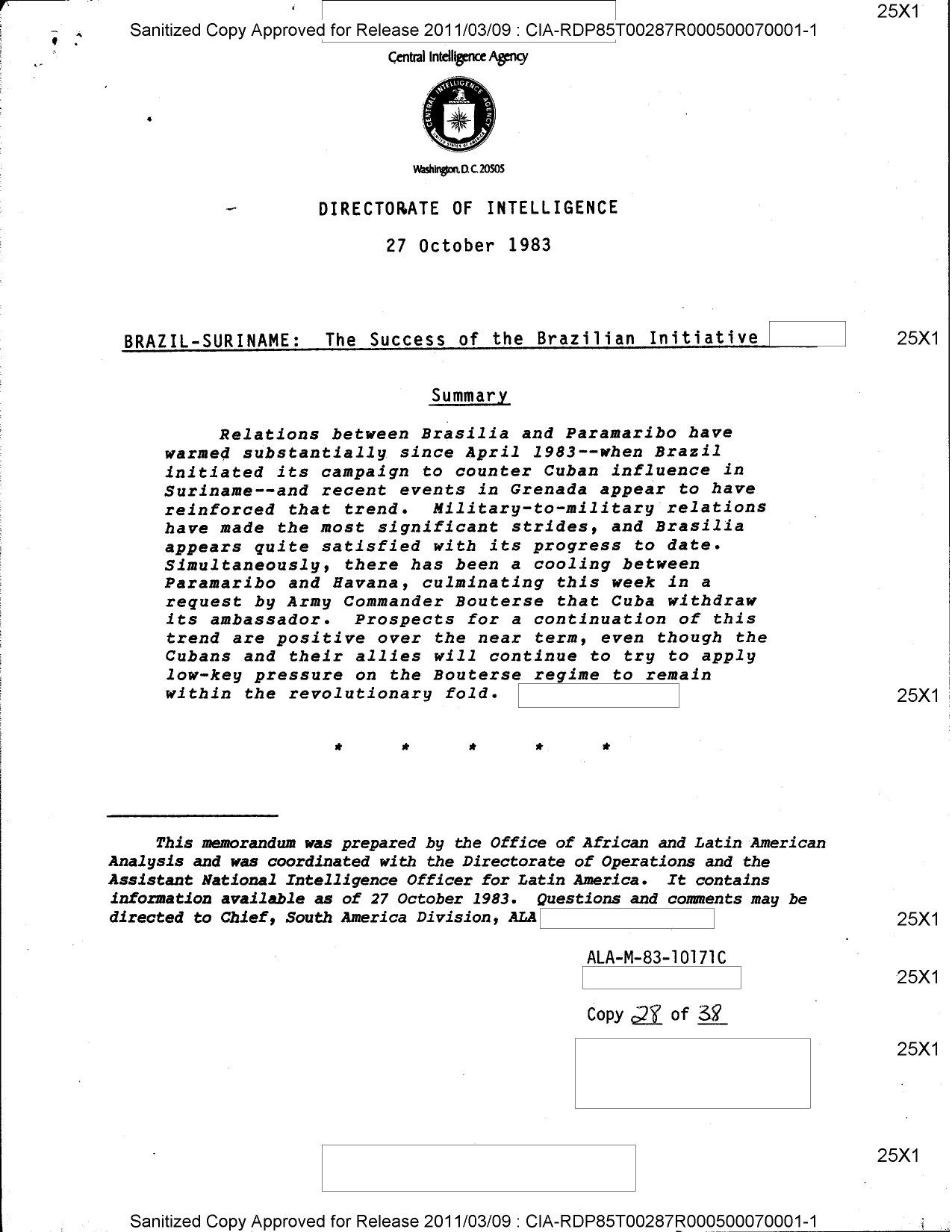
Relations between Brasilia and Paramaribo have warmed substantially since April 1983—when Brazil initiated its campaign to counter Cuban influence in Suriname—and recent events in Grenada appear to have reinforced that trend. Military-to-military relations have made the most significant strides, and Brasilia appears quite satisfied with its progress to date.
Simultaneously, there has been a cooling between Paramaribo and Havana, culminating this week in a request by Army Commander Bouterse that Cuba withdraw its ambassador. Prospects for a continuation of this trend are positive over the near term, even though the Cubans and their allies will continue to try to apply low-key pressure on the Bouterse regime to remain within the revolutionary fold.
This memorandum was prepared by the Office of African and Latin American Analysis and was coordinated with the Directorate of Operations and the Assistant National Intelligence Officer for Latin America. It contains information available as of 27 October 1983. Questions and comments may be directed to Chief, South America Division, ALA.
The Brazilian Initiative
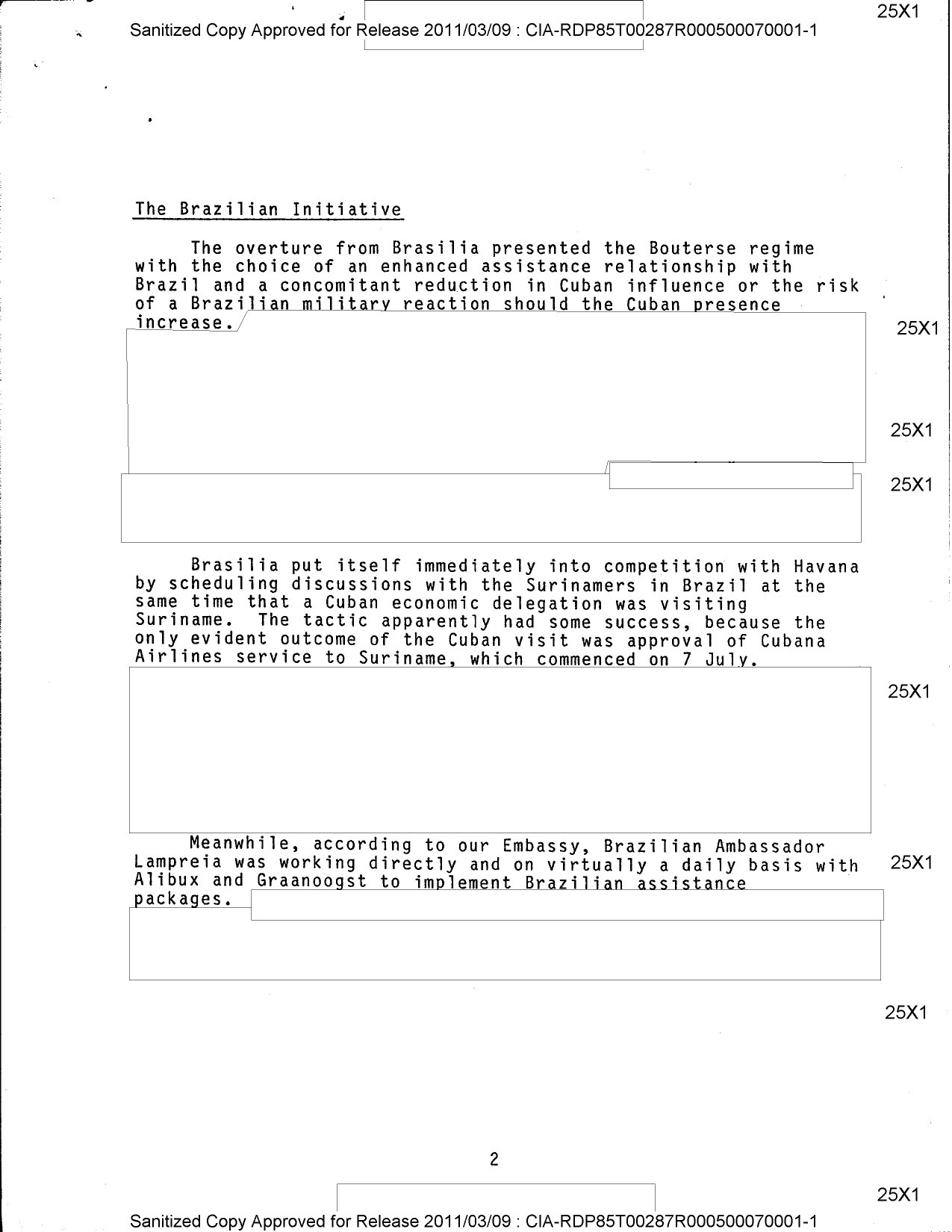
The overture from Brasilia presented the Bouterse regime with the choice of an enhanced assistance relationship with Brazil and a concomitant reduction in Cuban influence or the risk of a Brazilian military reaction should the Cuban presence increase.
Brasilia put itself immediately into competition with Havana by scheduling discussions with the Surinamers in Brazil at the same time that a Cuban economic delegation was visiting Suriname. The tactic apparently had some success, because the only evident outcome of the Cuban visit was approval of Cubana Airlines service to Suriname, which commenced on 7 July. Meanwhile, according to our Embassy, Brazilian Ambassador Lampreia was working directly and on virtually a daily basis with Alibux and Graanoogst to implement Brazilian assistance packages.
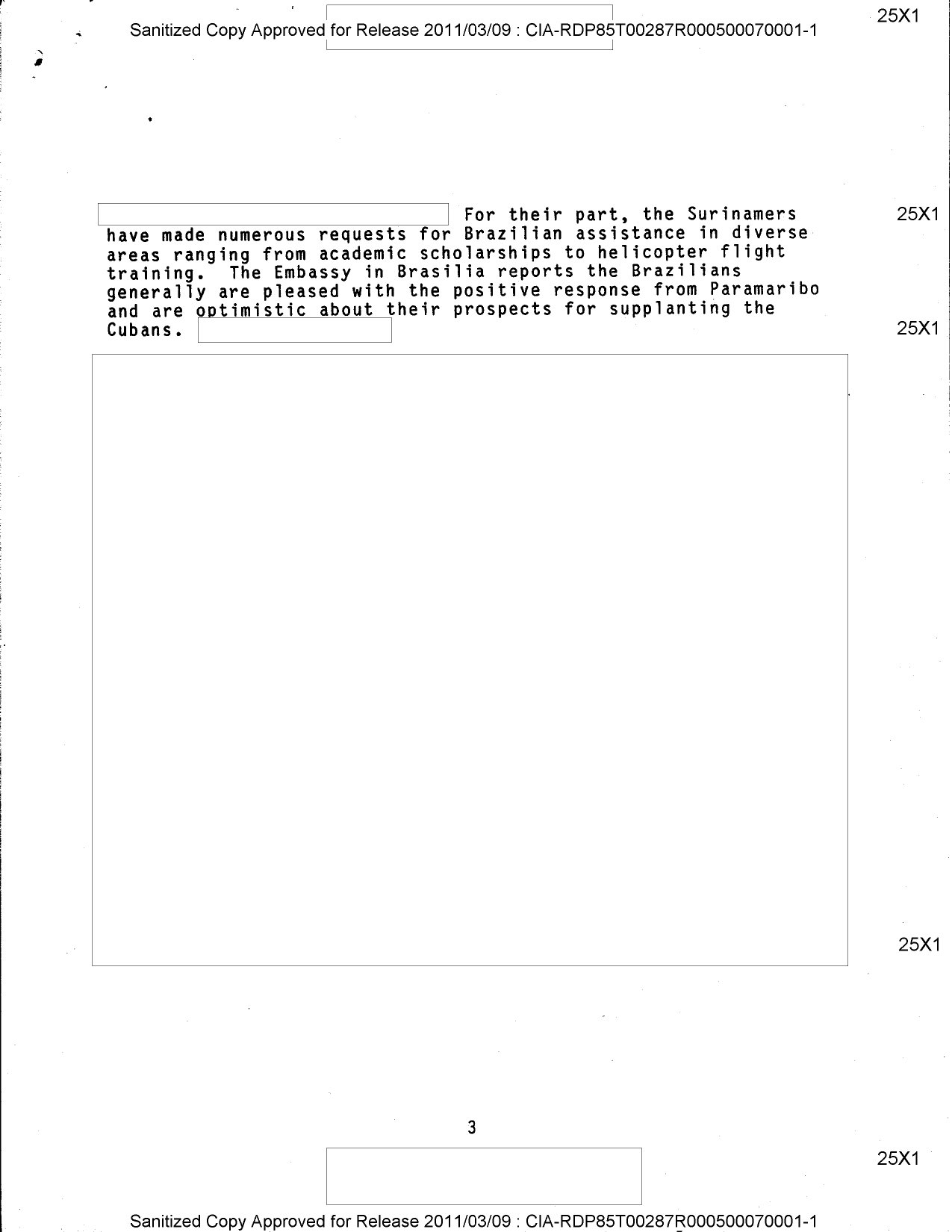
For their part, the Surinamers have made numerous requests for Brazilian assistance in diverse areas ranging from academic scholarships to helicopter flight training. The Embassy in Brasilia reports the Brazilians generally are pleased with the positive response from Paramaribo and are optimistic about their prospects for supplanting the Cubans.
Prospects
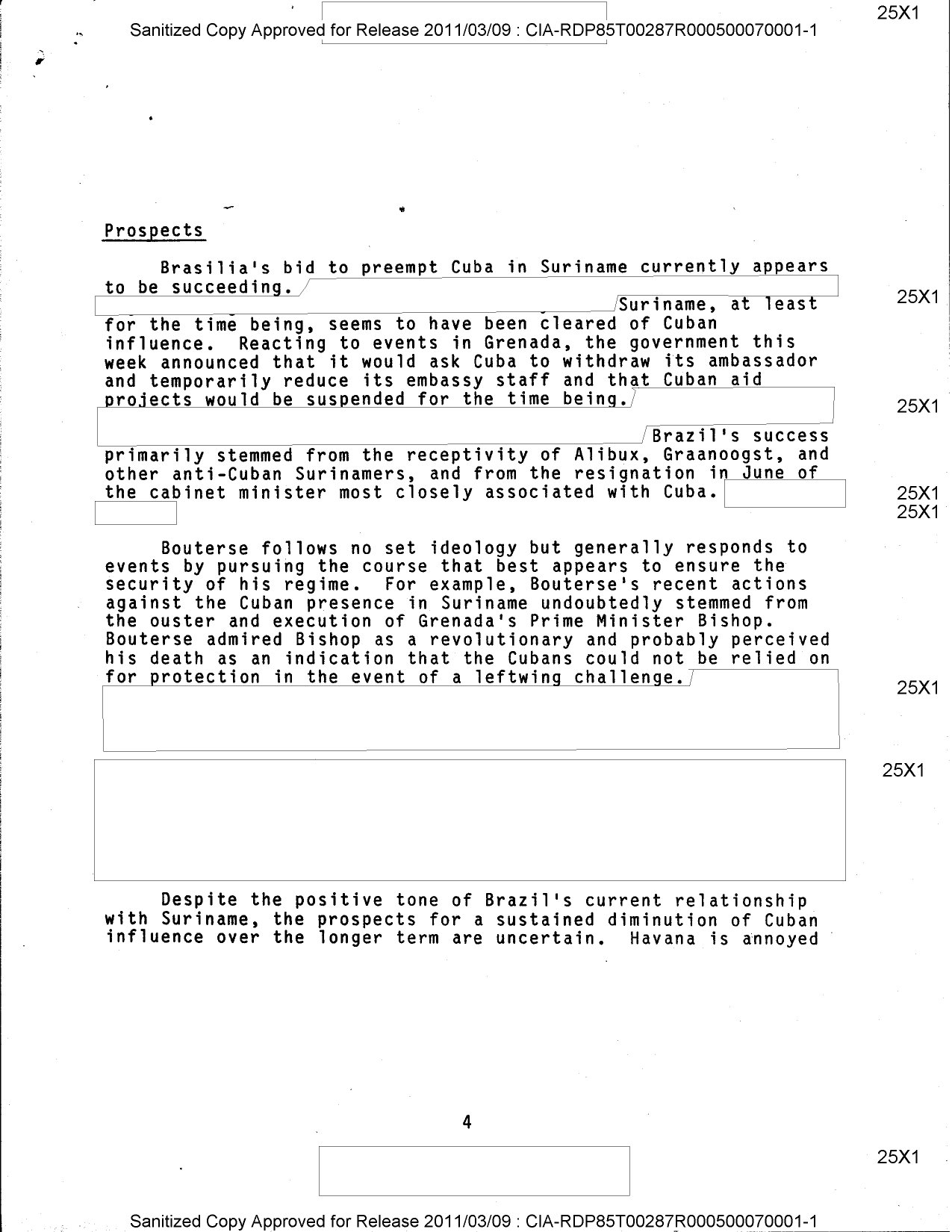
Brasilia’s bid to preempt Cuba in Suriname currently appears to be succeeding. Suriname, at least for the time being, seems to have been cleared of Cuban influence. Reacting to events in Grenada, the government this week announced that it would ask Cuba to withdraw its ambassador and temporarily reduce its embassy staff and that Cuban aid projects would be suspended for the time being.
Brazil’s success primarily stemmed from the receptivity of Alibux, Graanoogst, and other anti-Cuban Surinamers, and from the resignation in June of the cabinet minister most closely associated with Cuba. Bouterse follows no set ideology but generally responds to events by pursuing the course that best appears to ensure the security of his regime. For example, Bouterse’s recent actions against the Cuban presence in Suriname undoubtedly stemmed from the ouster and execution of Grenada’s Prime Minister Bishop. Bouterse admired Bishop as a revolutionary and probably perceived his death as an indication that the Cubans could not be relied upon for protection in the event of a leftwing challenge.
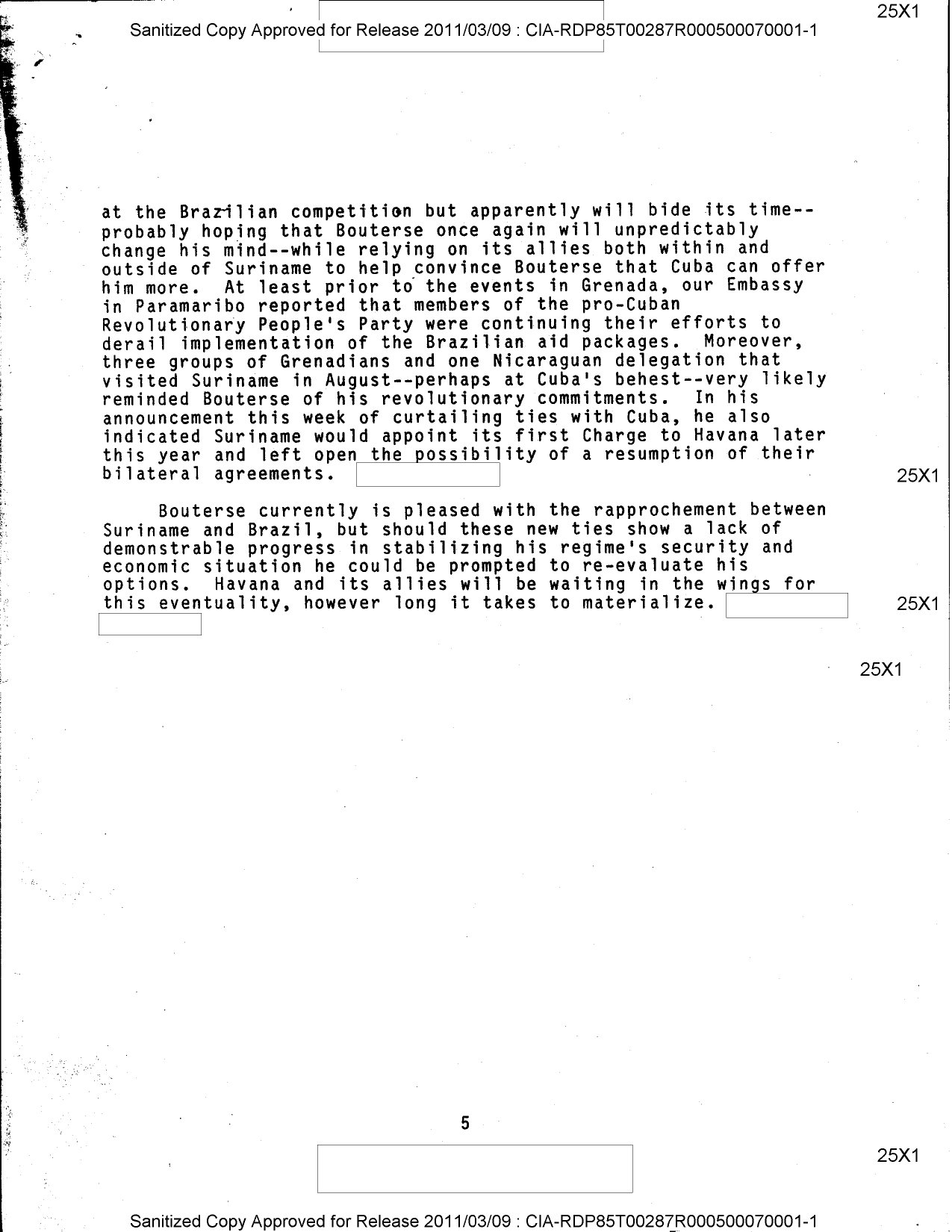
Despite the positive tone of Brazil’s current relationship with Suriname, the prospects for a sustained diminution of Cuban influence over the longer term are uncertain. Havana is annoyed at the Brazilian competition but apparently will bide its time—probably hoping that Bouterse once again will unpredictably change his mind—while relying on its allies both within and outside of Suriname to help convince Bouterse that Cuba can offer him more. At least prior to the events in Grenada, our Embassy in Paramaribo reported that members of the pro-Cuban Revolutionary People’s Party were continuing their efforts to derail implementation of the Brazilian aid packages. Moreover, three groups of Grenadians and one Nicaraguan delegation that visited Suriname in August—perhaps at Cuba’s behest—very likely reminded Bouterse of his revolutionary commitments. In his announcement this week of curtailing ties with Cuba, he also indicated Suriname would appoint its first Charge to Havana later this year and left open the possibility of a resumption of their bilateral agreements.
Bouterse currently is pleased with the rapprochement between Suriname and Brazil, but should these new ties show a lack of demonstrable progress in stabilizing his regime’s security and economic situation, he could be prompted to re-evaluate his options. Havana and its allies will be waiting in the wings for this eventuality, however long it takes to materialize.
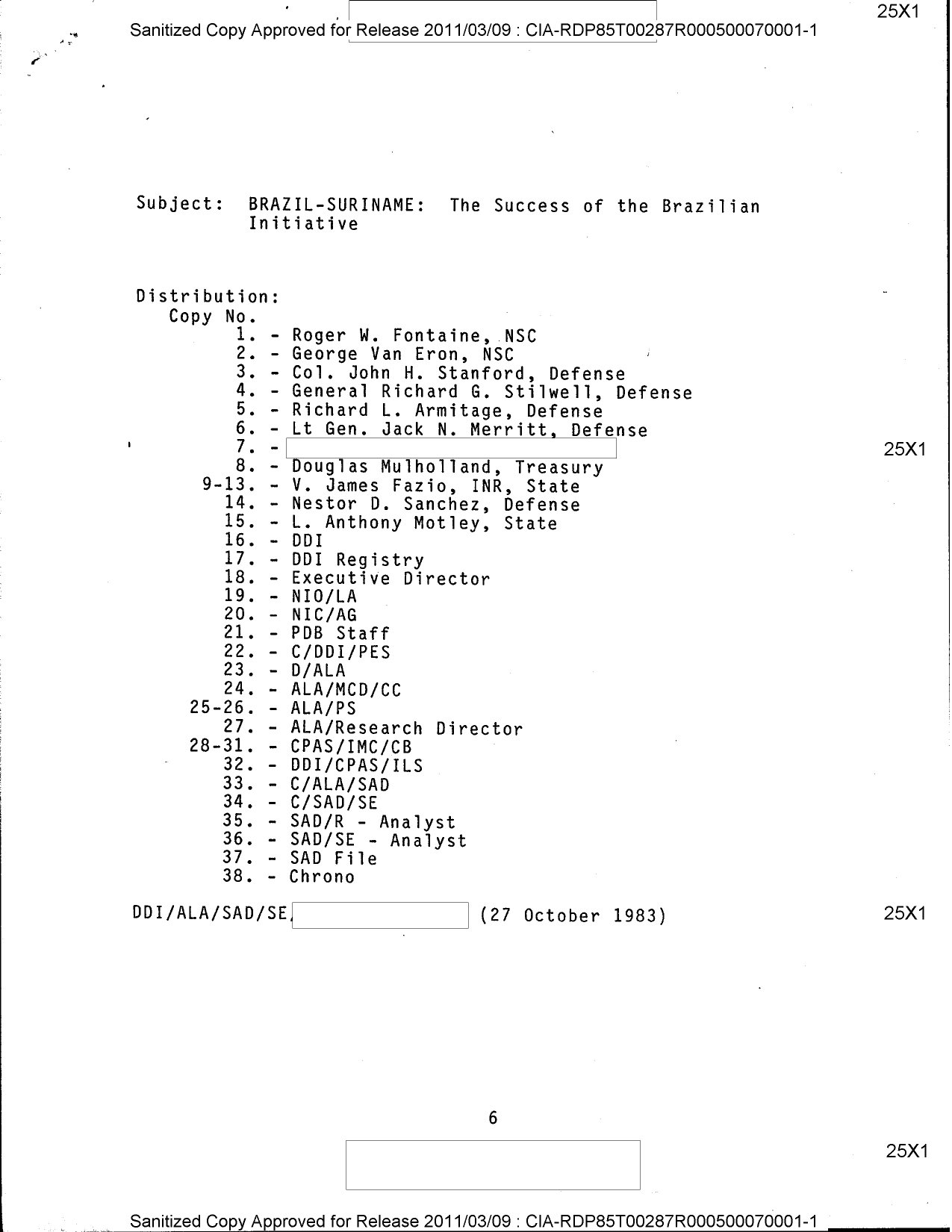
Distribution:
- Roger W. Fontaine, NSC
- George Van Eron, NSC
- Col. John H. Stanford, Defense
- General Richard G. Stilwell, Defense
- Richard L. Armitage, Defense
- Lt Gen. Jack N. Merritt, Defense
- [Vacant / Not listed]
- Douglas Mulholland, Treasury
9–13. V. James Fazio, INR, State - Nestor D. Sanchez, Defense
- L. Anthony Motley, State
- DDI
- DDI Registry
- Executive Director
- NIO/LA
- NIC/AG
- PDB Staff
- C/DDI/PES
- D/ALA
- ALA/MCD/CC
25–26. ALA/PS - ALA/Research Director
28–31. CPAS/IMC/CB - DDI/CPAS/ILS
- C/ALA/SAD
- C/SAD/SE
- SAD/R – Analyst
- SAD/SE – Analyst
- SAD File
- Chrono
DDI/ALA/SAD/SE (27 October 1983)
Source:
Link:
Internal Link: