New York Times: U.S. drops plan to overthrow government of Suriname
CIA-RDP92B00478R000800380001
by Philip Taubman
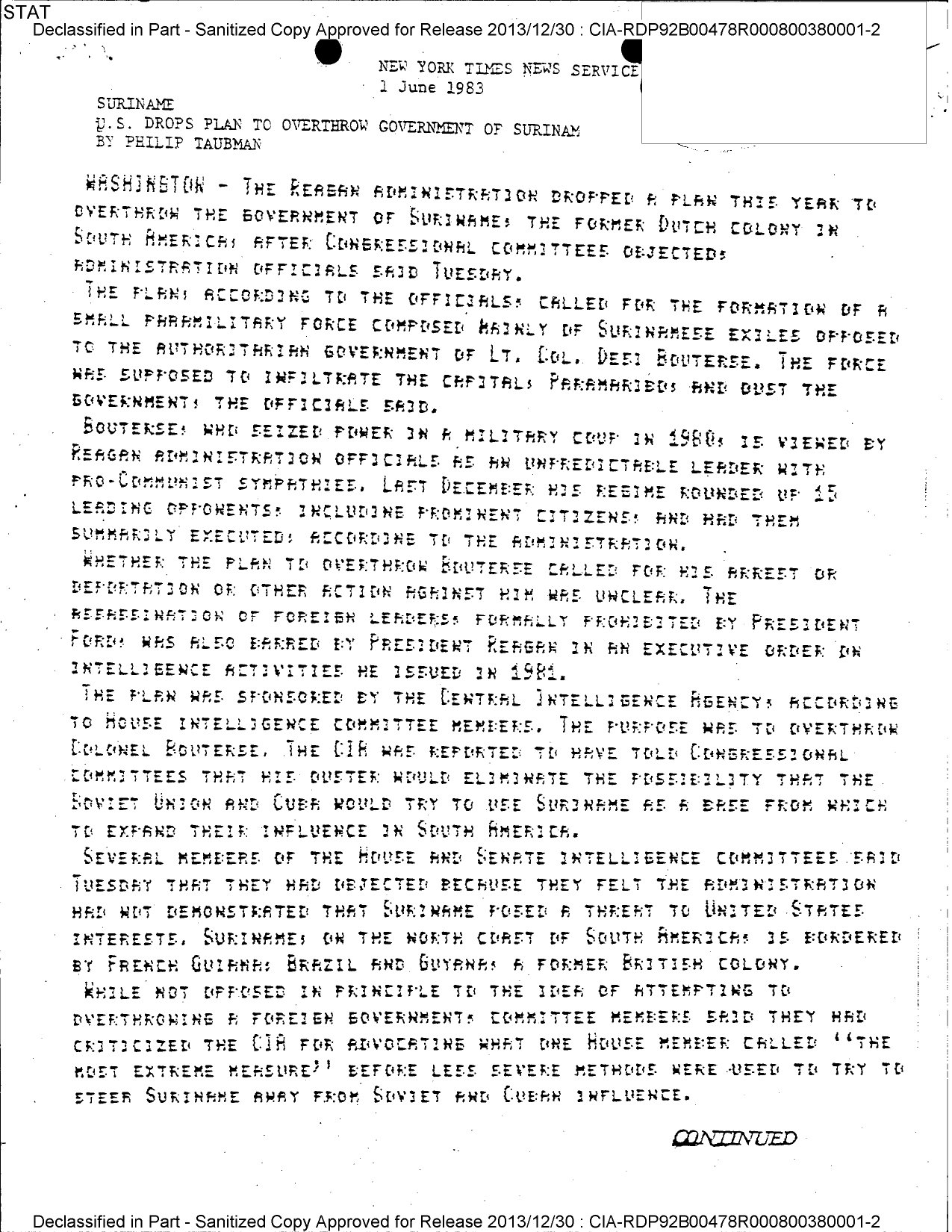
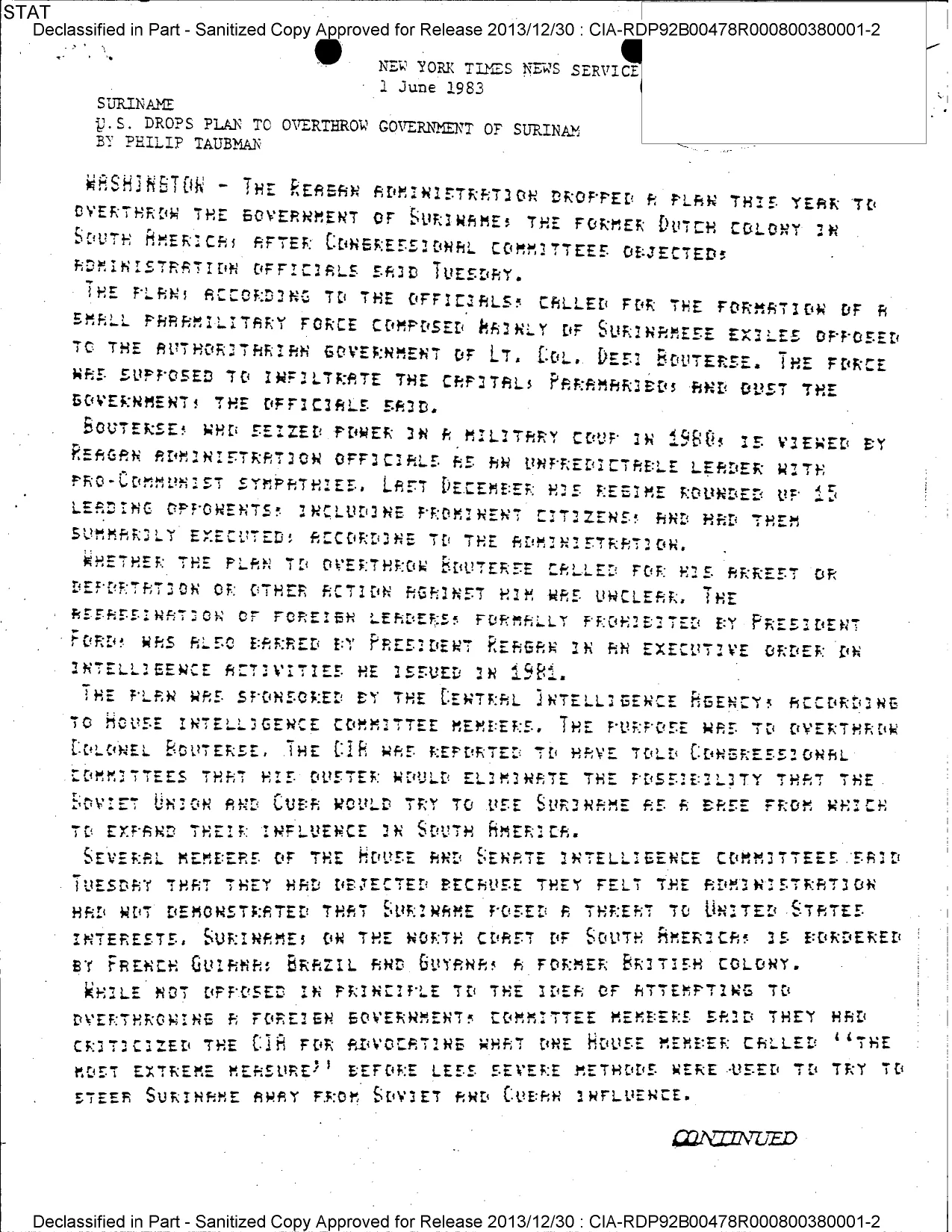
Washington – The Reagan administration dropped a plan this year to overthrow the government of Suriname: the former Dutch colony in South Americas after congressional committees objecteds administration officials said Tuesday.
The plan, according to the officials, called for the formation of a small paramilitary force composed mainly of Surinamese exiles opposed to the authoritarian government of Lt. Col. Dési Bouterse. The force was supposed to infiltrate the capital, Paramaribo, and oust the government, the officials said.
Bouterse, who seized power in a military coup in the 1980s, was viewed by Reagan administration officials as an unpredictable leader with pro-communist sympathies. Last December, his regime rounded up 15 leading opponents, including prominent citizens, and had them summarily executed, according to the administration.
Whether the plan to overthrow Bouterse called for his arrest, deportation, or other action against him was unclear. The assassination of foreign leaders, formally prohibited by President Ford, was also barred by President Reagan in an executive order on intelligence activities he issued in 1981.
The plan was sponsored by the Central Intelligence Agency according to House Intelligence Committee members. The purpose was to overthrow Colonel Bouterse, the CIA was reported to have told congressional committees that his duster would eliminate the possibility that the Soviet Union and Cuba would try to use Suriname as a base from which to expand their influence in South America.
Several members of the House and Senate Intelligence Committees said Tuesday that they had objected because they felt the administration had not demonstrated that Suriname posed a threat to United States interests. Suriname, on the north coast of South America, is bordered by French Guiana, Brazil, and Guyana, and is a former British colony.
While not opposed in principle to the idea of attempting to overthrow a foreign government, committee members said they had criticized the CIA for advocating what one House member called the most extreme measure before less severe methods were used to try to steer Suriname away from Soviet and Cuban influence.
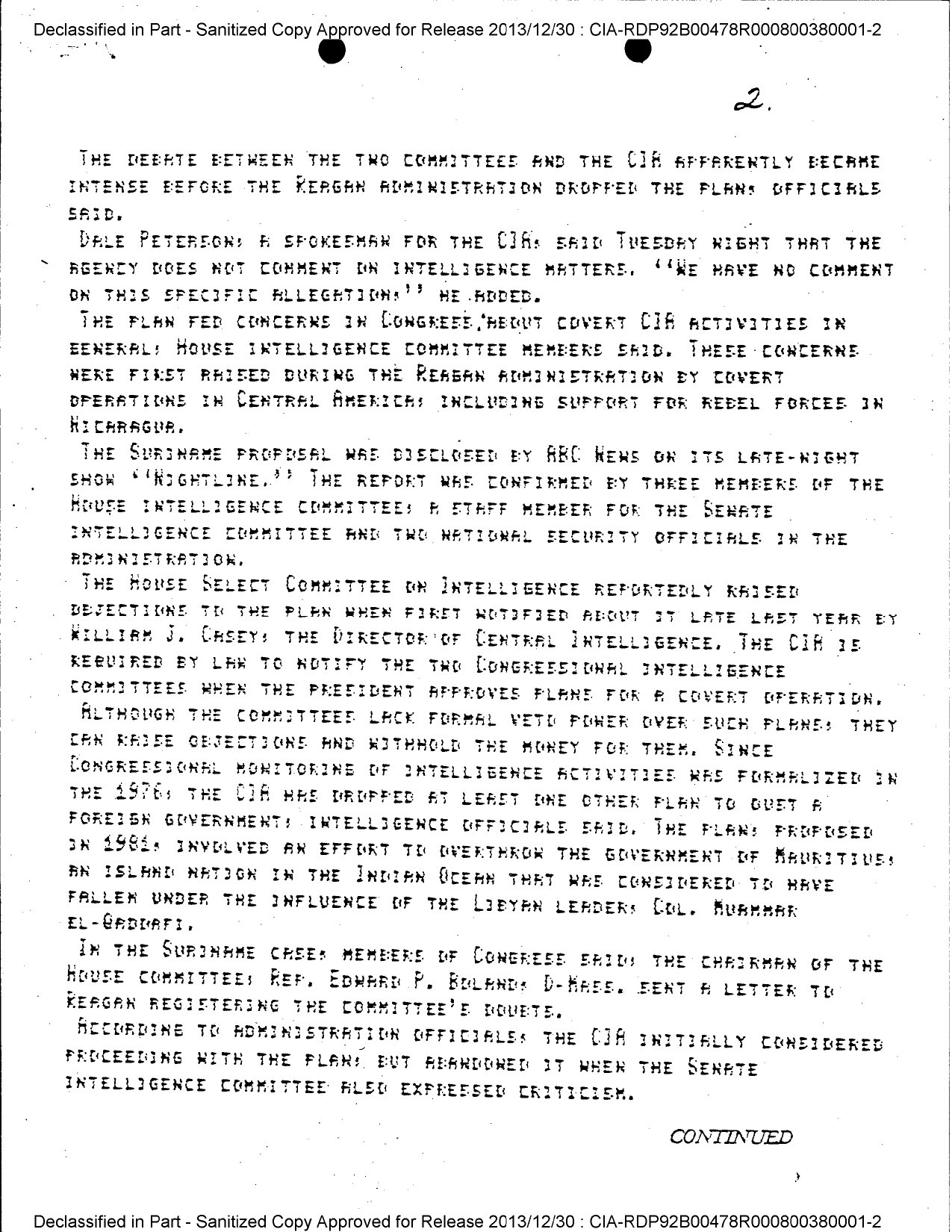
The debate between the two committees and the CIA apparently became intense before the Reagan administration dropped the plans, officials said.
Dale Peterson, a spokesman for the CIA, said Tuesday night that the agency does not comment on intelligence matters. “We have no comment on this specific allegation,” he added.
The plan fed concerns in Congress, he said. Covert CIA activities in general, House Intelligence Committee members said, were the issue. These concerns were first raised during the Reagan administration by covert operations in Central America, including support for rebel forces in Nicaragua.
The Suriname proposal was disclosed by ABC News on its late-night show Nightline. The report was confirmed by three members of the House Intelligence Committee, a staff member for the Senate Intelligence Committee, and two national security officials in the administration.
The House Select Committee on Intelligence reportedly raised objections to the plan when first notified about it late last year by William J. Casey, the Director of Central Intelligence.
The CIA is required by law to notify the two congressional intelligence committees when the president approves plans for a covert operation. Although the committees lack formal veto power over such plans, they can raise objections and withhold the money for them.
Since congressional monitoring of intelligence activities was formalized in 1976, the CIA has dropped at least one other plan to oust a foreign government, intelligence officials said. The plans proposed in 1981 involved an effort to overthrow the government of Mauritius, an island nation in the Indian Ocean, that was considered to have fallen under the influence of the Libyan leader, Col. Muammar el-Gaddafi.
In the Suriname case, members of Congress said the chairman of the House committee, Rep. Edward P. Boland (D-Mass.), sent a letter to Reagan registering the committee’s doubts.
According to administration officials, the CIA initially considered proceeding with the plans but abandoned them when the Senate Intelligence Committee expressed criticism.
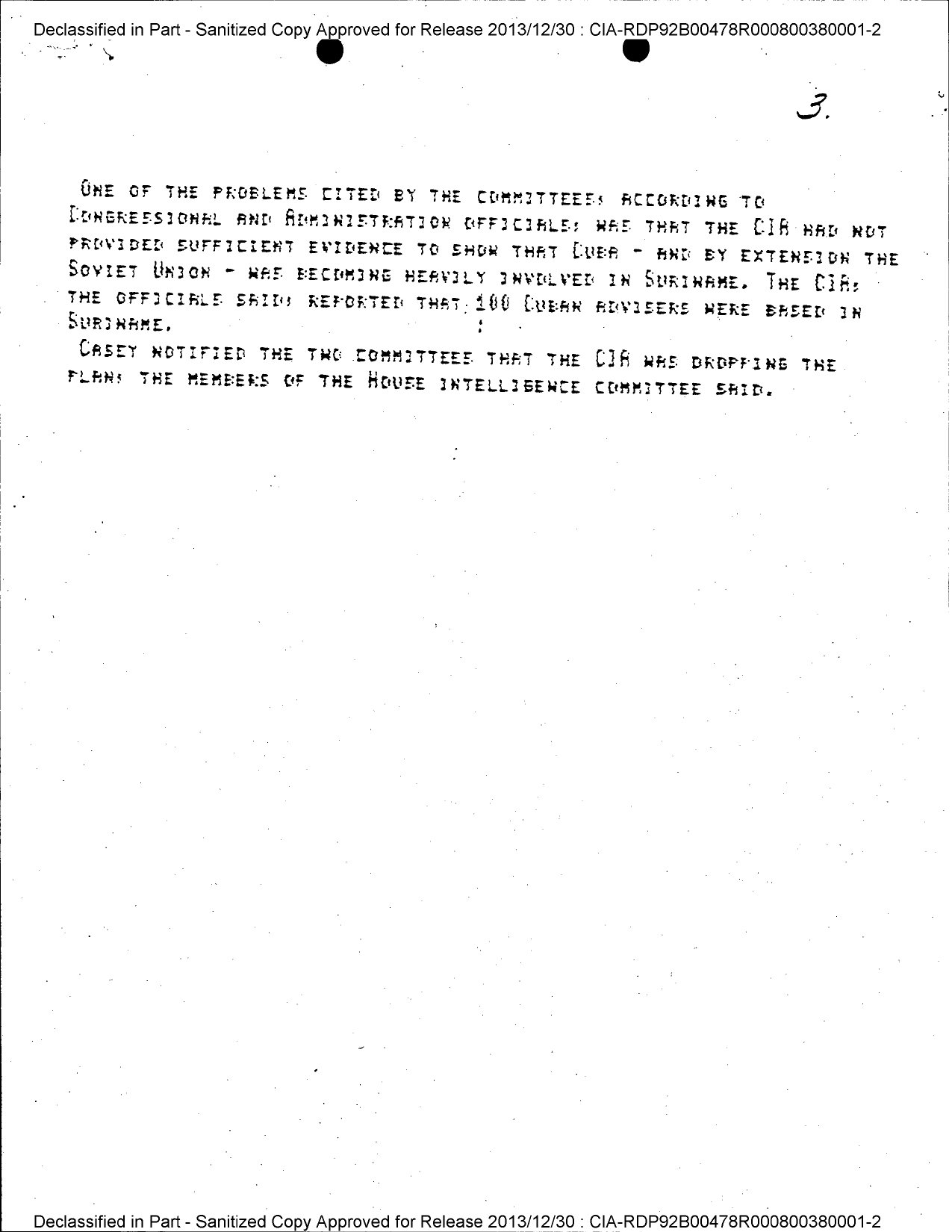
One of the problems cited by the committees, according to congressional and administration officials, was that the CIA had not provided sufficient evidence to show that Cuba, and by extension the Soviet Union, was becoming heavily involved in Suriname. The CIA, the officials said, reported that 100 Cuban
Casey notified the two committees that the CIA was dropping the plan, the members of the House Intelligence Committee said.
Source:
Link:
Internal Link:
Date:
June 1, 1983