United States Southern Command Historical Report 1983
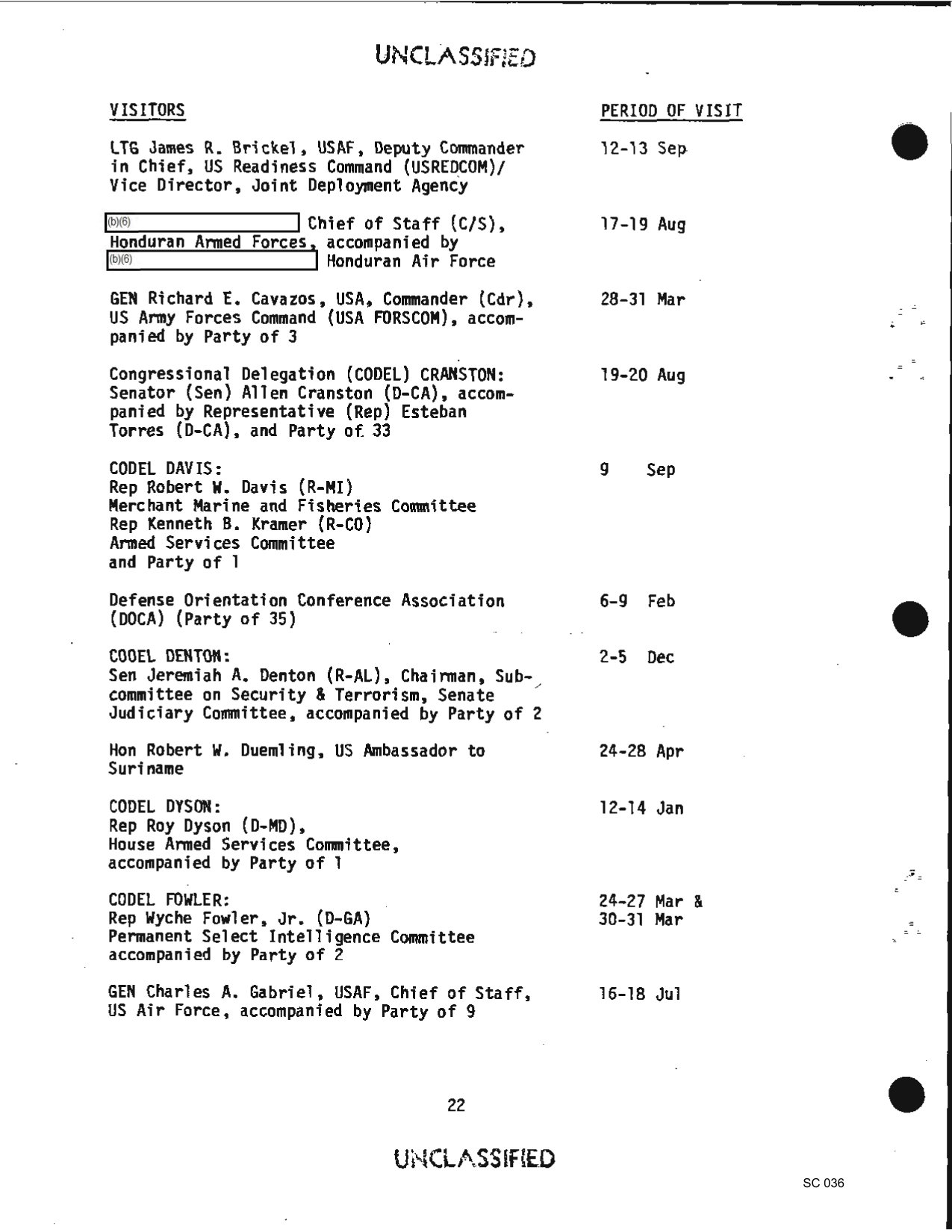
mentioning Suriname
few parts mention Suriname:
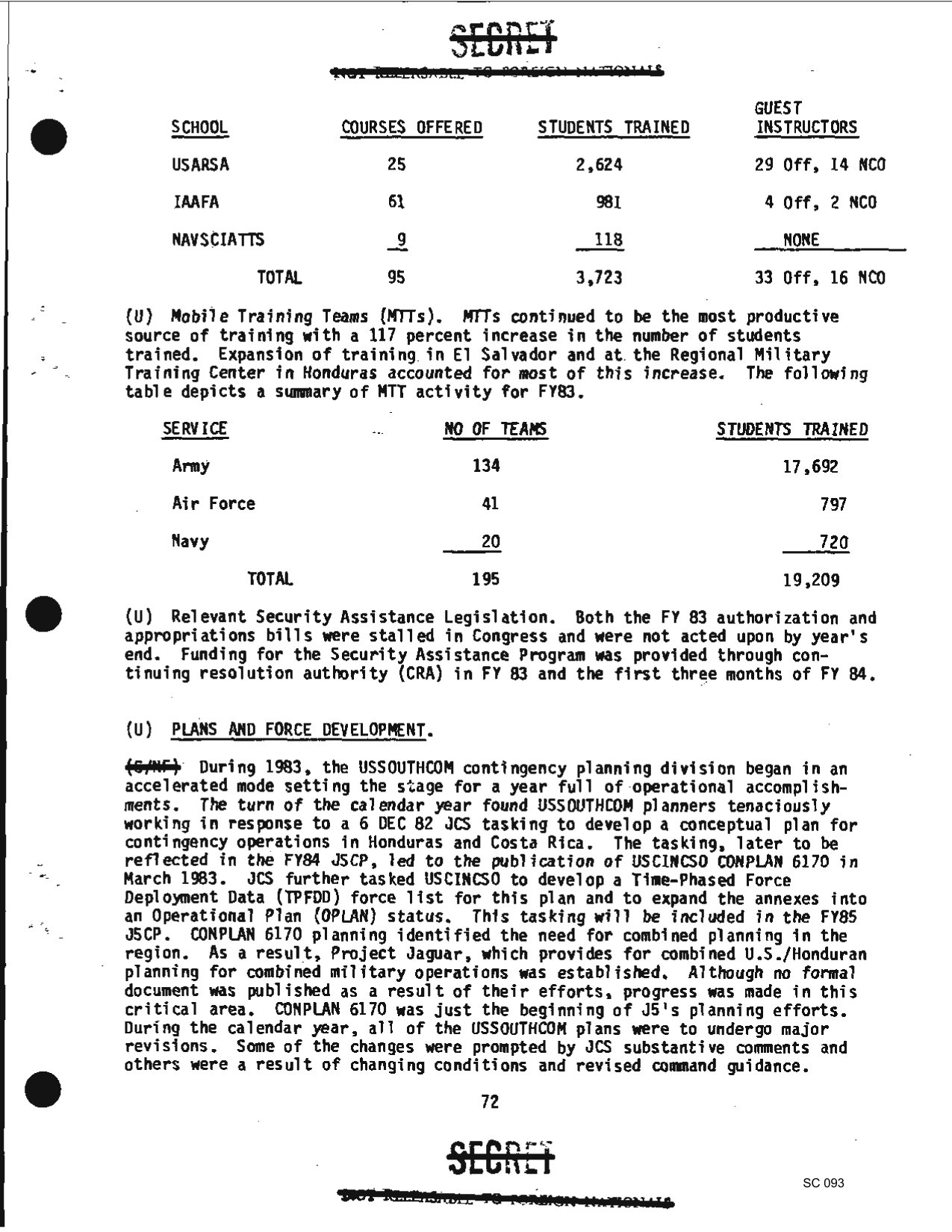
(U) PLANS ANO FORCE DEVELOPMENT
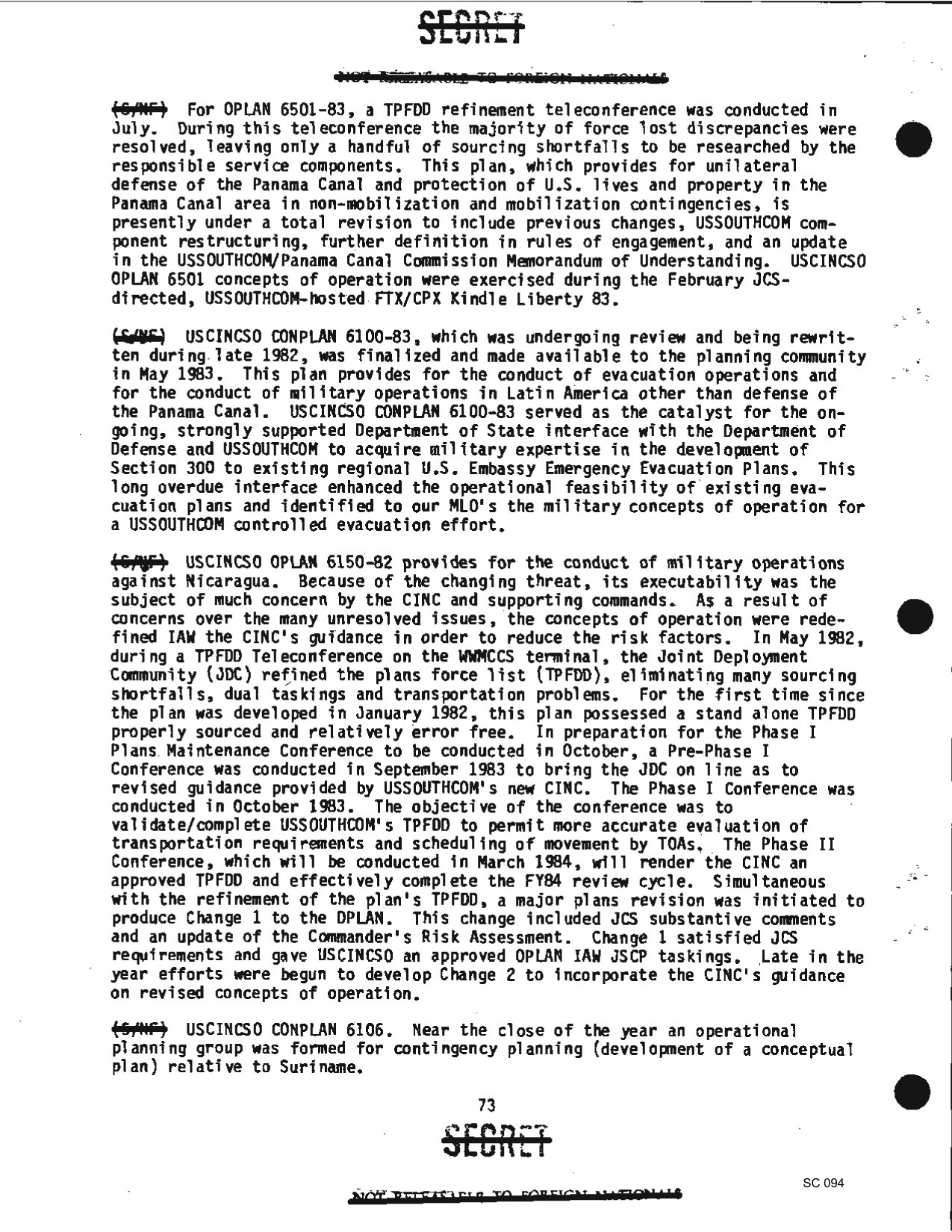
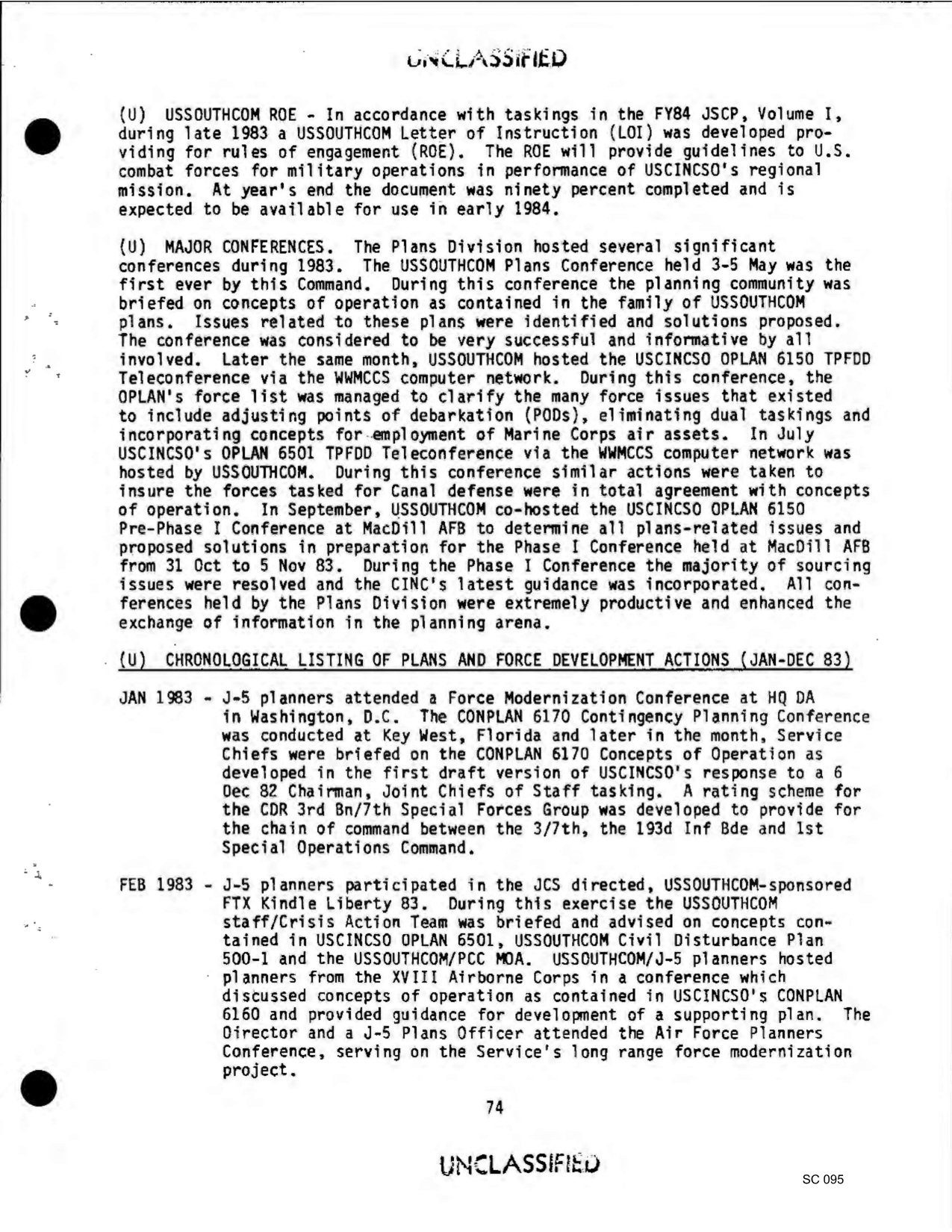
USCINCSO CONPLAN 6106. Near the close of the year an operational planning group was formed for contingency planning (developnent of a conceptual plan) relative to Suriname.
POLITICO-MILITARY SUMMARY
Suriname
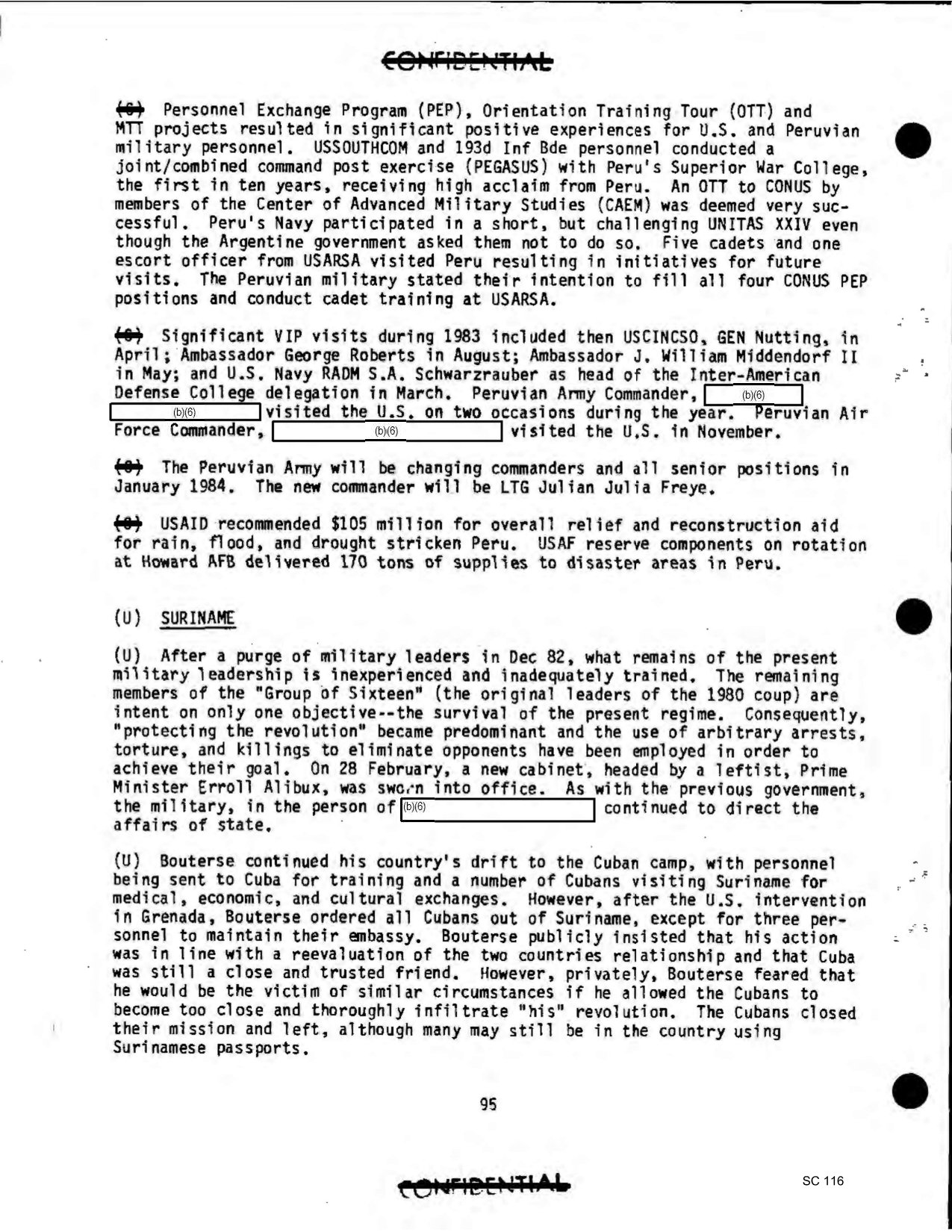
After a purge of military leaders in December 1982, what remains of the present military leadership is inexperienced and inadequately trained. The remaining members of the “Group of Sixteen” (the original leaders of the 1980 coup) are intent on only one objective—the survival of the present regime. Consequently, “protecting the revolution” became predominant, and the use of arbitrary arrests, torture, and killings to eliminate opponents has been employed in order to achieve their goal.
On 28 February, a new cabinet, headed by a leftist, Prime Minister Erroll Alibux, was sworn into office. As with the previous government, the military continued to direct the affairs of state.
Bouterse continued his country’s drift toward the Cuban camp, with personnel being sent to Cuba for training and a number of Cubans visiting Suriname for medical, economic, and cultural exchanges. However, after the U.S. intervention in Grenada, Bouterse ordered all Cubans out of Suriname, except for three personnel to maintain their embassy. Bouterse publicly insisted that his action was in line with a reevaluation of the two countries’ relationship and that Cuba was still a close and trusted friend. However, privately, Bouterse feared that he would be the victim of similar circumstances if he allowed the Cubans to become too close and thoroughly infiltrate “his” revolution. The Cubans closed their mission and left, although many may still be in the country using Surinamese passports.
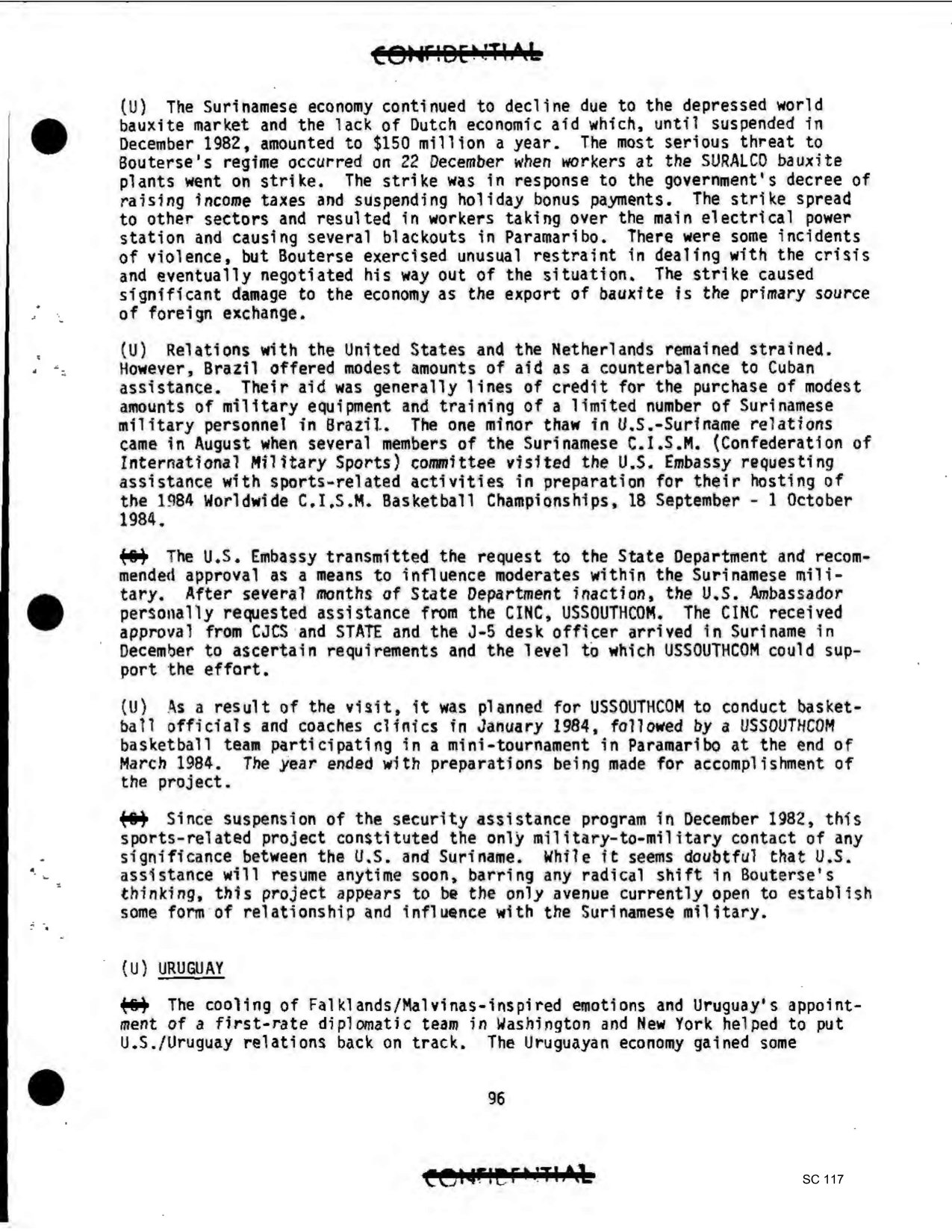
The Surinamese economy continued to decline due to the depressed world bauxite market and the lack of Dutch economic aid, which until suspended in December 1982 amounted to $150 million a year. The most serious threat to Bouterse’s regime occurred on 22 December when workers at the SURALCO bauxite plants went on strike. The strike was in response to the government’s decree of raising income taxes and suspending holiday bonus payments. The strike spread to other sectors and resulted in workers taking over the main electrical power station and causing several blackouts in Paramaribo. There were some incidents of violence, but Bouterse exercised unusual restraint in dealing with the crisis and eventually negotiated his way out of the situation. The strike caused significant damage to the economy, as the export of bauxite is the primary source of foreign exchange.
Relations with the United States and the Netherlands remained strained. However, Brazil offered modest amounts of aid as a counterbalance to Cuban assistance. Their aid was generally lines of credit for the purchase of modest amounts of military equipment and training of a limited number of Surinamese military personnel in Brazil.
The one minor thaw in U.S.-Suriname relations came in August when several members of the Surinamese C.I.S.M. (Confederation of International Military Sports) committee visited the U.S. Embassy requesting assistance with sports-related activities in preparation for their hosting of the 1984 Worldwide C.I.S.M. Basketball Championships, 18 September – 1 October 1984. The U.S. Embassy transmitted the request to the State Department and recommended approval as a means to influence moderates within the Surinamese military. After several months of State Department inaction, the U.S. Ambassador personally requested assistance from the CINC, USSOUTHCOM. The CINC received approval from CJCS and STATE, and the J-5 desk officer arrived in Suriname in December to ascertain requirements and the level to which USSOUTHCOM could support the effort.
As a result of the visit, it was planned for USSOUTHCOM to conduct basketball officials and coaches clinics in January 1984, followed by a USSOUTHCOM basketball team participating in a mini-tournament in Paramaribo at the end of March 1984. The year ended with preparations being made for accomplishment of the project.
Since the suspension of the security assistance program in December 1982, this sports-related project constituted the only military-to-military contact of any significance between the U.S. and Suriname. While it seems doubtful that U.S. assistance will resume anytime soon, barring any radical shift in Bouterse’s thinking, this project appears to be the only avenue currently open to establish some form of relationship and influence with the Surinamese military.
Source:
Link:
Internal Link:
Date:
June 29, 1984