Command and Cooperation: Innovating Unity of Command in the Caribbean Sea Frontier, 1942–1943
In the first year of U.S. involvement in World War II, the Allies suffered severe shipping losses due to German submarine operations off the Eastern Seaboard of the United States and within the Caribbean. At the height of their offensive in the Caribbean in 1942, German submarines sank on average 1.5 ships per day and over one million tons of shipping total. Gradually, however, the United States and its allies turned the tide against the Germans, significantly degrading the U-boat threat by the end of 1943. Technical and tactical innovations such as convoying and high-frequency direction finding played a critical role in this outcome, but organizational innovations were also quite important. With most of its ships and personnel allocated to other theaters, the U.S. Navy had to rely heavily on the support and cooperation of both the U.S. Army and foreign allies such as the British and the Dutch. This interdependence would require a new framework for cooperation, one rooted in the concept of “unity of command.” Equally important, it required commanders who possessed the collaborative mindset, organizational skills, and operational adaptability to innovate and refine different modes of cooperation in order to transform this new framework from a doctrinal proscription into a working practice.
Unity of command entails joint or combined forces operating “under a single commander with the requisite authority to direct all forces employed in pursuit of a common purpose.” Today, it is a cornerstone of U.S. military doctrine, but in 1941, it was still very much an open question as to whether this framework could actually work across an entire theater of operations in which joint and combined forces were involved.
The Caribbean Sea Frontier (CSF) demonstrated not only that it could, but that unity of command itself offered considerable operational benefits, including greater unity of effort and enhanced interoperability among joint or combined forces. Its successful implementation here foreshadowed the development of integrated joint/combined commands across other theaters, most notably, the Supreme Headquarters Allied Expeditionary Force in Europe.
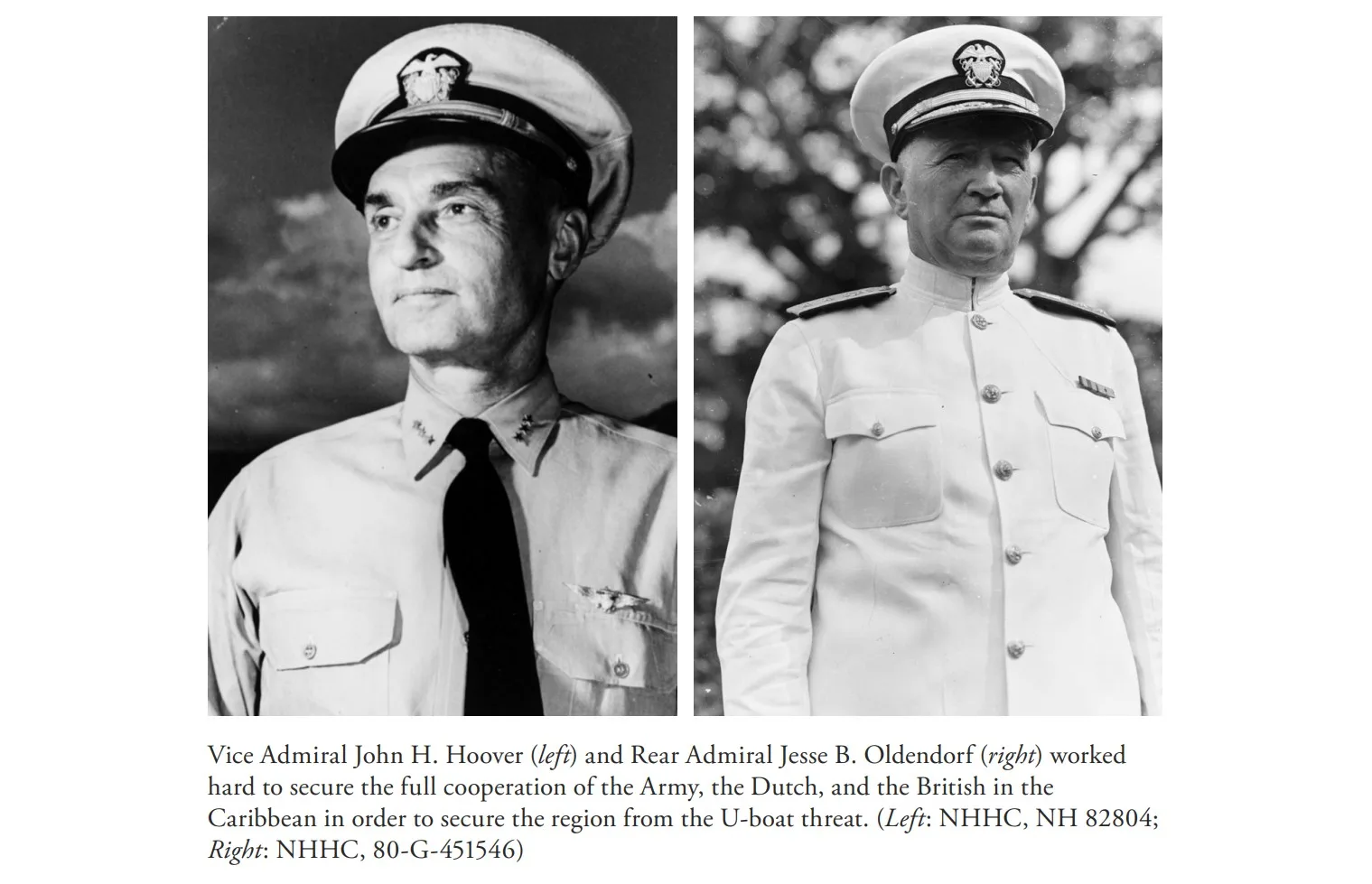
Within the Caribbean theater, unity of command succeeded not simply because it was a useful innovation nor because of the carefully crafted agreements made among the various governments and branches of the U.S. armed forces that allowed for its implementation. It succeeded because the CSF had officers who were capable of putting this concept into practice. Despite the considerable obstacles they faced, Vice Admiral John H. Hoover (Commander, CSF) and his subordinate, Rear Admiral Jesse B. Oldendorf (Commander, All Forces, Aruba-Curaçao; subsequently, Commander, Trinidad Sector), were able to secure the full cooperation of the Dutch, the British, and the U.S. Army largely by observing the very tenets of joint and multinational operations that military planners still emphasize today: exercising patience, developing personal rapport, demonstrating respect, acquiring knowledge, maintaining mission focus, and building trust.
Their efforts would not only help to secure the Caribbean from the U-boat menace and demonstrate the viability of unity of command as a framework for cooperation, but also provide a model for how officers can successfully navigate the tensions and territorialism that are often inherent in joint and combined operations.
Before delving into how these officers implemented unity of command, we first need to understand both the theater they were operating in and the challenges they faced in exercising command. The Caribbean’s importance to U.S. and Allied military operations during World War II should not be understated. The islands and the surrounding waters were an important defensive buffer for the continental United States; a source of key resources such as bauxite, oil, coffee, and sugar; a thoroughfare through which Navy ships could transport people and supplies to and from the Pacific; and a shared diplomatic concern among the United States and the countries of Central and South America. Roosevelt wrote that he feared “we would find ourselves surrounded by hostile states” if the Axis successfully infiltrated and occupied any of the islands in the Caribbean or the coastal South and Central American countries, so he conducted extensive negotiations with the British and Dutch to secure basing rights and land across their colonial holdings, as well as their mutual cooperation in the event of war.
While all parties agreed in principle that the United States had a prevailing interest in leading the defense of the Caribbean, the issue of how it would do so was still largely unsettled when the United States entered the war in December 1941. From Vice Admiral Hoover’s standpoint, there was never any question as to what was needed. As he later emphasized, “In order to make a situation like that work, where on each one of these bases we had some Army and some Air Corps people and Navy people, and foreigners, one had to have a unity of command.”
The most notable of these agreements, the destroyers-for-bases agreement, saw the United States swap 50 of its World War I–era destroyers for basing rights and long-term leases on the British-held islands of Bermuda, Jamaica, the Bahamas, Antigua, British Guiana, St. Lucia, and Trinidad.
Among the United States’ major partners, however, only the British had agreed to place their forces under the U.S. military’s overall command, but questions lingered about how command would be exercised within each territory. The Dutch proved far more reluctant partners, not even agreeing to allow U.S. forces onto the islands of Aruba and Curaçao until 11 February 1942, just five days before the Germans launched their first major submarine campaign. Even among the U.S. armed forces, it was still an open question well into December as to which branch would hold overall command within the Caribbean. Ultimately, President Roosevelt chose to split the difference, placing the Army in command of the Panama Canal and its surrounding waters while granting the Navy command of the Caribbean.
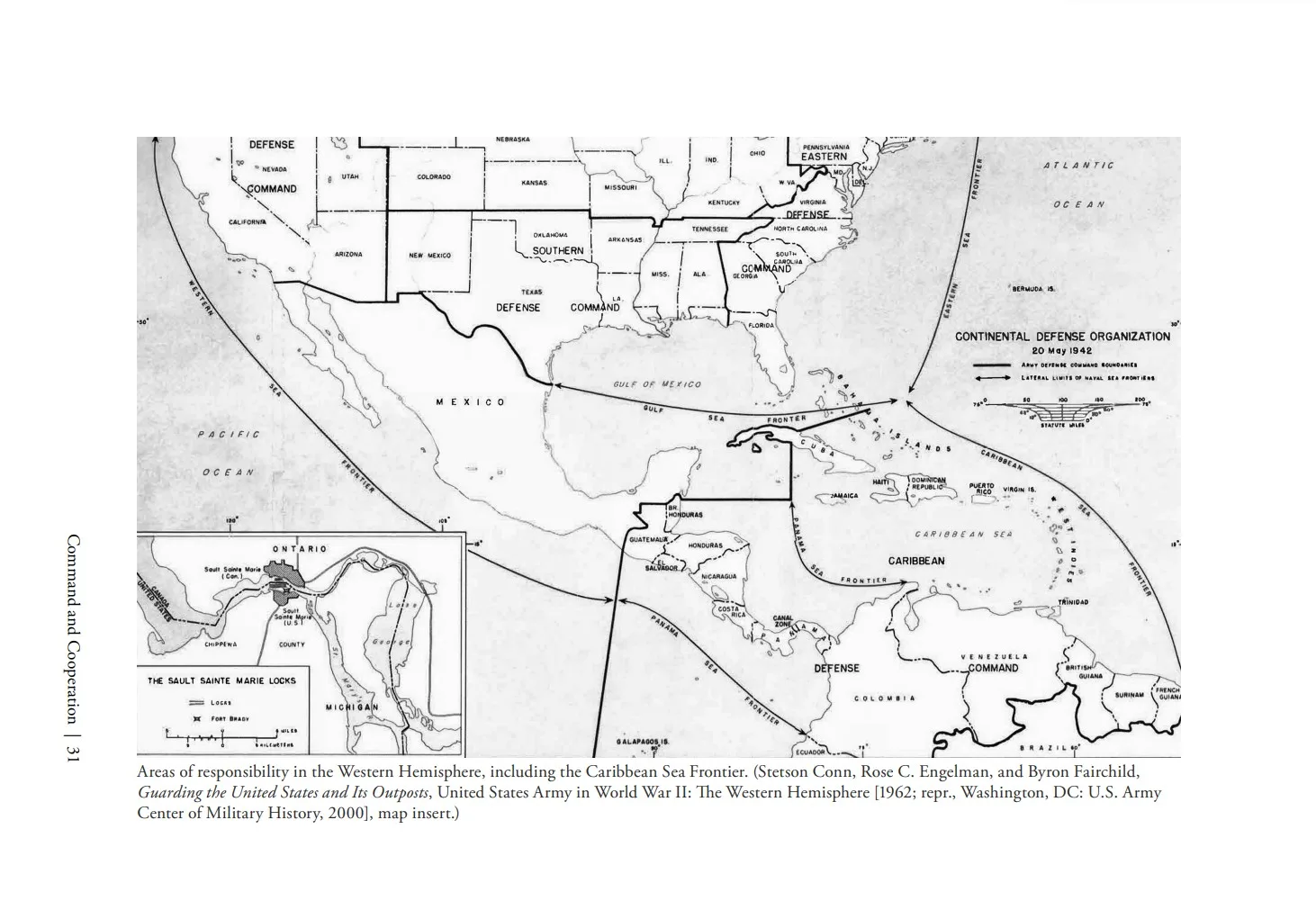
Setting aside, for the moment, the question of how the Navy would exercise command over the combined forces of the Army, the British, and the Dutch, it bears emphasizing that there were considerable logistical challenges to administering the Caribbean. The CSF encompassed an estimated 2.5 million square miles, making it among the largest antisubmarine commands. It was also among the most resource poor, being forced to compete with adjacent sea frontiers that were deemed more essential to operations such as the Panama Sea Frontier (Panama Canal and Central America), the Gulf Sea Frontier (Florida and the Gulf of Mexico), and the Eastern Sea Frontier (the Atlantic and the Eastern Seaboard of the United States). At the commencement of the Germans’ first major submarine campaign in the Caribbean in February 1942 (Operation Neuland), the CSF possessed only an estimated two destroyers, one squadron of PBY Catalinas belonging to Patrol Squadron 12, three S-class submarines, and a handful of smaller vessels such as yachts and subchasers. At the beginning of the campaign, as Hoover grimly noted, “About all you could do was to get the report that the ship was sinking, and then maybe a couple of days later, get something out there and pick up the survivors. The matter of hunting down, locating and sinking submarines was just out of the question.”
Given this dearth of resources, cooperation among the Navy, the Army, the British, and the Dutch was an absolute necessity for success. In theory, the arrangements for unity of command made among various Allied governments and branches of the U.S. armed forces guaranteed this, but, in practice, it would still fall to commanders on the ground to implement it, with success depending just as much on their professionalism and interpersonal skills as it did on their place within the CSF’s organizational chart. Fortunately, the Navy’s chosen commander for the CSF, Vice Admiral Hoover, was well suited to this task. Oldendorf described him as a “forceful personality and a fighting admiral” with “interests so broad that he usually” was “able to hold his own regardless of what subject” was “up for discussion.” Hoover not only had prior experience with conducting antisubmarine patrols during World War I, but also was one of the rare flag officers who was both a qualified aviator and a former submarine commander. All of this made him uniquely suited to implement unity of command and develop a workable antisubmarine strategy among all forces.
Hoover would not be operating alone, however. Given the sheer size of the CSF, it was necessary to divide it into multiple sectors (Puerto Rico, Guantanamo, Trinidad, and, later on, Aruba-Curaçao), each of which encompassed major sea-lanes, critical junctions in the Allies’ supply chain, and/or significant transfer points for convoys. To administer these sectors, officers from both the Army and the Navy were assigned to command, the most stalwart and successful of whom proved to be Rear Admiral Jesse “Oley” Oldendorf. At first glance, Oldendorf would not appear to have been a natural fit for the task at hand. Although he had some experience with convoying and antisubmarine warfare, he had only recently been appointed to flag rank and possessed very limited knowledge of the territory he was to command. It turned out, however, that Oldendorf was both a capable organizer and a natural-born diplomat, working very well with his Army, British, and Dutch counterparts. He was so successful in Aruba-Curaçao that Hoover swiftly placed him in charge of the much more extensive operations in the Trinidad Sector.
Despite their considerable abilities, both Hoover’s and Oldendorf’s skills would be sorely tested by the task in front of them. Leaving aside the fact that they had been provided with very few resources with which to conduct antisubmarine warfare (ASW) operations, they also had to overcome resistance from local civilian and military officials (some of whom were loath to cede any authority whatsoever to U.S. commanders), differences in strategic doctrine among all forces, and the Navy’s own lack of recent experience with conducting antisubmarine operations. Time and patience would help to overcome these challenges, but they also required Oldendorf and Hoover to build trust and personal rapport with their counterparts.
Failure to undertake this critical task could forestall or even permanently prevent unity of command from being implemented. In Surinam, for example, the unilateral decision by Brigadier General Ralph Talbot Jr. (Commander, Trinidad Sector) that the United States would be assuming command of all forces in the colony provoked a furious backlash from the Dutch government-in-exile, leading it to agree only to “mutual cooperation” among all forces rather than unity of command. A similar situation might have developed in Aruba-Curaçao, where Rear Admiral Oldendorf quickly discovered upon his arrival on 1 March 1942 that no word had been sent informing the Dutch governor, Gielliam Johannes Josephus Wouters, that he was assuming command. While the governor received Oldendorf cordially enough, he also pointedly reminded the admiral that “it was traditional among the Dutch that the governor of any province was, by virtue of his position, commander of all forces in his jurisdiction.”
Oldendorf wisely did not contest this point, at least not openly. Instead, he quietly assumed command of all U.S. forces in the area without issuing any public statement to that effect and assiduously avoided issuing any orders to the local Dutch forces. It was only when it became clear that the situation was not going to resolve itself anytime soon and that the U-boat threat was growing exponentially that he decided to announce publicly that he was assuming command of all American forces (both Army and Navy) in the area and sought to come to some sort of understanding with the Dutch. Even so, he proceeded cautiously, first informing the ranking British and Army officers of his plans and then calling a meeting with the commander of the Dutch forces, Captain Baron Carel Johan van Asbeck, and his senior officer afloat, Captain Cornelis Hellingman (commanding officer [CO], HMNS Van Kinsbergen). Taking a firm, but respectful, approach, Oldendorf pointedly asked Hellingman “if he considered himself to be operating under Admiral Hoover.” Hellingman answered in the affirmative, to which Oldendorf responded, “I am Admiral Hoover’s representative in Curaçao. So you are operating under me.
Is that correct? Hellingman again answered in the affirmative. Although this exchange did not entirely resolve the dispute, Oldendorf could note with evident satisfaction that “even before the Governor received word from his Government [concerning Oldendorf’s appointment], things were beginning to line up.”22 It was a testament to Oldendorf’s ability to balance the need for diplomacy with the need to maintain mission focus.
Oldendorf’s position as Commander, All Forces, Aruba-Curaçao (CAFAC) would eventually receive official acknowledgement from the Dutch government and Governor Wouters on 31 March 1943.23 It must be emphasized, however, that even after the dispute over his command had been resolved, Oldendorf always remained respectful toward his hosts and sensitive to their concerns. He not only made Captain van Asbeck his chief of staff and Captain Hellingman his senior officer afloat,24 but even went so far as to attend meetings of the local Rotary Club in Willemstad, Curaçao, in a bid to build stronger relations with the local community and deepen his knowledge of the Dutch and their customs.
He also came to appreciate that although his Dutch officers spoke English quite fluently, they did not always understand it perfectly, and he would need to exercise considerable patience with them, repeating his orders when necessary and expressing them in simpler terms that the Dutch could more easily understand. These efforts to demonstrate respect, develop local knowledge, and exercise patience were not only textbook examples of how to oversee a combined operation but served to build trust and facilitate cooperation between the Dutch and the Americans.25
Oldendorf’s deft handling of the Dutch would garner him a potentially tougher assignment in Trinidad. Trinidad had long been a source of tension between the United States and United Kingdom, with both sides largely operating independently of each other. Even after the United States entered the war, it took the two sides nearly three weeks to begin drawing up a joint defense plan, one which would not be completed until June of 1942, well after the U-boat offensive had commenced.26 Some of the blame for this can be attributed to the island’s governor, Sir Hubert Young, who was not only highly resistant to any attempts to implement unity of command, but also constantly at loggerheads with the Trinidad Sector commander, Brigadier General Ralph Talbot Jr.27
Both men proved to be intractable in their dealings with each other, with the Army’s own official history disapprovingly noting that both were “cut from the same cloth, blunt and outspoken in their personal opinions; each was insistent that the prestige of his own government could be upheld by not yielding to the other; neither believed in appeasement.”28
Compounding this situation further was the matter of rank. As Hoover astutely recognized, both Talbot and the Navy officers assigned to Trinidad were significantly outranked by their British counterparts. Young was not only a former officer in the British Army, but as governor, was considered to hold superior rank over everyone. The commander of the local naval defense force, Admiral Sir Michael Hodges, likewise outranked all of his American counterparts.29
Believing that “if you don’t have rank, you don’t get much consideration anywhere,” and that his officers “couldn’t quite hold their own with this high ranking governor,”30 Hoover pushed for a command shakeup, working with Lieutenant General Frank Andrews to replace Brigadier General Talbot with the higher-ranking (and considerably more diplomatic) Major General Henry Conger Pratt in January 1942 and then subsequently securing an agreement with the British to transfer control of the local naval defense force from Hodges to Oldendorf in September 1942.31
Equally important, Hoover and Admiral Ernest J. King, Commander in Chief, U.S. Fleet, and Chief of Naval Operations, persuaded the British government to recall Young on 8 June 1942. The governor’s replacement, Sir Bede Clifford, would prove far more amenable to cooperation, possibly on account of the fact that his own wife was an American.32
Fortunately for Hoover and his subordinates, issues of rank and rapport would be far less of an issue with the U.S. Army than they were with the Dutch and the British. Although questions over who would command in the Caribbean had provoked vigorous debate in Washington and would burn even hotter when it came to the ongoing discussions as to whether to organize a joint ASW command,33 at least in the Caribbean, there was significant cooperation from an early date. The command arrangements made at the war’s outset certainly had something to do with this, but it also seems clear that at least some of the Caribbean commanders had a more cooperative mindset, not to mention a greater degree of personal rapport with each other.
In contrast to his dealings with the Army in the Pacific, Hoover emphasized, “Down in the Caribbean they [the Army] were 100 percent cooperative and did all they could possibly do to help,” particularly when it came to supplying planes.34 Oldendorf echoed Hoover’s sentiments, noting, “It was remarkable how little friction there was, and how well we all got along together.” Concerning his Army counterpart in Trinidad, Major General Henry Conger Pratt, Oldendorf’s praise was even more fulsome: “The General and I hit it off perfectly from the first. We almost invariably saw eye to eye, and we literally never found ourselves at cross purposes. In fact, we came to be known as ‘the Service twins’—a nickname that pleased me immensely, and I hope did not displease the General.”35
Personal rapport between commanders was just one of the ingredients necessary for achieving unity of command. As more modern Joint Chiefs of Staff joint doctrine publications note, rapport and mutual confidence cannot exist without respect, and to obtain this, “all partners must be included in the planning process, and their opinions must be sought in mission assignment, organizational structure, and the operation assessment process. Understanding, discussing, and considering partner ideas are essential to building effective relationships.”36
Building this understanding is where joint and combined staffs played an important role. While Hoover certainly leaned on his fellow Navy officers for advice and support, he also had a joint staff that included members of both the Army and Army Air Forces (AAF), including General James Lawton Collins and Colonel Edwin House.37 Oldendorf, likewise, had combined staffs at both Aruba-Curaçao and Trinidad, though in his case, this was almost as much by necessity as it was by design, as he had been provided no Navy staff upon his assignment to Aruba-Curaçao.38 Even after his staff increased in size and he was able to incorporate more Navy officers into it, Oldendorf still relied heavily upon officers from other services such as Colonel Charles F. Born (AAF).
Historian Samuel Eliot Morison described Oldendorf and Born’s working relationship in positively glowing terms, noting, “Between them they ironed out every incipient Army-Navy conflict, and ran military activities as one team, with flexibility and intelligence. ‘Oley’ and ‘Charley’ were an inspiration to their subordinates; and the naval personnel worked themselves ragged to ‘keep the ships sailing.’”39
Morison’s reference to “incipient conflicts” and running “military activities as one team” raises an interesting point. To make unity of command truly effective, it was imperative that Hoover and his commanders not only build trust and foster respect among all partners, but also enhance their interoperability. Although the Dutch, the British, and the Army had all agreed to place their forces under the overall command of the Navy in the Caribbean, there were still critical differences in terms of strategic doctrine, training, and relative experience among all partners that needed to be resolved if they were to work effectively together. This cooperation is another area where joint and combined staffs played a critical role, as they not only created a forum through which disagreements could more easily be mediated and operating procedures standardized, but also offered a pool of knowledge and experience that commanders could draw upon to develop more effective ASW strategies and maximize partner contributions.
Take the Dutch officers under Oldendorf’s command, for example. Although their nation’s material contributions to the war effort in the Caribbean were more limited than those of other partners,40 the Dutch officers’ understanding of how both the British and the Germans operated was absolutely invaluable. As Oldendorf gratefully acknowledged in his memoir, much of his ASW strategy had been shaped by the advice of his senior officer afloat, Captain Hellingman, who he said was not only “highly efficient, intensely loyal, and invariably helpful on all the work on which we were called upon to cooperate,” but also quite experienced in dealing with the German submarines. Recognizing the value of this, Oldendorf actually went so far as to ask Hellingman to outline what he would do if he were in command of the U-boats and then formulated a strategy based upon those discussions.
Similarly, Oldendorf came to rely heavily on Lieutenant Commander Baron Thomas Karel van Asbeck, CO of HMNS Jan van Brakel, whose prior experience working with the British made him the ideal person to assist in coordinating the first Caribbean convoys when they launched in May 1942.41
The Dutch were, of course, not the only ones who could bring their expertise and experience to bear on the U-boat problem. Having endured U-boat attacks within their territorial waters since the war commenced, the British had already developed an effective system of convoys and air patrols to combat the submarine threat.42 Consequently, they could provide not only staff with the necessary expertise to help establish a similar system in the Caribbean, but also experienced air and naval units to assist in carrying out operations and training American personnel.
Escort Group B5, for example, was shifted from the North Atlantic to Trinidad in April 1942 and conducted some of the earliest convoy operations with additional contributions from the Royal Canadian Navy.43 No. 53 Squadron (Royal Air Force Coastal Command), which already had significant experience hunting U-boats off the coast of England, was equally valuable. Although the unit was only stationed in Trinidad from August to November 1942, it flew around 700 missions and carried out 15 attacks on U-boats.44 Its personnel also worked with Army and Navy pilots to improve their communication and ASW techniques, and even helped to supervise a system of coast-watching stations.45 Such efforts were critical, as they not only kept the U-boats in check, but also afforded the Navy additional time to train up its own antisubmarine squadrons.46
All of these measures would have been critical in any theater of war, but they were especially imperative in the Caribbean where the Navy could not rely primarily on its own capabilities to achieve victory. Particularly in the first half of 1942, when the Navy could spare few vessels and personnel, Hoover and his subordinates were largely reliant on ships, aircraft, and expertise provided by the British, the Dutch, and the Army to mitigate the severe shipping losses inflicted by the Germans. Even after the Navy was able to increase its presence in the Caribbean during the summer of 1942 and the tides began to turn against the U-boats, the service would still rely heavily on partner contributions to organize and implement a robust convoy system and provide significant air coverage across the Caribbean.
While these actions alone were not sufficient to achieve victory, they helped keep the war effort afloat until other factors (technological advancements, a robust intelligence-collecting apparatus, success in other theaters of war, increasing U.S. industrial capacity, etc.) could come into play. As Hoover acknowledged, “We were getting help from everywhere in the world before we got through.”53
It would be only in September 1943, when the campaign against the U-boats had largely been won and an all-new antisubmarine command, Tenth Fleet, had been set up, that the Navy would be capable of assuming sole responsibility for antisubmarine operations in the Caribbean.54
Incidentally, it was around this time that there was a changing of the guard in the Caribbean, with Oldendorf departing for an assignment in Argentia, Newfoundland, in April 1943 and Hoover transferring to the Pacific in August. Although their legacies would ultimately be defined by their subsequent successes in the Pacific theater,55 their contributions in the Caribbean should not be overlooked. Hoover and Oldendorf had not only protected critical sea-lanes from the U-boat onslaught, but also were among the first commanders to successfully implement unity of command across a major joint/combined theater of operations during World War II.
Oldendorf was quick to emphasize just how critical this development was to operations, noting to reporters, “We make no distinctions between uniforms. The United States Army, Navy, air and merchant marine are all working together alongside the British and Dutch in this area. We are a single fighting unit.”56
This “single fighting unit” was not forged overnight nor solely by agreements made between the United States and its partners. It was a product of Oldendorf’s and Hoover’s ability to innovate and refine different modes of cooperation in order to transform unity of command from a collection of abstract political and interservice agreements into a concrete set of working practices.
Although neither one of them had been particularly keen to take on this assignment (Hoover described it as “being relegated to the boondocks”),57 they were, in many respects, the perfect officers for this task, possessing the sort of collaborative mindset, organizational skills, and operational adaptability necessary to implement and exercise unity of command.
In a war noted for its clashing personalities and internecine conflicts among branches of the U.S. armed services and its international allies, their performance in the CSF was both a model for how to oversee a joint/combined operation and an unmistakable reminder that military innovation requires not only strategically sound ideas but also officers capable of putting them into action.
Working with the Army provided a different sort of challenge for Hoover and his subordinates.47 Although the Army had already agreed that the Navy would exercise unity of command in the Caribbean, the Army still offered some resistance to deploying its aircraft in what the service saw as long-range reconnaissance missions.
From the Army Air Forces’ standpoint, the defensive system set up in the Caribbean “robbed the air arm of what the AAF considered its primary advantage, namely, its mobility as an offensive striking force.”48 While Navy commanders themselves would have preferred a more offensive-oriented role, they did not have enough planes to execute such a strategy, let alone cover the convoys. Thus, it fell to the Army to provide much of the air coverage from 1942 to 1943.
Unity of command mooted some of the above disagreements, but it did not change the fact that Army pilots lacked both the training and the experience to conduct effective antisubmarine operations. Aside from the complexities of navigating and attacking targets over water,49 one of the most significant challenges faced by Army pilots was that they, in Hoover’s colorful description, could not “tell a submarine from a whale or a fish or a rock.”50 False submarine sightings, in particular, proved to be a significant impediment to operations, as every report required Hoover and his commanders to deploy the limited ships and aircraft at their disposal to investigate. The Army was, of course, cognizant of this issue and sought to train its pilots to conduct ASW operations, but Hoover could not afford to exercise patience in this instance.
As the Joint Chiefs of Staff guidance notes, “If operational necessity requires tasks being assigned to personnel who are not proficient in accomplishing those tasks, then the MNFC [multinational force commander] must recognize the risks and apply appropriate mitigating measures.”51 In Hoover’s case, these “mitigating measures” amounted to using his authority to send the Army pilots within his command to Saint Thomas, U.S. Virgin Islands. There, they conducted joint training exercises with two Navy submarines, spending days observing the submarines maneuver about until they could identify them under a variety of conditions. In Hoover’s estimation, the exercises led to a significant decrease in the number of false reports received and increased the overall effectiveness of the air patrols.52
The above examples are just a few that highlight both the primary challenges and the benefits of unity of command. It was not simply enough for all sides to agree in principle to unity of command; there needed to be a constant effort on the part of commanders to build trust and command the respect of partners, to integrate partners into their command structure and decision-making processes, and to facilitate the exchange of expertise in order to enhance interoperability.
The agreements made between the Navy and its partners certainly offered the opportunity for all of this, but it was up to commanders such as Hoover and Oldendorf to put unity into practice. Their success in doing so not only allowed for closer cooperation among all partners, but also enhanced individual and collective effectiveness as a fighting force and achieved unity of effort more rapidly than might have been possible under a different framework of cooperation.
Appendix
- 1 Samuel Eliot Morison, History of United States Naval Operations in World War II, vol. 1, The Battle of the Atlantic, September 1939–1943 (1947; repr., Annapolis, MD: Naval Institute Press, 2010), 257–58.
- 2 Joint Publication (JP) 3-0, Joint Operations, rev. ed. (2017; repr., Washington, DC: Joint Chiefs of Staff, 2018), A-2. Hereafter cited as JP 3-0.
- 3 JP 3-0, ix; JP 3-16, Multinational Operations (Washington, DC: Joint Chiefs of Staff, 2019), II-5. Hereafter cited as JP 3-16.
- 4 The closest precedent was General Ferdinand Foch’s elevation to Supreme Allied Commander in 1918, but this arrangement was still heavily reliant on mutual cooperation among all forces rather than a truly integrated command structure. Forrest C. Pogue, The Supreme Command, United States Army in World War II: The European Theater of Operations (1954; repr., Washington, DC: U.S. Army Center of Military History, 1989), 59.
- 5 Pogue, The Supreme Command, 42–55; Commander, Caribbean Sea Frontier, “Aruba-Curaçao Command Headquarters, Commander All Forces (Caribbean Sea Frontier)” (unpublished manuscript, 1945), 11. U.S. Naval Administrative Histories of World War II, Navy Department Library, Naval History and Heritage Command (NHHC), Washington Navy Yard, DC. Hereafter cited as “Aruba-Curaçao Admin.”
- 6 JP 3-16, I-2-5.
- 7 Quoted in Stetson Conn and Byron Fairchild, The Framework of Hemisphere Defense, United States Army in World War II: The Western Hemisphere (1960; repr., Washington, DC: U.S. Army Center of Military History, 1989), 7.
- 8 Fitzroy André Baptiste, War, Cooperation, and Conflict: The European Possessions in the Caribbean, 1939–1945 (New York: Greenwood Press, 1988), 51–61; Stetson Conn, Rose C. Engelman, and Byron Fairchild, Guarding the United States and Its Outposts, United States Army in World War II: The Western Hemisphere (1962; repr., Washington, DC: U.S. Army Center of Military History, 2000), 354–83; Morison, Battle of the Atlantic, 33–36. The most notable of these agreements, the destroyers-for-bases agreement, saw the United States swap 50 of its World War I–era destroyers for basing rights and long-term leases on the British-held islands of Bermuda, Jamaica, the Bahamas, Antigua, British Guiana, St. Lucia, and Trinidad.
- 9 John H. Hoover, The Reminiscences of Admiral John H. Hoover, Naval History Project (New York: Columbia University, Oral History Research Office, 1964), 265.
- 10 Commander, Caribbean Sea Frontier, “An Administrative History of the US Naval Operating Base Trinidad, BWI and the Trinidad Sector of the Caribbean Sea Frontier,
7 December 1941 to August 1945,” (unpublished manuscript, 1945), 27, U.S. Naval Administrative Histories of World War II, Navy Department Library, NHHC, Washington Navy Yard, DC. Hereafter cited as “Trinidad Admin.” - 11 Baptiste, War, Cooperation, and Conflict, 120–23, 131–40; Conn, Engelman, and Fairchild, Guarding the United States, 414–15. This difficulty was, in no small part, due to the United States’ insistence on including the Brazilian and Venezuelan militaries as part of any defense arrangements.
- 12 Conn, Engelman, and Fairchild, Guarding the United States, 410–11.
- 13 Gaylord T. M. Kelshall, The U-Boat War in the Caribbean (Annapolis, MD: Naval Institute Press, 1994), 8.
- 14 Morison, Battle of the Atlantic, 145n43; Hoover, Reminiscences, 276; Conn, Engelman, and Fairchild, Guarding the United States, 413.
- 15 Hoover, Reminiscences, 276–77.
- 16 Jesse B. Oldendorf and Hawthorne Daniel, “As Seen from the Bridge: Glimpses Along the Sea Road to Tokyo, as Seen by an Admiral Enroute,” (unpublished memoir, 1945), 11–12, Jesse B. Oldendorf Memoirs, 1944–1945, Special Collections & Archives, Nimitz Library, U.S. Naval Academy, Annapolis, MD.
- 17 Hoover, Reminiscences, 121–28. Hoover had been in command of Cushing (Destroyer No. 55).
- 18 Hoover, Reminiscences, 202.
- 19 Oldendorf had served as a gunnery officer on board the troop transport President Lincoln and even survived its torpedoing on 31 May 1918. For more on his career, see “Jesse Barrett Oldendorf, 16 February 1887–27 April 1974,” NHHC, last modified 20 March 2019, https://www.history.navy.mil/content/history/nhhc/research/library/research-guides/modern-biographical-files-ndl/modern-bios-o/oldendorf-jesse-barrett.html.
- 20 Baptiste, War, Cooperation, and Conflict, 115–31; Conn, Engelman, and Fairchild, Guarding the United States, 422. Both the War Department and Lieutenant General Frank Andrews (Commander, Caribbean Defense Command) swiftly countermanded Talbot’s orders, but this proved insufficient.
Governor Johannes C. Kielstra and the Dutch government were already concerned about the possibility that the United States was seeking to annex Surinam, owing to earlier statements from U.S. military officials to the effect that they would take whatever military action was necessary in the event of an emergency (including moving U.S. forces into Surinam). - 21 Oldendorf, “As Seen from the Bridge,” 20.
- 22 Oldendorf, “As Seen from the Bridge,” 23–24.
- 23 “Aruba-Curaçao Admin,” Annex 3.
- 24 “Aruba-Curaçao Admin,” 43. In this arrangement, the chief of staff served as head of
- the Dutch naval and military forces rather than as an executive officer to CAFAC.
- 25 Oldendorf, “As Seen from the Bridge,” 27–29.
- 26 Kelshall, U-Boat War, 5.
- 27 Conn, Engelman, and Fairchild, Guarding the United States, 416–19. Examples
- of Young’s recalcitrance can be found in the minutes of the Local Combined Defense
- Committee, in which he raised numerous objections on any matters related to unity of command. “Trinidad Admin,” 28–31, 33–37.
- 28 Conn, Engelman, and Fairchild, Guarding the United States, 406.
- 29 Kelshall, U-Boat War, 44. Prior to Oldendorf’s arrival in July 1942, the ranking
- Navy officers included Captain Silas Ginder and Commander Arthur W. Radford. Radford
- would serve as chairman of the Joint Chiefs of Staff between 1953 and 1957.
- 30 Hoover, Reminiscences, 267, 307.
- 31 Conn, Engelman, and Fairchild, Guarding the United States, 419.
- 32 Baptiste, War, Cooperation, and Conflict, 162–63; Kelshall, U-Boat War, 101;
- Oldendorf, “As Seen from the Bridge,” 33. It is perhaps no coincidence that after Clifford
- arrived, the Americans and the British finally settled on a joint defense plan for Trinidad, granting the Americans command over routing and shipping to and from the island. The principle
- of determining command based on rank and force strength could and did work both ways. In
- Jamaica, for example, the British sought to have the local police and volunteer militia counted
- as part of their force strength (nearly doubling it) and also made plans to promote the local
- commander to the rank of major general in order to forestall the possibility of the United States
- assuming command. Conn, Engelman, and Fairchild, Guarding the United States, 419–20.
- 33 Morison, Battle of the Atlantic, 244–47.
- 34 Hoover, Reminiscences, 306, 398. As Hoover acknowledged, much of this was due
- to the efforts of Lieutenant General Frank Andrews, his counterpart who led the Caribbean
- Defense Command.
- 35 Oldendorf, “As Seen from the Bridge,” 33.
- 36 JP 3-16, I-3.
- 37 Hoover, Reminiscences, 306.
- 38 Hoover, Reminiscences, 309; Oldendorf, “As Seen from the Bridge,” 12. According to
- CAFAC’s administrative history, there were only seven Navy officers and one enlisted sailor
- when Oldendorf was formally named commander. “Aruba-Curaçao Admin,” 32.
- 39 Morison, Battle of the Atlantic, 148.
- 40 Hoover, Reminiscences, 279, 308.
- 41 Oldendorf, “As Seen from the Bridge,” 24–27. Commander Baron van Asbeck was Captain Baron van Asbeck’s cousin.
- 42 U.S. Navy leadership (particularly Admiral King) had initially been quite reluctant to adopt similar tactics, but the severe shipping losses inflicted by Operation Paukenschlag (Drumbeat) off the East Coast and by Operation Neuland in the Caribbean ultimately forced the Navy to establish a convoy system. For perspectives on this, see Michael Gannon, Operation Drumbeat (New York: Harper & Row, 1990), 384–91; and Kelshall, U-Boat War, 12–18.
- 43 Kelshall, U-Boat War, 97.
- 44 Kelshall, U-Boat War, 237.
- 45 Morison, Battle of the Atlantic, 259.
- 46 Kelshall, U-Boat War, 128, 237.
- 47 Traditionally, the roles of the Army and the Navy in coastal defense had been delineated between defense of the shore and defense of the sea-lanes. The advent of air power
- complicated this considerably, leading to the creation of a command framework that allowed
- for limited unity of command depending on which branch had “paramount interest” in the
- operation. Joint Action of the Army and the Navy, rev. ed. (1927; repr., Washington, DC: U.S.
- Government Printing Office, 1936), 17–18, 43–46; Joint Army and Navy Action in Coast
- Defense (Washington, DC: U.S. Government Printing Office, 1920), 12–15.
- 48 Wesley F. Craven and James L. Cate, eds., The Army Air Forces in WWII (1948; repr.,
- Washington, DC: Office of Air Force History, 1983), 542. See also David J. Bercuson and
- Holger H. Herwig, Long Night of the Tankers: Hitler’s War against Caribbean Oil (Calgary:
- University of Calgary Press, 2014), 35; and Conn, Engelman, and Fairchild, Guarding the
- United States, 429.
- 49 Morison, Battle of the Atlantic, 237–47.
- 50 Hoover, Reminiscences, 277.
- 51 JP 3-16, I-4.
- 52 Hoover, Reminiscences, 277.
- 53 JP 3-16, I-4.
- 52 Hoover, Reminiscences, 277.
- 56 Reynolds Packard, “Dirty Tricks Used by Subs to Lure Ships,” Knoxville News-Sentinel, 26 October 1942, 2.
- 57 Hoover, Reminiscences, 258. Oldendorf similarly characterized his time in the Caribbean as the “hard work and the drudgery of war, not the brilliant battle action that makes headlines.” Oldendorf, “As Seen from the Bridge,” 39.