Hypnosis and Disguised Induction
Covert Hypnosis Techniques and the Use of Medical Equipment for Induction
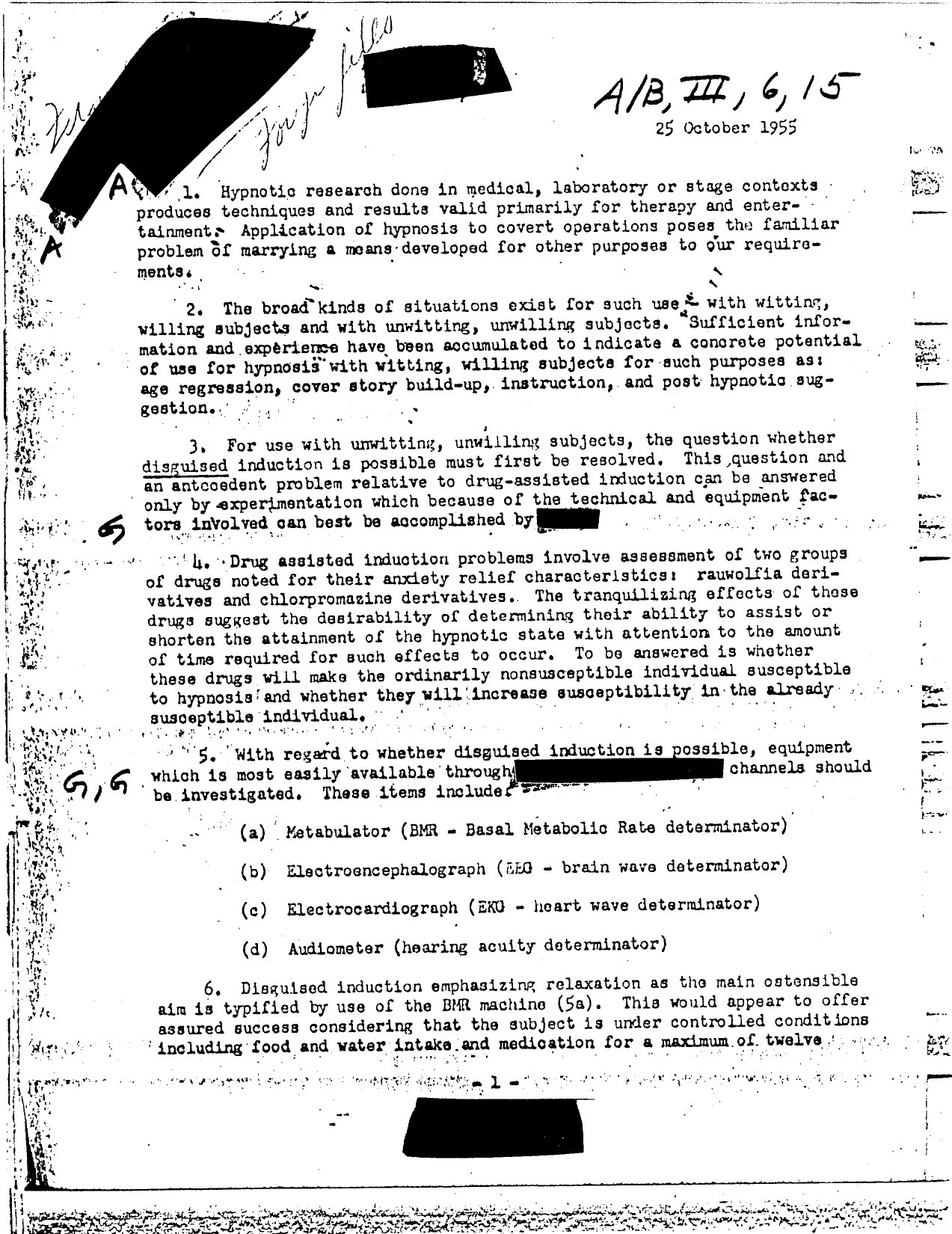
(1) Hypnotic research done in medical, laboratory or stage contexts – produces techniques and results valid primarily for therapy and entertainment. Application of hypnosis to covert operations poses the familiar problem of marrying a means developed for other purposes to our requirements.
(2) The broad kinds of situations exist for such uses, with witting, willing subjects and with unwitting, unwilling subjects. Sufficient information and experience have been accumulated to indicate a concrete potential of use for hypnosis with willing, willing subjects for such purposes as: age regression, cover story build-up, instruction, and post-hypnotic suggestion.
(3) For use with unwitting, unwilling subjects, the question whether disguised induction is possible must first be resolved. This question and an antecedent problem relative to drug-assisted induction can be answered only by experimentation which, because of the technical and equipment factors involved, can best be accomplished by [CENSORED].
(4) Drug-assisted induction problems involve assessment of two groups of drugs noted for their anxiety relief characteristics: rauwolfia derivatives and chlorpromazine derivatives. The tranquilizing effects of these drugs suggest the desirability of determining their ability to assist or shorten the attainment of the hypnotic state, with attention to the amount of time required for such effects to occur. To be answered is whether these drugs will make the ordinarily nonsusceptible individual susceptible to hypnosis, and whether they will increase susceptibility in the already susceptible individual.
(5) With regard to whether disguised induction is possible, equipment which is most easily available [CENSORED] channels should be investigated. These items include:
(a) Metabulator (ass – Basal Metabolic Rate determinator)
(b) Electroencephalograph (EEG – brain wave determinator)
(c) Electrocardiograph (EKG – heart wave determinator)
(d) Audiometer (hearing acuity determinator)
(6) Disguised induction emphasizing relaxation as the main ostensible aim is typified by use of the BHR machine (5e). This would appear to offer assured success, considering that the subject is under controlled conditions including food and water intake and medication for a maximum of twelve hours.
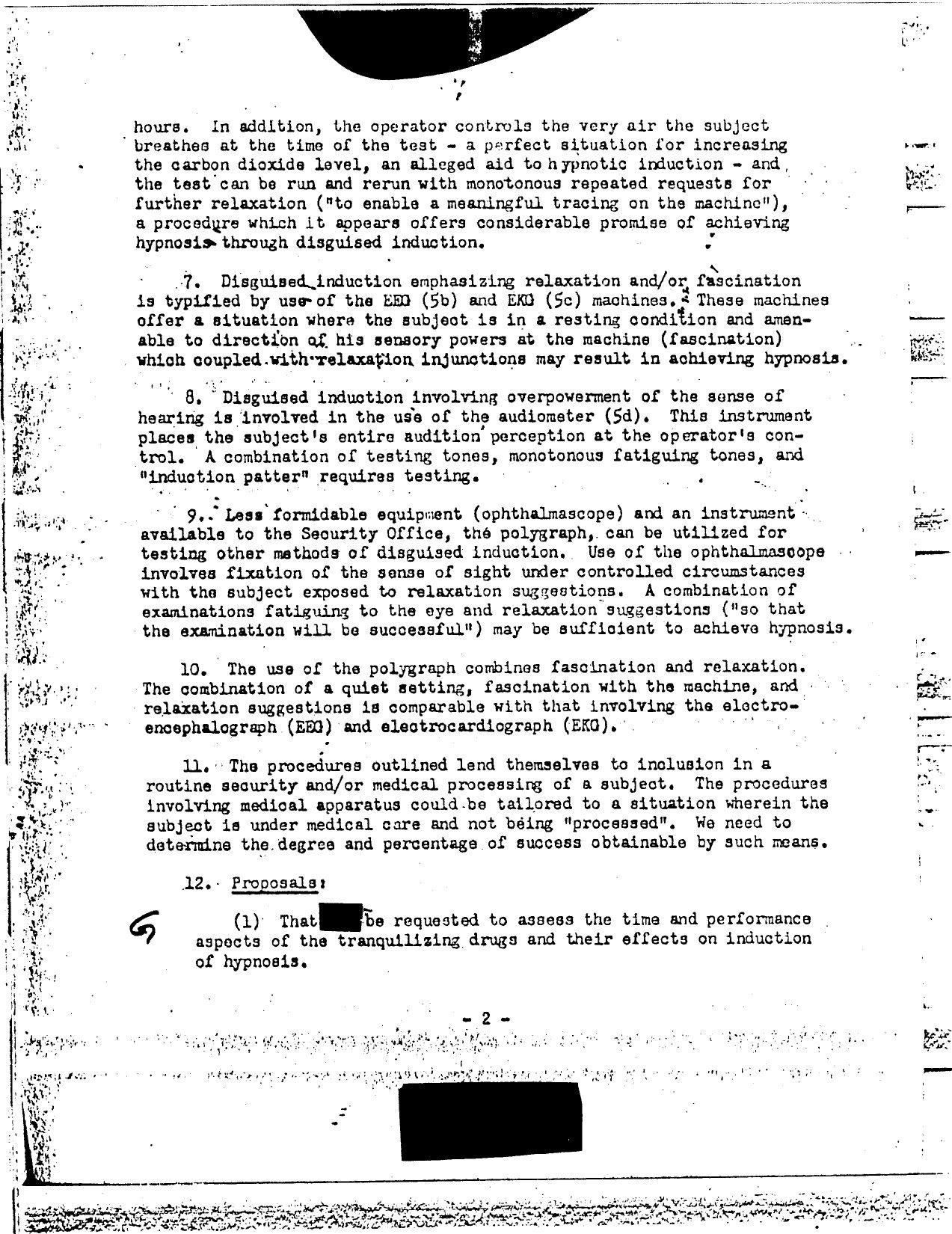
In addition, the operator controls the very air the subject breathes at the time of the test – a perfect situation for increasing the carbon dioxide level, an alleged aid to hypnotic induction – and the test can run and rerun with the monotonous repeated requests for further relaxation (“to enable a meaningful tracing on the machine”), a procedure which it appears offers considerable promise of achieving hypnosis through disguised induction.
(7) Disguised induction emphasizing relaxation and/or fascination is typified by use of the EEG (5b) and EKG (5c) machines. These machines offer a situation where the subject is in a resting condition and amenable to direction of his sensory powers at the machine (fascination), which, coupled with relaxation injunctions, may result in achieving hypnosis.
(8) Disguised induction involving overpowerment of the sense of hearing is involved in the use of the audiometer (5d). This instrument places the subject’s entire audition perception at the operator’s control. A combination of testing tones, monotonous fatiguing tones, and “induction patter” requires testing.
(9) Less formidable equipment (ophthalmoscope) and instruments available to the Security Office, the polygraph can be utilized for testing other methods of disguised induction. Use of the ophthalmoscope involves fixation of the sense of sight under controlled circumstances with the subject exposed to relaxation suggestions. A combination of examinations fatiguing to the eye and relaxation suggestions (“so that the examination will be successful”) may be sufficient to achieve hypnosis.
(10) The use of the polygraph combines fascination and relaxation. The combination of a quiet setting, fascination with the machine, and relaxation suggestions is comparable with that involving the electroencephalograph (EEG) and electrocardiograph (EKG).
(11) The procedures outlined lend themselves to inclusion in a routine security and/or medical processing of a subject. The procedures involving medical apparatus could be tailored to a situation wherein the subject is under medical care and not being “processed”. We need to determine the degree and percentage of success obtainable by such means.
(A1) That I be requested to assess the time and performance aspects of the tranquilizing drugs and their effects on induction of hypnosis.
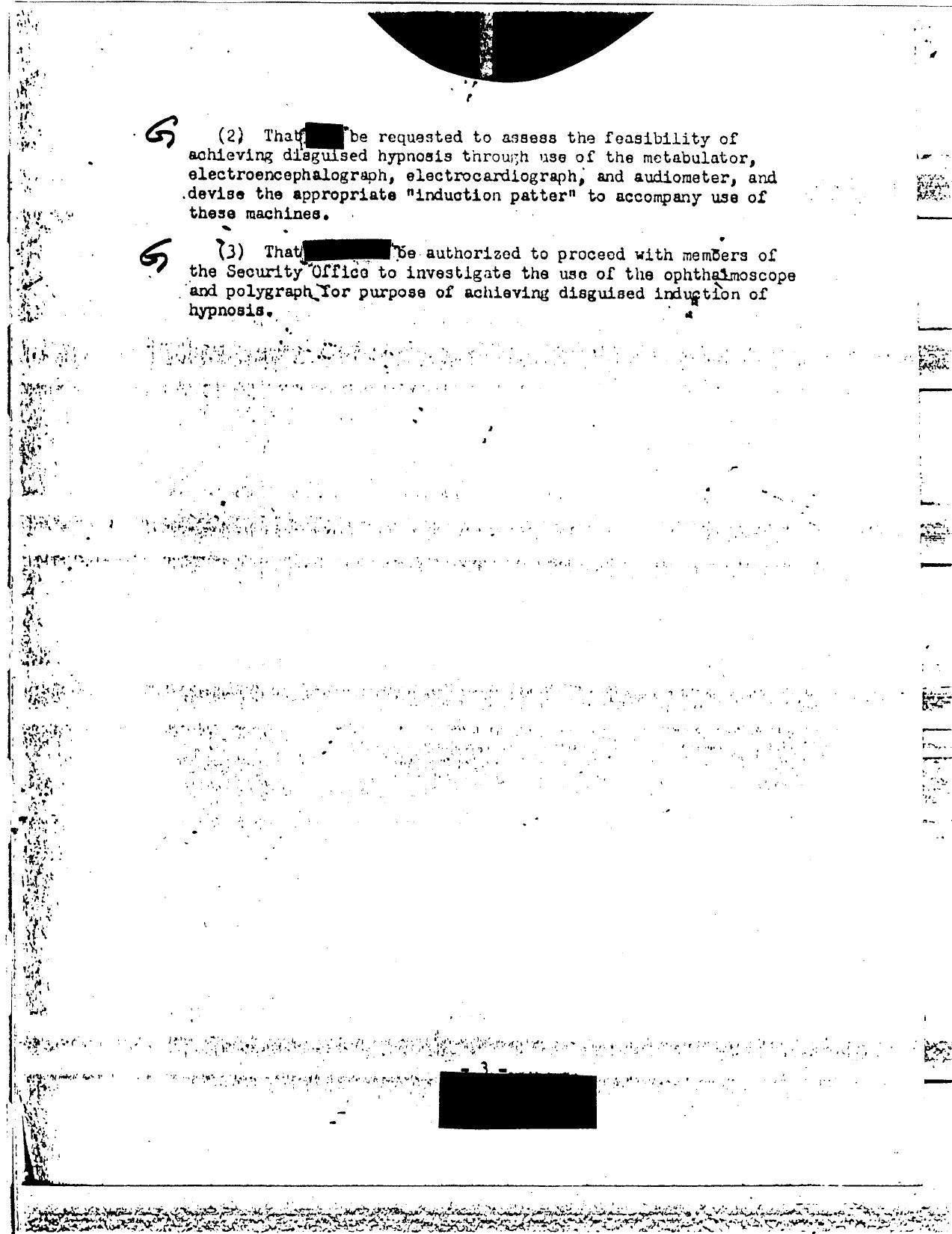
(A2) That [CENSORED] be requested to assess the feasibility of achieving disguised hypnosis through use of the metabulator, electroencephalograph, electrocardiograph, and audiometer, and devise the appropriate “induction patter” to accompany use of these machines.
(A3) That [CENSORED] be authorized to proceed with the Security Office to investigate the use of the ophthalmoscope and polygraph for purpose of achieving disguised induction of hypnosis.
Source:
Link:
Internal Link:
Date:
October 12, 1955
Categories:
Tags:
Age Regression, Audiometer, BHR Machine, Chlorpromazine, Cover Story, Covert Operations, Disguised Induction, Drug-Assisted Induction, EEG, EKG, Hypnosis, Hypnotic Research, MK Ultra, Medical Research, Ophthalmoscope, Polygraph, Post-Hypnotic Suggestion, Rauwolfia, Security Procedures, Tranquilizing Drugs