Surinamese & International Reaction to Intervention
Talking Points on Suriname for DDCI and DDI – 18 December 1986
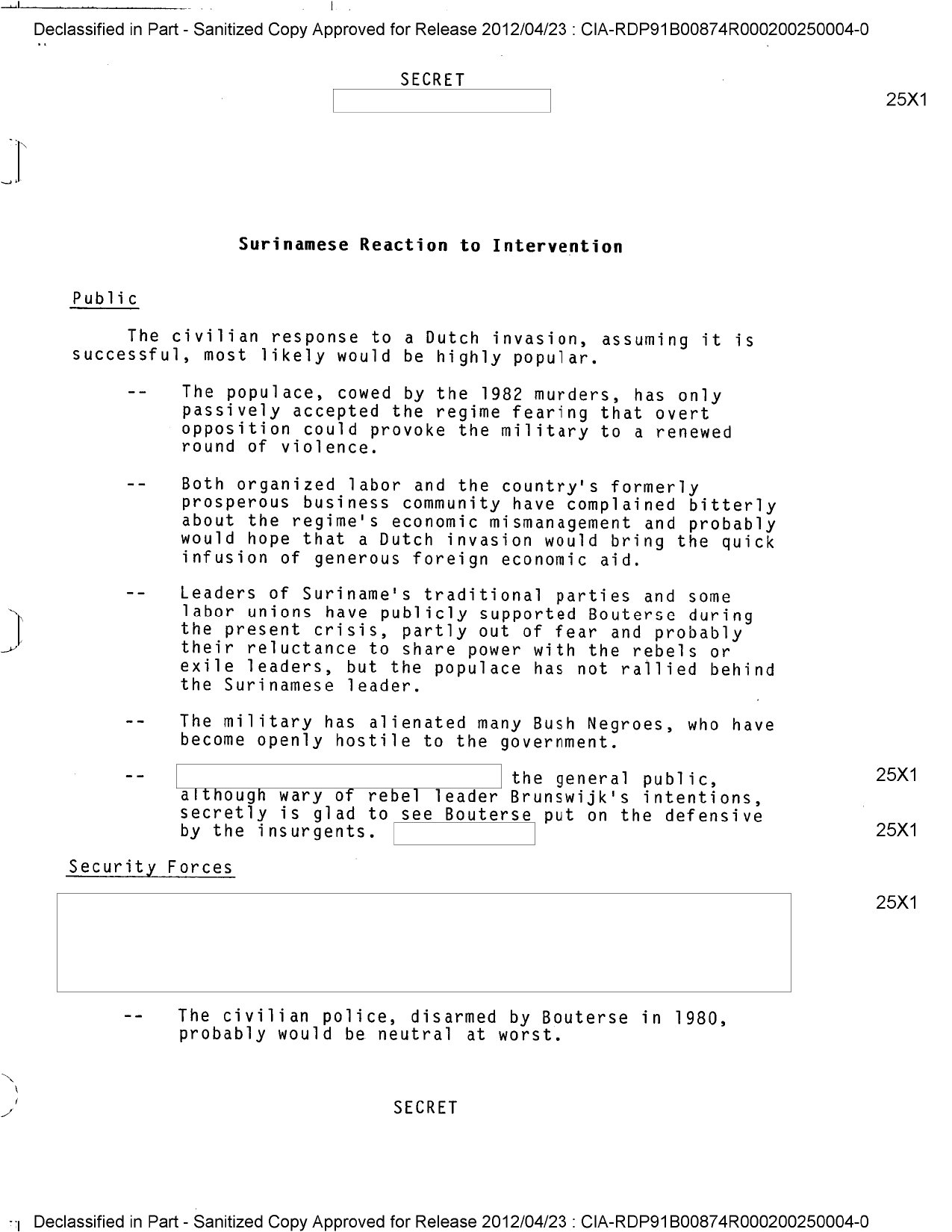
Surinamese Reaction to Intervention
Public
The civilian response to a Dutch invasion, assuming it is successful, most likely would be highly popular.
- The populace, cowed by the 1982 murders, has only passively accepted the regime, fearing that overt opposition could provoke the military to a renewed round of violence.
- Both organized labor and the country’s formerly prosperous business community have complained bitterly about the regime’s economic mismanagement and probably would hope that a Dutch invasion would bring the quick infusion of generous foreign economic aid.
- Leaders of Suriname’s traditional parties and some labor unions have publicly supported Bouterse during the present crisis, partly out of fear and probably their reluctance to share power with the rebels or exile leaders, but the populace has not rallied behind the Surinamese leader.
- The military has alienated many Bush Negroes, who have become openly hostile to the government.
- [CENSORED] the general public, although wary of rebel leader Brunswijk’s intentions, secretly is glad to see Bouterse put on the defensive by the insurgents.
Security Forces
- [CENSORED]
- The civilian police, disarmed by Bouterse in 1980, probably would be neutral at worst.
Reports of growing desertions and the reluctance of some draftees to go into dense jungle areas of eastern Suriname to weed out the insurgents suggest that the military rank and file probably would offer relatively little resistance.
The militia might make a stand in isolated groups but would find it difficult to coordinate their activities.
- Those elements most closely associated with civilian atrocities—Suriname’s intelligence and security services and remnants of the Group of 16 that seized power in 1980—probably would offer the stiffest resistance or would attempt to escape.
Even so, flagging military morale, insufficient military equipment, and incompetent military leadership would severely hamper the ability of military hardliners to muster the wherewithal needed to make a strong stand.
The possible continuing deployment of a large chunk of the military for the recent major offensive in isolated areas of eastern Suriname would further work against a quick and effective military response to an invasion. Reports of growing desertions and the reluctance of some draftees to go into dense jungle areas of eastern Suriname to weed out the insurgents suggest that the military rank and file probably would offer relatively little resistance.
The militia might make a stand in isolated groups but would find it difficult to coordinate their activities.
- Those elements most closely associated with civilian atrocities—Suriname’s intelligence and security services and remnants of the Group of 16 that seized power in 1980—probably would offer the stiffest resistance or would attempt to escape.
Even so, flagging military morale, insufficient military equipment, and incompetent military leadership would severely hamper the ability of military hardliners to muster the wherewithal needed to make a strong stand.
The possible continuing deployment of a large chunk of the military for the recent major offensive in isolated areas of eastern Suriname would further work against a quick and effective military response to an invasion. [CENSORED]
[MANY FULL PAGES CENSORED]
Latin American Reactions
O) Brazil
[FULL PAGE CENSORED]
P) Venezuela
[FULL PAGE CENSORED]
Q) Cuba
Although Havana would provide a show of outrage—at least for international consumption and as a demonstration of solidarity with its Marxist allies—over Dutch intervention in Suriname, privately, the Castro regime would not be disappointed over Bouterse’s ouster and might even welcome an opportunity to work with a new transition government.
Although Cuba and Suriname still maintain diplomatic relations, President Fidel Castro remains furious at Bouterse over the events of October 1983 and considers him to be a cowardly opportunist.
Even before this debacle, the Cubans had been shouldered out by Brazilian offers of aid to Bouterse, who apparently believed this carried fewer risks than help from Havana and worried about Castro undermining his power.
During the more than three years since the closing of the Cuban mission in Paramaribo, there have been sporadic reports of renewed cooperation between the two governments.
None of the reported contacts between Surinamese and Cuban officials, or reported Surinamese offers to allow Havana to reopen its embassy in Paramaribo, have apparently borne any fruit, however.
Even if Castro had swallowed his pride by responding to such initiatives just to get his foot in the door, it surely would have been aimed at promoting a shift to the left in Surinamese policy rather than at solidifying Bouterse’s grip on power.
[CENSORED]
Since the setback Havana suffered as a result of Grenada—the loss of a valuable military base and political ally—Cuba has been trying to slowly rebuild its influence in the eastern Caribbean.
Although the Cubans shifted their base of operations to Guyana after Grenada, that relationship has been at a standstill since the death of Guyanese President Burnham.
As demonstrated by its intensive courtship of the Bouterse government during the early 1980s, Havana clearly views Suriname as a potentially valuable base for extending its military and political power in the region. [CENSORED]
If the Dutch were to stumble in their attempt to neutralize the Surinamese military and Bouterse called upon Castro for help, we see little that the Cubans could do to save him.
Nonetheless, there is a slim possibility that the Cubans might risk a clandestine airdrop of arms and advisers, or the even riskier act of sneaking them across the border from Guyana, to help the beleaguered Surinamese.
The repercussions of being discovered in these acts, however, almost surely would dissuade Havana from undertaking such a risky venture. [CENSORED]
[FULL PAGE CENSORED]
R) Nicaragua
Because serving US interests, the Sandinista regime would be likely to see any Dutch invasion as a threat. Managua would be quick to condemn the attack regardless of the outcome.
The Bouterse domestic press probably would paint Sandinista representatives at the UN and OAS as a victim of US “aggression,” and would follow suit. Managua also would use the invasion as ammunition in its current propaganda offensive against the US, particularly regarding air raids against Nicaragua over the weekend.
In particular, Managua might try to use the proposal by the UN and OAS Secretaries General to help implement a regional peace agreement by using UN personnel as observers.
[CENSORED] The exiles regime and government has few—if any—contacts among Surinamese and would be unlikely to recognize an interim government established in the wake of an invasion. [CENSORED]
Nicaragua’s reaction to the invasion would be unlikely to go beyond rhetoric, however.
With the Sandinistas, Caribbean countries, despite recent efforts to enhance relations, have limited diplomatic contacts with Suriname. For example, Managua’s nonresident ambassador to Suriname was accredited just 9 months ago. [CENSORED]
Nicaraguan military support for Bouterse also has been minimal.
This document is part of this file: https://surinamepress.com/bb2/talking-points-on-suriname-for-ddci-and-ddi/
Source:
Link:
Internal Link:
Date:
December 19, 1986